
Title: Active galactic nucleus outflows accelerate when they escape the bulge
Authors: Kastytis Zubovas and Matas Tartėnas
First Author’s Institution: Center for Physical Sciences and Technology, Vilnius, Lithuania
Status: Published in Astronomy & Astrophysics (open access)
Drama is unfolding in the villa…and it’s more juicy than anything ever seen on Love Island. The culprit: galaxy evolution, a topic guaranteed to cause a heated discussion during journal club.
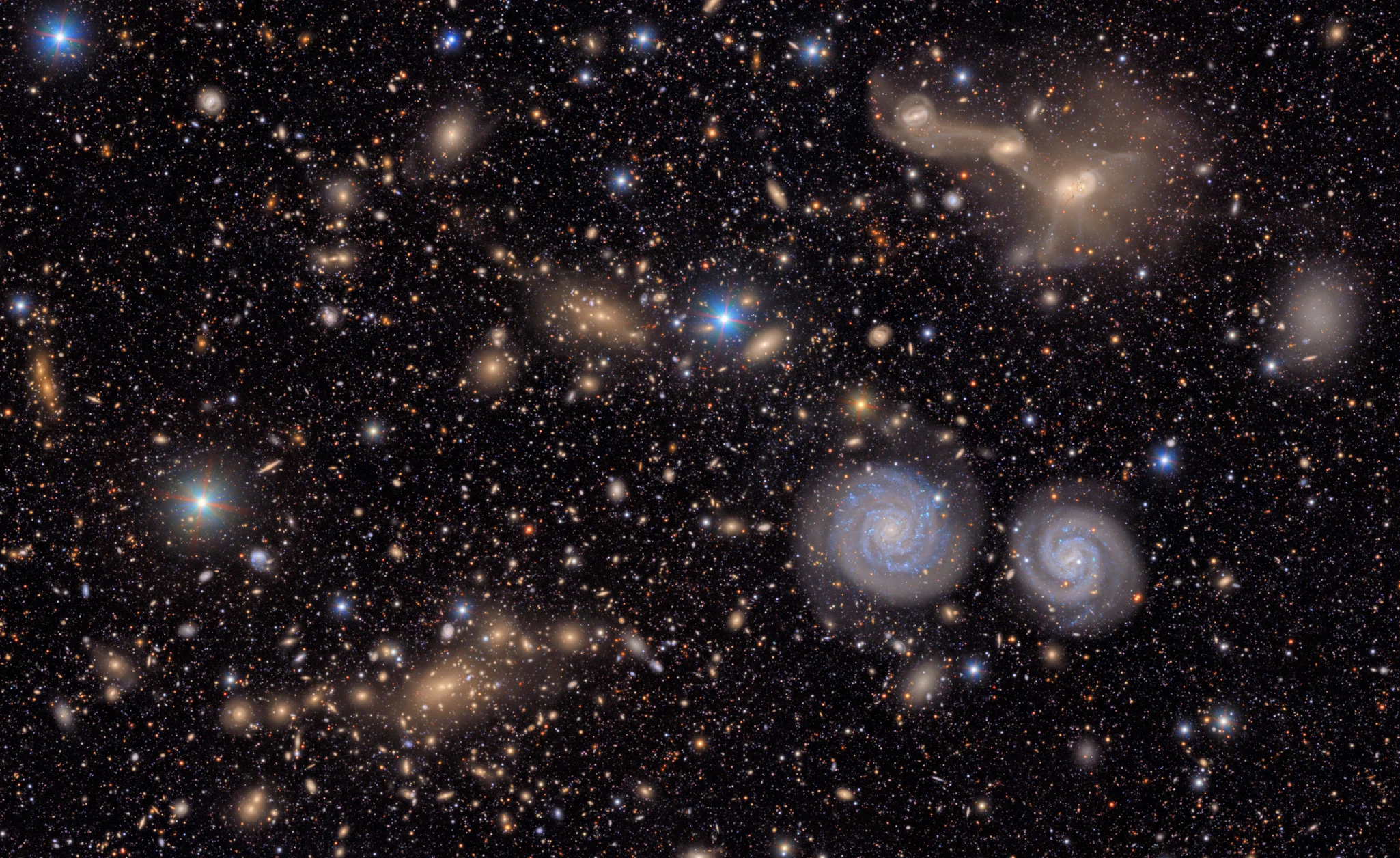
A comprehensive theory of galaxy evolution is the holy grail in extragalactic astronomy; who doesn’t want to be the one to explain the diverse collection of galaxies we see in the universe today, like those spotted with Vera Rubin in Figure 1? Unfortunately, galaxies are complicated, both dynamically and observationally. In any arbitrary galaxy, there’s quite a bit going on – we’ve got stars, dark matter, and gas and dust of every temperature imaginable, and they’re all moving about in complex gravitational (and probably, magnetic) fields. As if this weren’t enough, gathering information observationally is extremely challenging. There’s dust obscuring our view, and some galaxies are too far away to resolve, making in-depth study of their spatial structure impossible.
Accreting supermassive black holes complicate matters
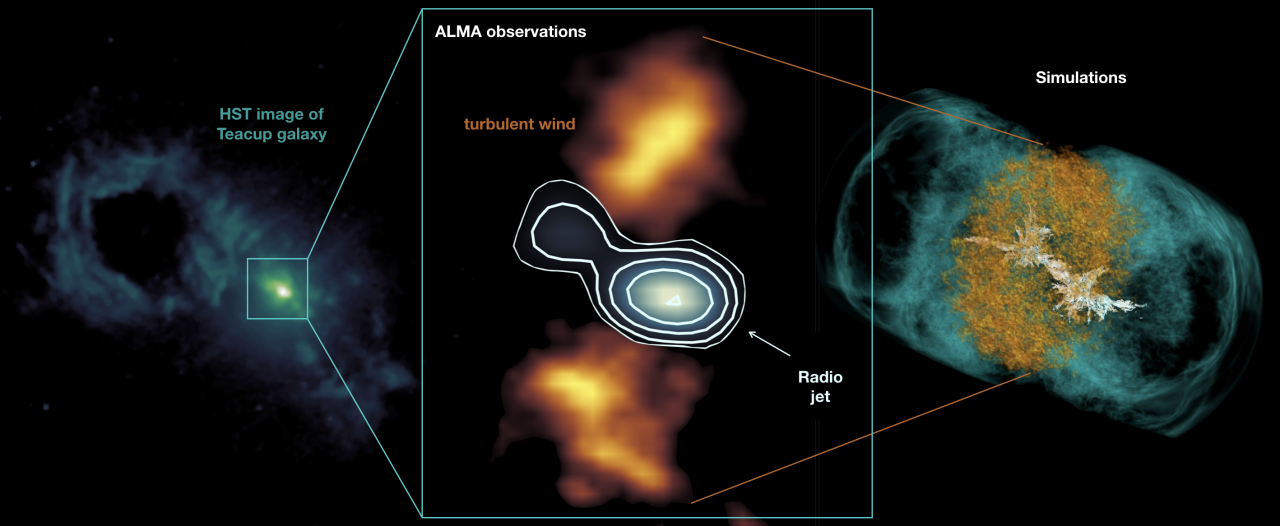
Oh, and we can’t forget about the mischievious supermassive black holes (or nuclei) at the center of each galaxy. For a few eons (some 10,000 years or so), the black hole can become active and start accreting material from its host galaxy. We can’t really fault the black hole for this – how else do we expect our baby early-universe black holes to grow up into our beloved supermassive black holes? – but this is a messy process. An active nucleus generates a ton of energy through accretion (it can even outshine literally everything else in the galaxy), and this can lead to outflows (such as those observed in the Teacup galaxy in Figure 2), which push away material that would have otherwise collapsed into stars.
How exactly does accretion cause one of these outflows? Well, the jury is still out, but the leading theory is through very fast winds. First, these winds slam into the ambient interstellar gas at speeds of about one-hundred-million kilometers per hour. The wind is shocked (literally, and I like to imagine figuratively, too after such a collision), and heats up to ten billion Kelvin. This hot, shocked gas starts moving outward, forming an outflow. Today’s theatrics concern this very phenomenon.
Act I: Observations reveal mysterious outflows
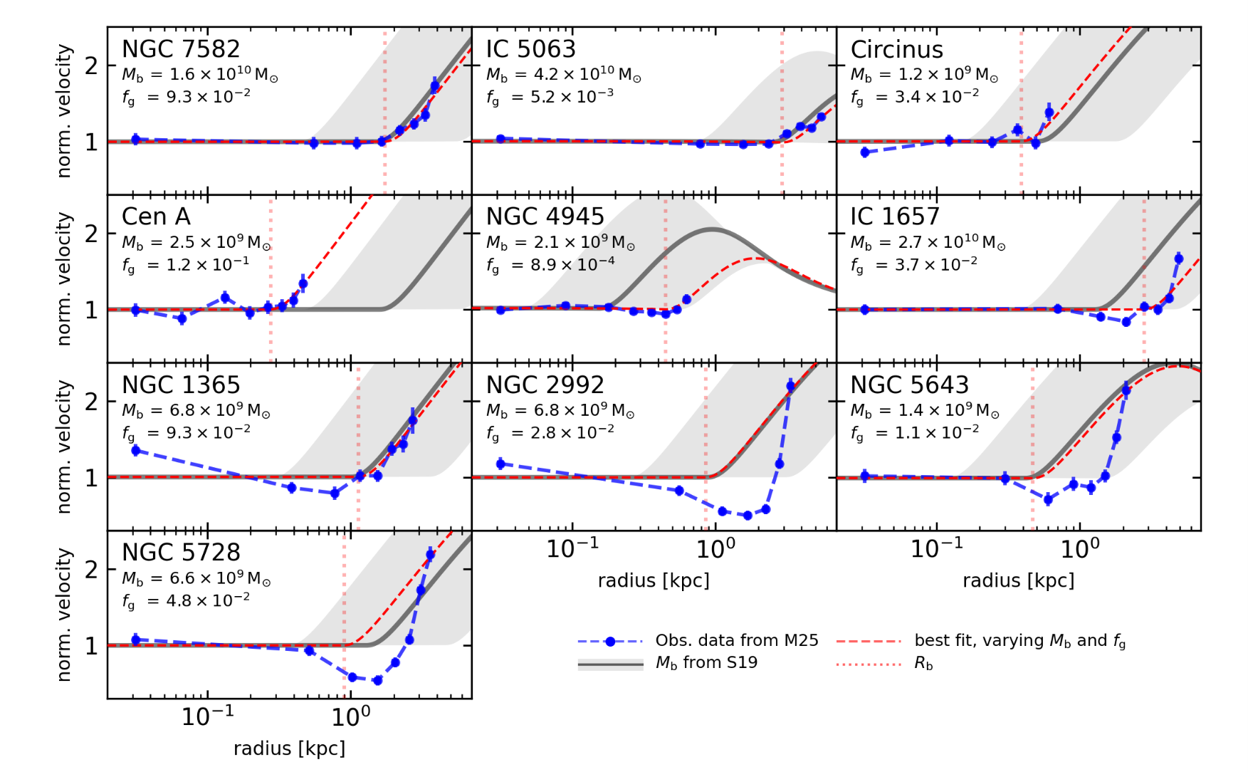
Everything began with some accretion-driven outflows observed in ten nearby active galaxies. Since they are basically in our backyard, we have been able to measure the speed of the outflow at different locations in each galaxy. The results, shown in Figure 3, are peculiar. In some of the galaxies, the velocity of the outflow remains constant for the first few kiloparsecs as it travels from its point of origin. In the rest, the outflow slows down in this region instead. Then, in all ten galaxies, the outflow abruptly accelerates further out, more than doubling in speed. No wind-driven outflow model seemed to explain this strange behavior.
Act II: An explanation emerges
Then, in the spring of 2025, the news dropped – and in Nature, no less: an explanation for the outflows had been found. The article authors proposed that the abrupt acceleration occurs after a change in cooling efficiency. In addition to riling up an accretion wind, the active nucleus is also creating loads of light, and the central region of the galaxy is thick with photons. Many of these photons steal energy from the hot electrons in the shocked wind via inverse Compton scattering before this energy can be transferred to the surrounding gas. Therefore, only the momentum from the wind is left to push the gas outward, resulting in a momentum-driven flow. Further away from the nucleus, this inverse Compton nonsense becomes less important, and as the wind acquires energy, it gets mainlined into the outflow (now an energy-driven flow), which moves much faster. We are just seeing the transition between these two regimes. Order is restored in the astronomical community.
Act III: The explanation refuted
That is, until now. Today’s authors slam this explanation. Sure, the theory is cute qualitatively, but how does it fare when you throw it into the ring with some chalk and a blackboard? Can we actually reproduce the observed outflow velocities and the location of the radial break between the two regimes? Luckily, these galaxies have been well studied, and we already have two pieces of crucial information about each: the mass of the central supermassive black hole and the velocity dispersion, or the spread in orbital speeds of material cirling about the galaxy. So, our clever authors derive the outflow velocities and radius at which the momentum-driven flow becomes an energy-driven flow. The results will shock you.
Our authors deliver the first blow: as it turns out, the terrain of inverse Compton scattering dominance is much too limited, and the outflow will transition to energy-driven as early as 70 parsecs into its journey. The outflows were observed to accelerate around the 2-3 kiloparsec mark, and certainly the regime transition should have occured before then. What’s more, our authors argue the idea of a momentum-driven flow surviving for any appreciable distance is unphysical. To achieve the momentum-driven flow, the shocked wind needs to cool faster (presumably, via inverse Compton scattering) than its energy can be replenished. However, the photons have a major obstacle in their quest to up-scatter off the hot wind electrons: the second law of thermodynamics. A hot, shocked wind blowing into the cooler interstellar gas makes for quite the unstable setup, and in order to mitigate this, the wind-gas system will naturally move toward achieving a constant temperature throughout. Accounting for this additional complication, our authors re-derive the limiting radius for the momentum-driven flow to be less than a parsec – essentially limiting this regime to the surburbs of the accretion disk.
To add insult to injury, our authors find that the velocity of the momentum-driven outflow is much too slow. Even if we ignore the additional gravitational drag from the host galaxy, the observed outflow speed in the inner region is still 4-120 times faster than the model predicts.
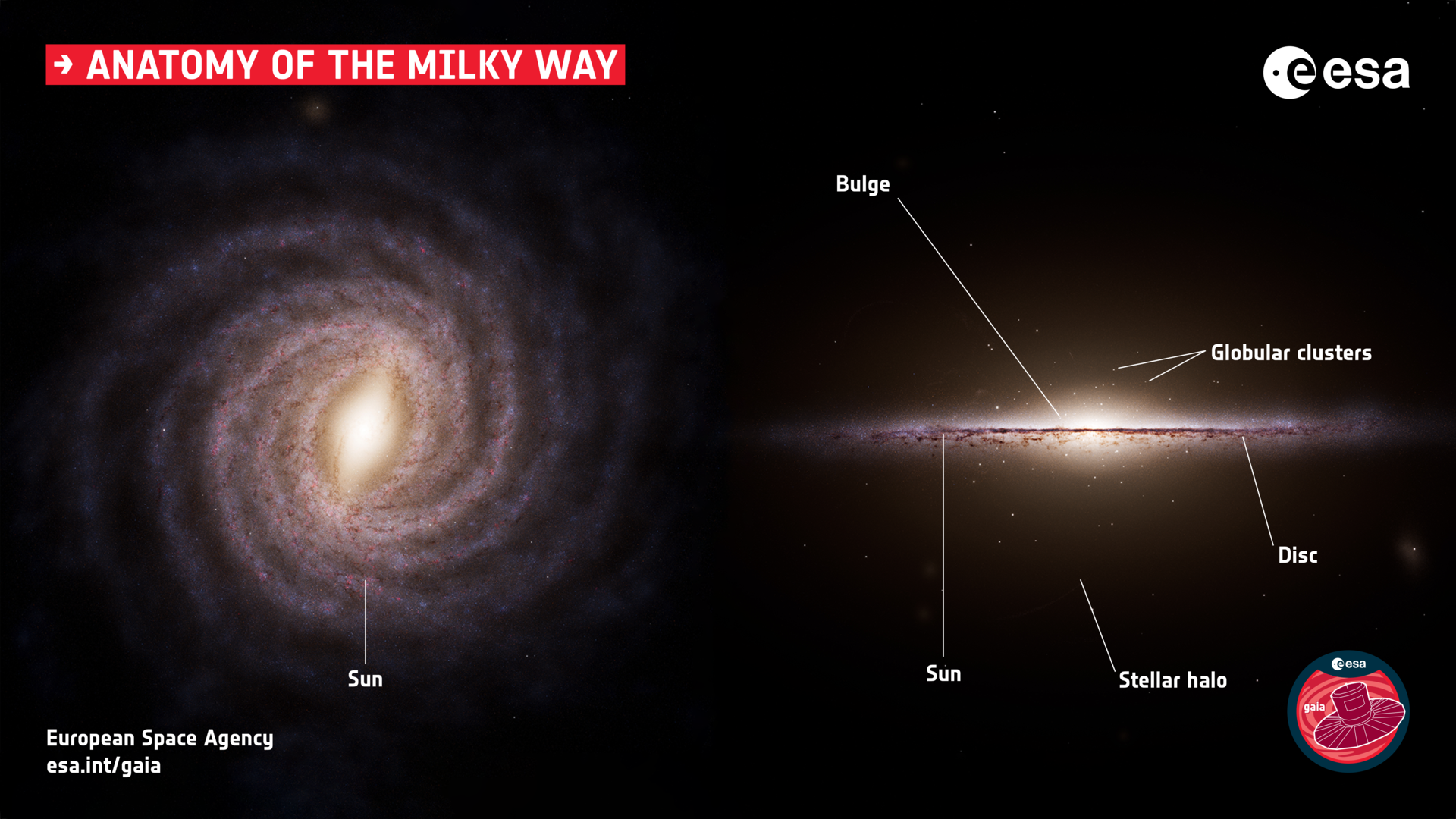
Our authors don’t stop at contradicting the momentum-to-energy-driven outflow theory – no, they also propose their own theory. The outflow is always energy-driven, and the abrupt acceleration is a consequence of the galaxy structure. These galaxies boast a typical two-part morphology, illustrated in Figure 4: a gas-rich bulge, which is home to the nucleus and all the yuppy stars; and a gas-poor halo, which is sparse and hosts mainly older stars. Inside the bulge of an active galaxy, the outflow has to plow through loads of gas, which slows it down. Once it passes into the halo, however, it’s all open highways, and the flow naturally accelerates.
Next, our authors test this theory by solving the equation of motion describing such an outflow, which will determine whether or not it agrees with the observed dynamics. They assume the flow is wind-driven and spherically symmetric, a computationally strategic approximation which ensures the outflow speed will change only with distance from the center, not direction. Two parameters are unknown: the distribution of gas inside the bulge and the mass of the bulge. The distribution of gas affects the outflow while it is inside the bulge, and the bulge mass dictates its spatial size, or equivalently, where the outflow escapes.
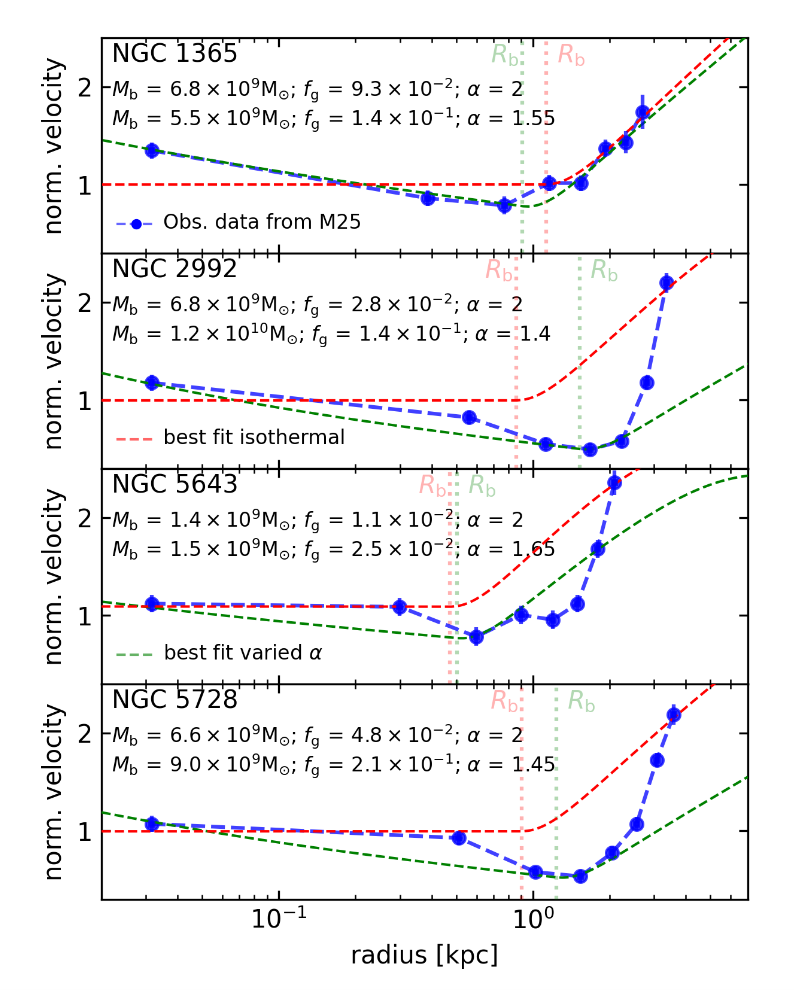
So, our authors just need to determine which combination of parameters fit the observed data – simple, right?
In fact, as illustrated in Figure 5, fitting the observed data with this model is impossible! Initially, our authors assume the most basic model for galactic bulge gas distribution, but in this scenario, the outflow can never reach the highest velocities observed in the halo. This gas distribution model must be too strict, so they relax it a bit, which allows the outflow to hit these speeds. Unfortunately, this also makes the outflow too fast in the bulge.
Our unflappable authors have an explanation – star formation. These outflows are not smooth; the gas is clumpy and turbulent, and inevitably, some clumps get stuck, cool, and collapse into stars. Inside the bulge, more gas is constantly pulled into the flow to replenish the mass lost to star formation. Once the flow escapes the bulge, however, there is no gas to capture, and it becomes faster as more clumps drop out.
It may seem like I’ve skipped something obvious – doesn’t the amount of energy outputted by the active nucleus matter here?? And we can certainly tell how much energy this is – it is just its brightness! Well, the first part is true, but there’s a problem. The outflows in these galaxies have been expanding for at least a million years by now, but nuclei only stay active for a few tens of thousands of years. These outflows were each triggered by an active nucleus in its prime, which has long since faded. All is not lost, though. For one, there is a minimum brightness required to achieve the conditions necessary for the underlying assumption of an accretion wind driven outflow. Beyond this, changing the energy output of the nucleus influences the outflow dynamics by changing the distribution of ambient gas, which is already a free parameter in the model. If the accretion is more powerful, more gas is pushed out, leaving less gas in the bulge to slow the outflow. Conversely, if the accretion is less powerful, the bulge gas is denser, and the outflow slower.
After presenting their argument, our theorist authors challenge the astronomical community to prove them wrong, or better yet, contradict the accretion wind model entirely. Specifically, they have three demands for the observers: first, many more spatially resolved observations of expanding outflows, including in non-active galaxies; second, extend these observations far into the halo, which will show whether or not the outflow continues to accelerate, as expected by the star formation hypothesis; and third, observations of the cold gas in these galaxies, so we can study the interactions between the shocked wind and the turbulent gas.
Stay tuned for the next installment in this saga, where we’ll hear what – if any – response the momentum-driven wind theorists give us.
Featured image: Figure 1 in today’s paper.
Astrobite edited by Lucie Rowland
