
Title: Magnetic field strengths of hot giant exoplanets consistent with Solar System values
Authors: Julia V. Seidel, Vivien Parmentier, Bibiana Prinoth, Thea Hood, et al.
First Author’s Institution: Laboratoire Lagrange, Observatoire de la Côte d’Azur, CNRS,
Université Côte d’Azur, Nice, France
Status: Published in Nature Astronomy [closed access]
When today’s authors set out to compare the winds on distant planets, they discovered a surprising trend, and were the first ones to measure magnetic fields on planets outside the solar system.
For decades, researchers have been hunting for signs of magnetic fields on exoplanets. We know that Earth has one; it protects us from the harsh radiation in space and gives us pretty auroras to look at. All the gas giants in our solar system also have magnetic fields, and we’ve even detected one on Jupiter’s moon Ganymede. So we always expected exoplanets to have magnetic fields, and some research has previously found indications of their existence, but no one has managed to directly measure their strength.
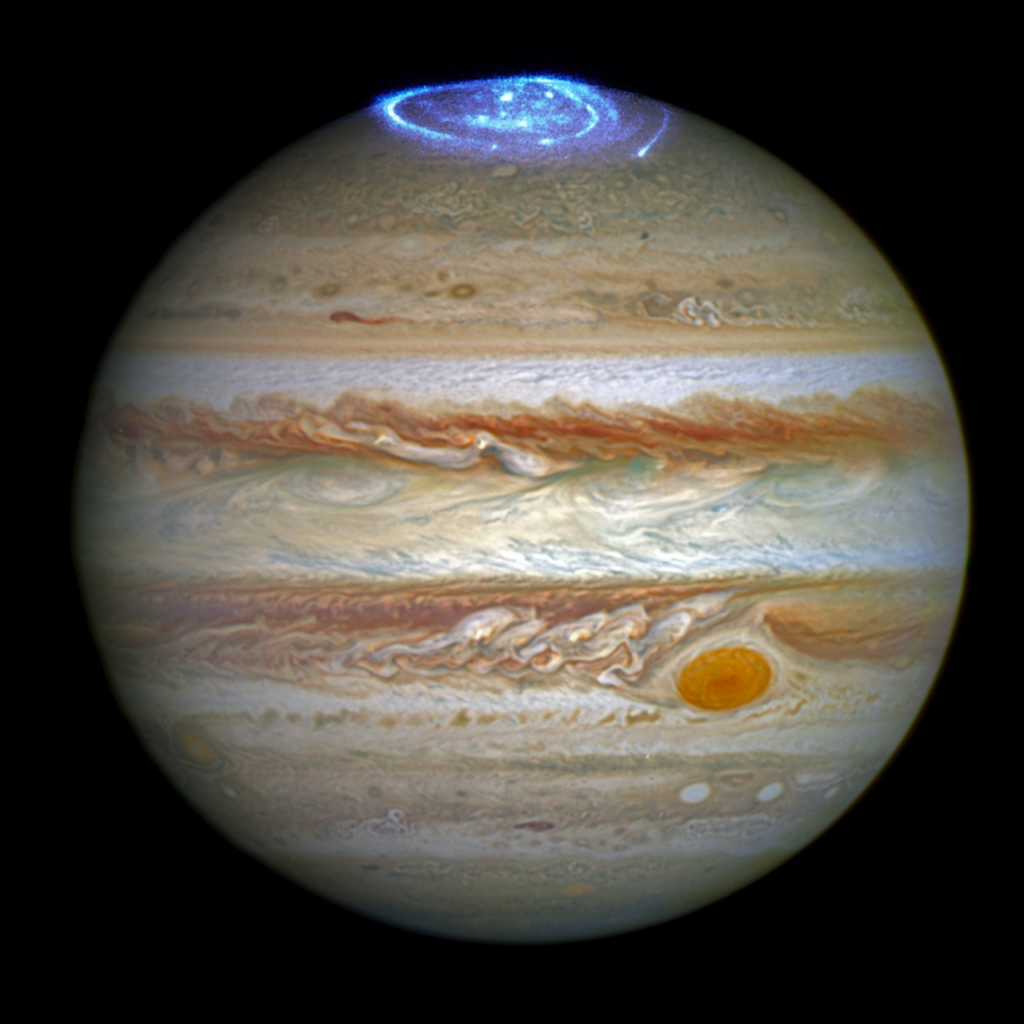
We’ve seen auroras on the poles of Jupiter (see Figure 1), created by its strong magnetic field. If exoplanets have similar fields, perhaps we can begin to dream about colourful curtains of light rolling across an alien sky.
The dark side of the planet
The gravitational and rotational interplay between the Earth and the Moon is synchronised, so one lunar orbit is the same length as one lunar rotation with respect to the Earth. This is why the moon always has the same side towards the Earth, giving rise to centuries of astronomical head-scratching and a great Pink Floyd album. We call it being tidally locked, and we see it in planets, too: Mercury, for example, is tidally locked with the sun so that two orbits correspond to three rotations.
Some exoplanets are tidally locked in a 1:1 ratio with their star, such that they always point the same side towards the light. As you can imagine, that side gets rather hot. The side of perpetual darkness is very cold. These large temperature differences cause gases in the planet’s atmosphere to move rapidly from one side to the other, creating strong winds. Moreover, this effect (in isolation) theoretically predicts that the winds should be stronger the hotter the planet. Another way of seeing it is that a warmer atmosphere contains more energy that can be put into making winds. But this was a theoretical prediction, and today’s authors decided to see if the data agreed.
Wind speeds?? More like wind slows
Pause for a second. How are we able to measure wind speeds on distant planets, when we can just barely resolve them with the most advanced imaging techniques available to us?
That takes, in words from today’s paper, “ultra-stable, ultra-precise, high-spectral resolution spectrographs”, such as ESPRESSO on VLT or MAROON-X on the Gemini-North telescope. By using these incredibly high-quality spectra of exoplanet atmospheres, today’s authors can measure the Doppler shift in the lines from the atmospheric iron. The winds in the atmosphere move the atoms towards or away from us at high speeds, which, from our point of view, very slightly changes the wavelength of the light they emit and absorb. This shift depends on the velocity and is detectable in the spectra, allowing the researchers to determine how fast the gases are moving.
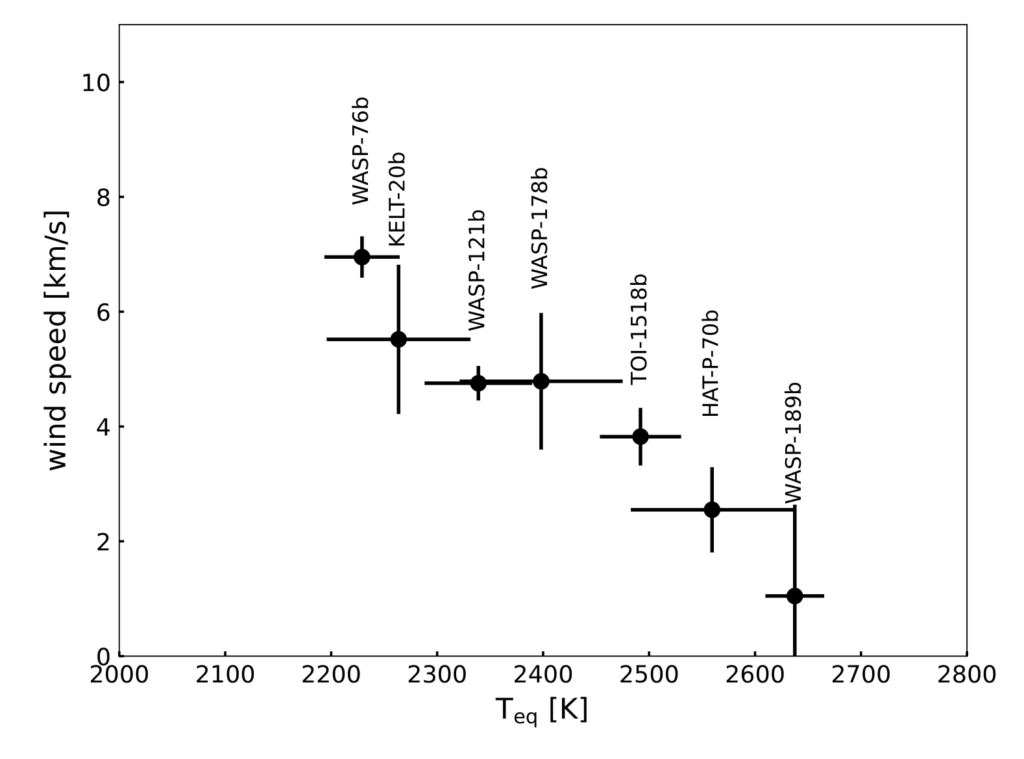
They selected a sample of 7 exoplanets that are the size of Jupiter, close to their host star (“Hot Jupiters”), and tidally locked with it, and compared their wind speeds to their temperature, expecting the two to rise together. But the data told a different story: The wind speeds were clearly lower on the hotter planets (see Figure 2).
Hot Jupiters in (magnetic) Drag
So, there must be something slowing down the wind, something heavily dependent on temperature. There are several mechanisms known to dissipate wind energy in an atmosphere, but the only one that can explain such a dramatic decrease is magnetic (or Ohmic) drag. In a very hot atmosphere, many of the atoms and molecules are ionised and thus charged. This means that any magnetic field will slow them down. The warmer the atmosphere, the more charged particles, the larger the drag.
This nicely explains the behaviour that the authors see in Figure 2, and further allows them to estimate the strength of the magnetic fields by scaling the effect. It seems that the magnetic fields of these hot, distant exoplanets are very alike those in our solar system – about half of what we’ve measured on our own Jupiter.
If the magnetic fields are similar to what we know from our own solar system, can we expect a similar spectacle of Northern and Southern lights to be unfolding above the clouds of these exotic cousins? Well… Maybe. The existence, and especially the visibility, of aurora also depend on which atoms are in the atmosphere. And to know that, we, as always, need more data. With today’s article, we’ve taken a step further towards understanding the composition of other-worldly planets, but the alien auroras will be confined to our inner world of imagination for some time still.
Astrobite edited by Neel Kolhe
Featured image credit: JAXA
