
Title: No evolution in the number density of little red dots from cosmic dawn to cosmic noon
Authors: Federica Loiacono, Roberto Gilli, Marco Mignoli, Marcella Brusa, et al.
First Author institution: INAF – Osservatorio di Astrofisica e Scienza dello Spazio di Bologna, via Gobetti 93/3, I-40129, Bologna, Italy
Status: Submitted to Astronomy & Astrophysics [open access]
How would you feel if you had discovered this really cool object in the early Universe, one that could only be seen because of the newest telescope ever launched into space, just to find out you may have had one in your backyard this whole time? That is the dramatic retelling of today’s bite.
So what actually is a Little Red Dot?
Little Red Dots (LRDs) are a class of objects first spotted in the initial images from the James Webb Space Telescope (JWST) back in 2022, named later in 2024 because these shiny new images were littered with a background of tiny red spots. Now, there are quite a number of other red-ish dots in the sky, but what made these ones special was that they sat at extremely high redshift and looked suspiciously like active galactic nuclei (AGN), galaxies whose central supermassive black holes are actively feeding. So what is so concerning about this? Their broad emission lines implied black holes of ten to a hundred million solar masses, sitting there fully formed when the Universe was under a billion years old. That is an uncomfortable amount of black hole to assemble in the cosmic equivalent of a long weekend.
LRDs are also mysteriously silent in both X-rays and radio waves (things a well-fed black hole is normally very loud about), their black holes appear overmassive compared to their host galaxies, and a decent fraction show strange absorption features seen in only about 0.1% of normal AGN. Since their discovery, a plethora of theories have been proposed, dense gas cocoons, super-Eddington accretion, “black hole stars”, even globular clusters in formation, but no known object ticks all of the boxes at once. So potentially a new object, or new physics, is the answer.
Counting dots
One thing researchers are particularly interested in is how many of these things there are, and whether that changes over cosmic time, because if we know that, maybe we can map LRDs onto other well-known objects or physical processes in the Universe. The classic LRD population sits at redshifts of roughly z ≈ 4–8, and earlier studies found their numbers dropping off below z ≈ 4.5. However, recent discoveries have turned up a handful of genuinely local LRDs, three at z ~ 1 in SDSS data and eight at 0.2 < z < 0.5 in DESI data, hence the backyard drama. Today’s authors wade into the contested middle ground: cosmic noon, at z < 4, an epoch traditionally thought to be nearly LRD-free.
Five needles, one very deep haystack
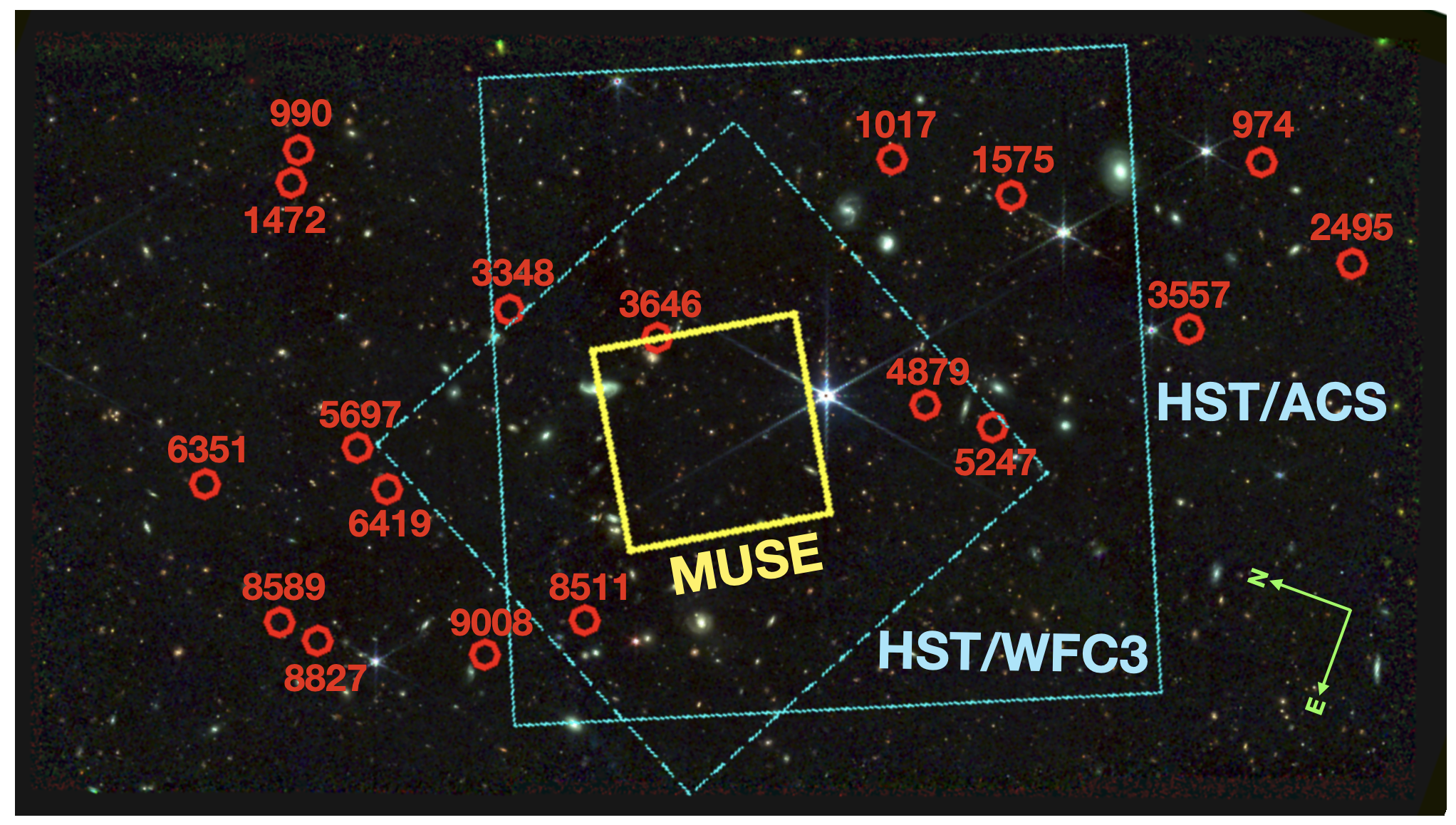
Today’s authors use archival data from the EIGER GTO program, focusing specifically on the J1030 field: a patch of sky already lovingly imaged at basically every wavelength humanity has access to. This patch can be seen in Figure 1 along with all the surveys pointing at that sky region. After some general cleaning and processing, their JWST photometric catalogue of the field contained 11,838 sources. But since the authors wanted to make a claim about LRDs specifically, they had to enforce some selection criteria. How exactly to select an LRD is still a matter of some debate, but these authors adopted the following cuts:
(i) Point-like morphology in the F356W and F200W images. LRDs are unresolved even by JWST, whatever is powering them is compact, pointing to a central engine rather than an extended galaxy full of stars. This cut took 11,838 sources down to 154 point-like ones, and demanding red colours (plus removing four known X-ray AGN) left 18 candidates.
(ii) Presence of broad emission lines (widths above 1000 km/s). Broad lines mean gas whipping around at over a thousand kilometres per second, the classic signature of material orbiting deep in a black hole’s gravitational well. Conveniently, the line width also lets you weigh the black hole.
(iii) Lack of X-ray emission. This is a weird one. A normal AGN this bright should light up the field’s very deep Chandra X-ray image, and these don’t. X-ray silence is one of the defining head-scratchers of LRDs, so requiring it filters out garden-variety AGN sneaking into the sample.
So this left the authors with 5 sources. Not a lot! Strictly speaking, the sample consists of three LRDs, one Little Blue Dot (LBD), and one intermediate object. The difference comes down to the slope of the optical continuum: LRDs are red in the optical, giving them their famous “v-shaped” spectrum, while LBDs are otherwise-identical objects (compact, broad lines, X-ray silent) that stay blue all the way through. The intermediate object sits at a slope of almost exactly zero, diplomatically refusing to pick a side.
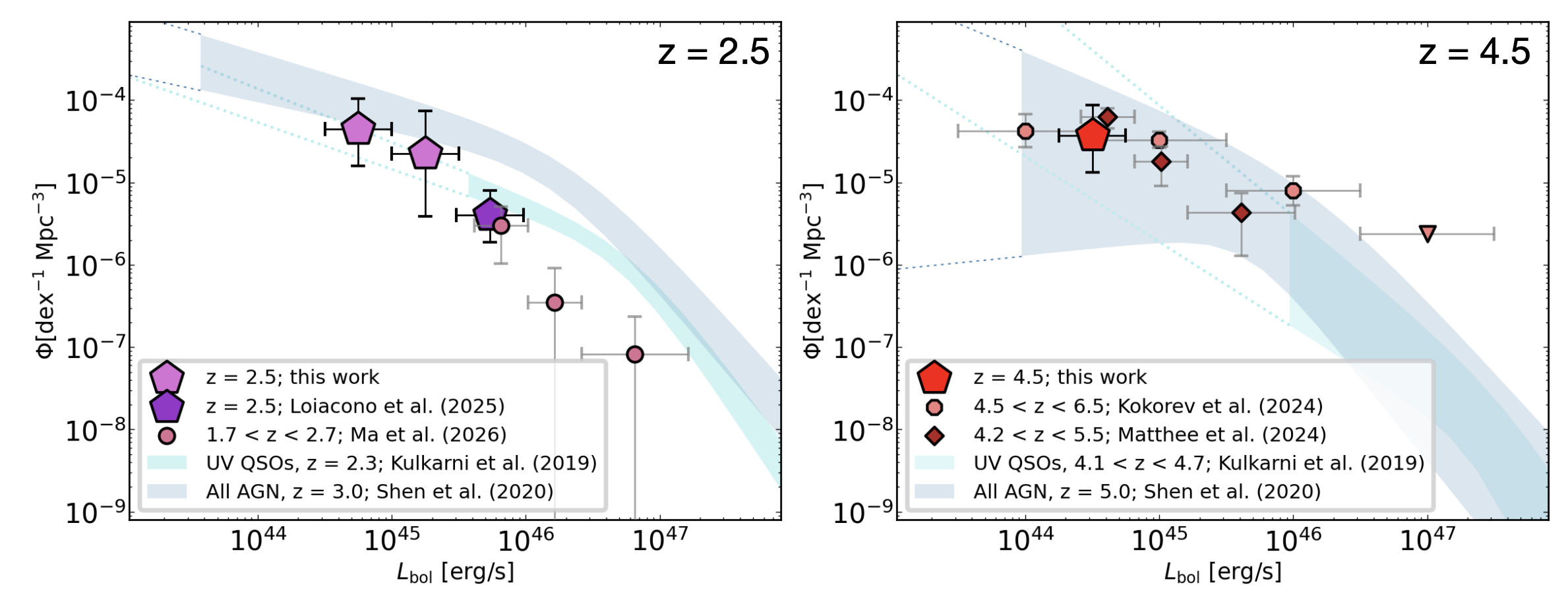
From this handful of objects, luminosity functions (LFs) were constructed, a statistical tool that tells us how many objects of a given brightness exist per unit volume of the Universe, which we can integrate to get a total number density. At z ~ 2.4 the LF has two bins containing two sources and one source; at
z ~ 4.5, a single bin containing two sources, both of which can be seen in Figure 2. The headline result: the abundance of LRDs at cosmic noon is a factor of ~350 larger than recent model predictions, and comparable to X-ray selected AGN of similar luminosity. In other words, LRDs don’t disappear after cosmic dawn at all. Their numbers stay essentially flat from z ~ 7 all the way down to z ~ 2.4.
Hold on, can we trust five data points?
A fair question, and to the authors’ credit, they’re upfront about it. The error bars are doing a lot of work, and are calculated using proper small-number statistics that are honest about the fact that three objects are, in fact, only a few objects. There’s also a caveat that the two z ~ 4.5 sources sit at nearly identical redshifts and may be clustered neighbours, which could nudge the density high.
There is some reassurance in the agreement with independent work. The z ~ 4.5 point matches surveys covering areas over eight times larger, and the z ~ 2.4 result lines up with previous JWST measurements. Even the ground-based study that reported a dramatic drop in LRD numbers at z < 4 turns out to agree once you notice it was only sensitive to the brightest LRDs. Those studies weren’t seeing fewer LRDs; they were seeing only the flashy ones.
And what about mixing LRDs, an LBD, and a fence-sitter into one measurement? The authors do this deliberately: every study they compare against also lumped these populations together, so it’s apples to apples. There’s a physical argument too. Recent models suggest LRDs may literally be LBDs viewed edge-on through dust, the same object at a different viewing angle, like the difference between looking at a frisbee side-on versus face-on. If that’s right, splitting them apart would be artificially cutting one population in two. However if these populations are more distinct this may not be the best way to approach the data.
But what does it all mean for black holes?
A popular subsection of LRD explanations assumes there’s an accreting black hole inside, and the authors run with this too. If these sources are powered by black holes, the light they give off, specifically the luminosity and width of their broad lines, lets us weigh them. The five sources come out to be around 10 to 100 million times the mass of our Sun.
One leading theory holds that LRDs are the very first stage of a black hole’s life: the initial super-Eddington growth spurt of a “heavy seed” born at around 1,000 to 10,000 solar masses. The masses found here are much larger than seed mass, but that alone isn’t the problem, seeds grow, that’s rather the point. The tidier alternative is that LRDs are not a birth announcement but a phase, a high-accretion growth spurt that any sufficiently well-fed, already-mature black hole can go through.
So why aren’t they everywhere today?
If LRDs held steady for billions of years, why is the local Universe almost empty of them, down by a factor of ~10,000 compared to cosmic noon? The paper offers two answers. Physically: the LRD phase may simply become unsustainable. Once a black hole has bulked up and its host galaxy’s gas reservoir runs low, partly eaten, partly blown away by the black hole’s own feedback, the super-Eddington party ends. Yesterday’s LRD became today’s perfectly ordinary AGN. Observationally: the local searches were biased against exactly this kind of compact red blob, so those tiny local numbers are probably undercounts.
So I would say the Little Red Dots themselves probably aren’t in our backyard, but their retired descendants, ordinary accreting black holes quietly living out their golden years, definitely could be.
Astrobite edited by Kaz Gary
Featured image credit: Jayde Willingham (Adapted from Lucas Pezeta)
