
This guest post was written by Paul Andrew Smith, a 2nd year master’s student in planetary sciences at the University of Aberdeen. He recently completed a bachelor’s degree in astrophysics from the University of Cincinnati, where he is also in his final year of a geosciences degree. He is also a visiting researcher in the Astronomy Department at Ohio State University, where he studies exoplanet atmospheres with the James Webb Space Telescope.
Title: A Massive Hot-Jupiter Companion that Disfavors Giant Planet Formation Beyond the Water-Ice Line
Authors: Eritas Yang, Tiger Lu, Daniel A. Yahalomi, Joshua N. Winn
First Author’s Institution: Department of Astrophysical Sciences, Princeton University, Princeton, New Jersey, USA.
Status: Published in The Astrophysical Journal Letters [open access]
The first exoplanet discovered around a Sun-like star, dubbed 51 Pegasi b, wasn’t what anyone expected. Actually, the surprise wasn’t what it was—it was where it was. 51 Pegasi b is a gas giant slightly larger than Jupiter. But it occupies an orbit unlike anything in our solar system—only 0.05 astronomical units (au) from its star, about one-eighth of Mercury’s distance from the Sun! As a result, it’s a scorching-hot 1,300 K (1880 F), earning it the title of a “hot Jupiter”.
It turned out not to be an anomaly. Astronomers have since discovered hundreds of hot Jupiters orbiting unimaginably close to their host stars. So, the question naturally arose, “How did these gas giants get there?” Two obvious possibilities emerged. Either they formed close to where they are today, or they formed much further out and migrated inwards to their current orbit.
That second option quickly became the favored solution, because it’s generally believed that gas giants can’t form in such close-in orbits, while planet migration seems at least theoretically possible. Here’s why that became the consensus view:
Why shouldn’t gas giants be able to form in close-in orbits?
Gas giants are thought to form either through gravitational instability (GI) or through core accretion (CA). In GI, the planet forms more directly and homogeneously, like a star, with gas from the proto-planetary disk clumping together until a gas giant is formed. In CA, a solid core forms first through dust and pebble accretion, and that mass then attracts a large gaseous envelope.
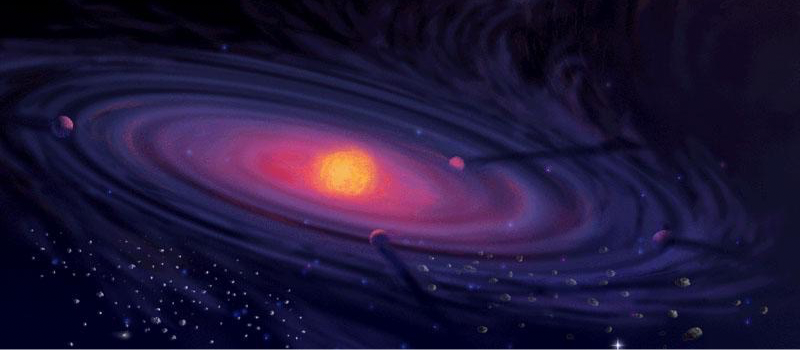
Figure 1: Artist’s concept of a proto-planetary disk with active planet formation. Not to scale. Figure credit: NASA
Gas giant formation through either GI or CA is probably less efficient close to the host star. For GI, the problem is that gas in the proto-planetary disk moves around the star at different speeds—faster close to the star and slower farther out. That creates a shear force that is usually strong enough to break up any gravitationally collapsing gaseous proto-planet. There’s less difference in the speeds farther out.
The problem with CA in close orbits is that a giant planet first has to build a solid core of roughly 10 Earth masses before it can rapidly accrete gas. In the outer planetary disk, beyond the water-ice line (or “snow line”), temperatures are low enough for water and other volatile compounds to freeze into solid grains. This increases the amount of solid material available for building planetary cores. That makes giant-planet formation easier, and more likely, than in the warmer inner disk. For perspective, in our solar system, the snow line is around 2.7 au, somewhere in the asteroid belt between Mars and Jupiter.
What can make a planet migrate closer to its star?
Two mechanisms are theorized. In “disk-driven migration,” gravitational interactions with the gas and dust in the proto-planetary disk cause the gas giant to lose angular momentum and therefore spiral inward. In “high eccentricity migration,” gravitational perturbations from a passing star or other large body send the planet into a highly elliptical orbit that repeatedly passes closer to the star. At each pass, tidal forces gradually shrink and circularize the orbit.
A challenge to the paradigm
So if there was ever any evidence that a hot Jupiter may have formed in or near its close-in orbit, that would definitely upset the conventional wisdom. But that’s exactly what the authors of today’s paper are suggesting about a hot Jupiter called KELT-20b. The authors have discovered that KELT-20 (KELT-20b’s host star) has a brown dwarf companion that comes as close as 4 au to the star during its orbit. They argue the presence of this brown dwarf makes it unlikely that KELT-20b’s extremely tight orbit (~0.05 au) could be explained in the conventional manner—i.e., formation beyond the snow line (8-15 au) and migration inwards.
They give two reasons. First, the presence of the brown dwarf would make it too gravitationally unstable around the snow line to form a planet there in the first place. Each orbit of the brown dwarf would tug on any forming planet and break it up. This same mechanism explains why we have an asteroid belt between Mars and Jupiter: Jupiter’s gravitational influence prevented these asteroids from growing any larger and becoming planets.
Second, if a planet did form beyond the snow line and start to migrate inwards, it would be difficult for the planet to cross the more massive brown dwarf’s orbit without getting flung out of the system or into the star. Hence, the more likely option is that KELT-20b formed well inside the snow line (probably within 1.5 au) and migrated to its current orbit.
Evidence for this new brown dwarf companion to KELT-20
At 444 light years away, the brown dwarf is both too faint and too close to its star to be seen directly even with our best telescopes. So the authors combine two indirect detection methods to identify this new brown dwarf companion: astrometry and transit timing variations (TTV). Astrometry measures the slight changes in the position of the star in the sky. The authors cite three independent measurements from the Hipparcos-Gaia catalog that show its proper motion changing in time, consistent with the gravitational influence of an unseen companion.
The TTV method works by observing multiple transits, those moments when a planet with a perfectly-aligned orbit passes directly in front of its star, thus dimming the light from the star ever so slightly. KELT-20b is such a perfectly-aligned planet. Those transits should be observed at perfectly regular intervals. But they aren’t. They come at irregular intervals—sometimes slightly early, sometimes slightly late. The authors interpret this as evidence that the entire star-planet system is wobbling due to the gravitational impact of an unseen companion, causing small changes in the light-travel time between KELT-20 and Earth.
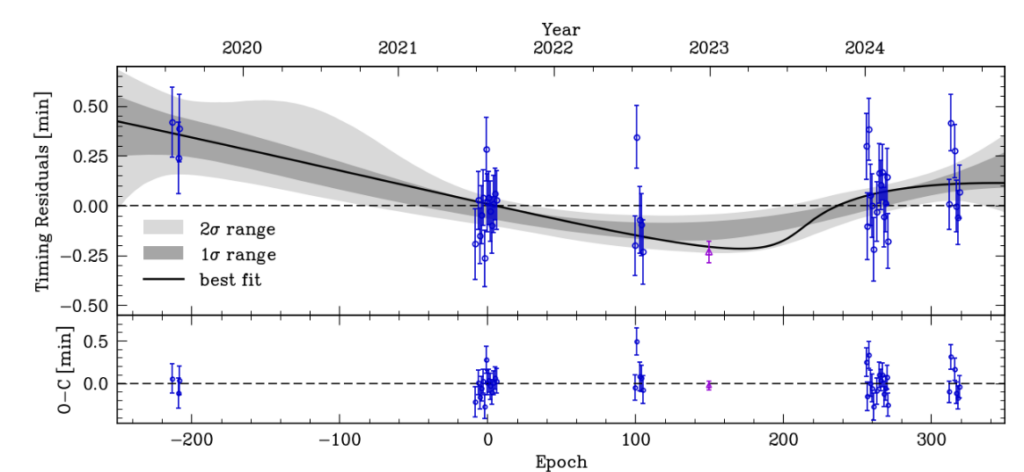
Figure 2: Transit timing variations of KELT-20b relative to a constant-period orbit. The observed transit times (blue from TESS, purple from Hubble) drift systematically from a linear ephemeris (dotted line) and are consistent with the model (black curve) for an unseen companion orbiting the system. Figure credit: adapted from Figure 3 of Yang et al. (2026).
The authors ultimately used a model that combines both the astrometric and TTV data to determine the likely mass and orbit of that unseen companion. They conclude that it is a brown dwarf with a mass somewhere between 23 and 64 Jupiter masses and whose orbit brings it to between 2.3 and 7.4 au at closest approach.
The authors estimate that KELT-20b would need to have formed within about 3.7 au of its star to avoid crossing the orbit of the brown dwarf during migration. And it would need to have formed within about 1.5 au to remain dynamically stable over the system’s 58 Myr lifetime. Either way, it more than likely formed inside the snow line.
Two caveats
The authors note that the brown dwarf’s parameters are weakly constrained. Therefore, they cannot rule out the possibility that it’s really a stellar-mass companion on a wider orbit. Also, they assume that the brown dwarf has remained near its current orbit. It is possible, but less likely, that the brown dwarf formed beyond the snow line and migrated inward along with KELT-20b.
Forthcoming Gaia data will better constrain these findings. But if astronomers confirm that KELT-20b formed close to its host star, it would be one of the strongest observational challenges to conventional theories of gas giant formation.
Astrobite edited by Christopher Layden
Featured image generated with generative AI
