Title: The SPHEREx Satellite Mission
Authors: J. Bock, A. Aboobaker, J. Adamo, R. Akeson, J. Alred, et al.
First Author’s Institution: Department of Physics, California Institute of Technology, Pasadena, CA, USA
Status: Published in The Astrophysical Journal [open access]
You know the James Webb Space Telescope. You’ve likely heard about the soon-to-launch Nancy Grace Roman Space Telescope. But did you know that NASA launched a third space telescope focused on infrared astronomy just last year? That telescope, called SPHEREx (short for Spectro-Photometer for the History of the Universe, Epoch of Reionization, and Ices Explorer, but we’ll forgive the tortured acronym), is currently carrying out its ambitious mission to record an infrared spectrum for every point in the sky. Let’s break down SPHEREx’s three main science goals and then discuss how SPHEREx will accomplish its mission.
Goal #1: Stress-testing cosmic inflation
According to our best current models of cosmology, the very early universe experienced a rapid burst of accelerating expansion called cosmic inflation. During inflation, small regions of the universe that by chance had slightly higher energy density than their neighbors (due to quantum fluctuations) expanded to huge scales. Because these regions were very gravitationally attractive, once inflation ended, they became the seeds where matter accumulated and eventually formed galaxies.
This means that the distribution of galaxies that we see today is a reflection of the properties of inflation (i.e., what the quantum fluctuations were like and how inflation supersized them). SPHEREx will assemble the largest atlas of galaxies ever, recording the three-dimensional positions of hundreds of millions of galaxies across the entire sky. To do this, SPHEREx must figure out how far away these galaxies are from Earth, using their redshifts. SPHEREx’s low-resolution infrared spectroscopy allows for moderately precise measurements of these redshifts. By performing statistical analyses of how galaxies are separated from each other, SPHEREx will test different theories of inflation, like whether inflation was driven by multiple fields.
Goal #2: Frozen assets
Astronomers are racing to find evidence for life (or at least habitability) in the atmospheres of exoplanets through transmission spectroscopy. However, we don’t know for sure how molecules that could be used in biological processes (called biogenic molecules, including water, carbon dioxide, carbon monoxide, and methanol) even end up on planets.
We think that a large fraction of these molecules are frozen onto dust grains throughout the interstellar medium (ISM). When a new star forms in the ISM, this ice and dust would become part of the star’s protoplanetary disk. The ice species can help create planetesimals (which may grow into planets) or can later deliver biogenic molecules to planetary surfaces. Earth’s oceans likely came (at least in part) from collisions with icy asteroids. As Fig. 1 shows, SPHEREx will measure the abundance of ice species in different environments that track the history of solar system formation, from dense clouds in the ISM that may soon form stars to regions around newborn stars to evolving protoplanetary disks. In this way, SPHEREx will track how biogenic molecules from the ISM can end up on planets.
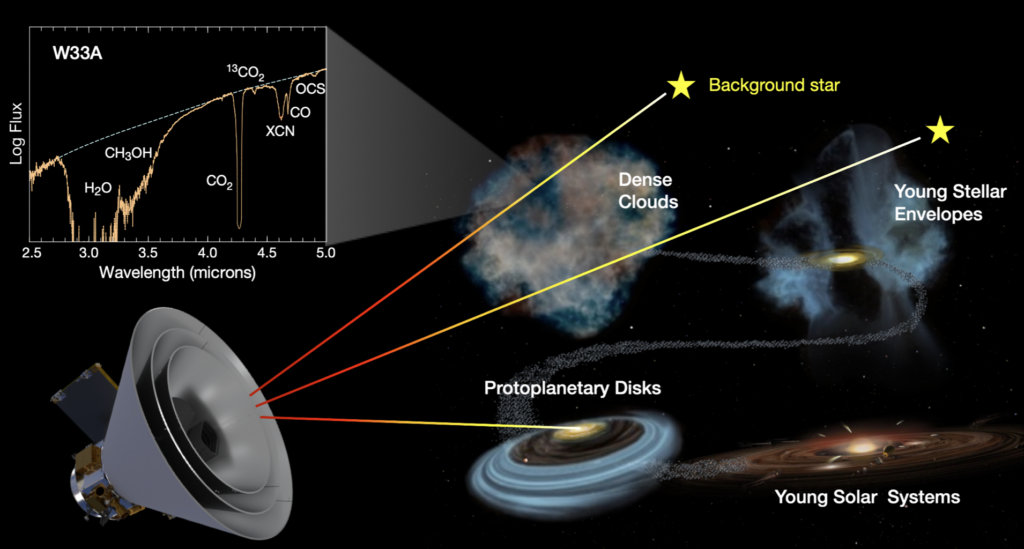
Figure 1: Examples of the sources SPHEREx will look at to search for biogenic ice species. In the top left, what the spectra of these sources will look like if those species are present: each type of ice leaves a distinct fingerprint in an infrared spectrum. Figure credit: figure 4 of today’s paper.
Goal #3: Your noise is SPHEREx’s signal
SPHEREx will measure an infrared spectrum for every point in the sky—even those that don’t contain galaxies or stars that we can resolve. These points are instead dominated by diffuse extragalactic background light (EBL). The EBL comes from many different sources, including stars, dust, and quasars, from the early universe to the present day, all added together incoherently. For most telescopes, the EBL is just a frustrating source of noise. For SPHEREx, it’s a treasure trove. We can compare the properties of the EBL that SPHEREx measures (its spectrum and how it fluctuates across the sky) to theoretical predictions and see if we seem to be missing anything. SPHEREx’s very broad infrared spectra—capturing redshifted light from the very early universe—and total sky coverage are crucial for this purpose. For instance, the SPHEREx team will try to isolate emission from the first stars and galaxies, which ionized most of the gas in the universe in the epoch of reionization. By understanding this and other contributions to the EBL, we can test hypotheses about how galaxies form and evolve.
Making it happen
Beyond inflation, ices, and extragalactic background light, SPHEREx’s all-sky infrared spectra will be invaluable for countless other science cases, like studying asteroids, characterizing the atmospheres of stars that host exoplanets, and even understanding the upper atmosphere of Earth, through which SPHEREx orbits.
But how can SPHEREx even make a spectrum for every point in the sky? An image of some part of the sky is fundamentally two-dimensional, and measuring how the brightness of every point changes with wavelength adds a third dimension. Astronomers have come up with many ways to solve this problem, which is called integral field spectroscopy. These approaches typically involve splitting an image into small regions or strips, then using a dispersive element like a prism or grating to make a spectrum of each region, and finally putting these spectra side-by-side on a camera. Figure 2 shows an example of this strategy, as well as what the final three-dimensional “datacube” looks like after processing.
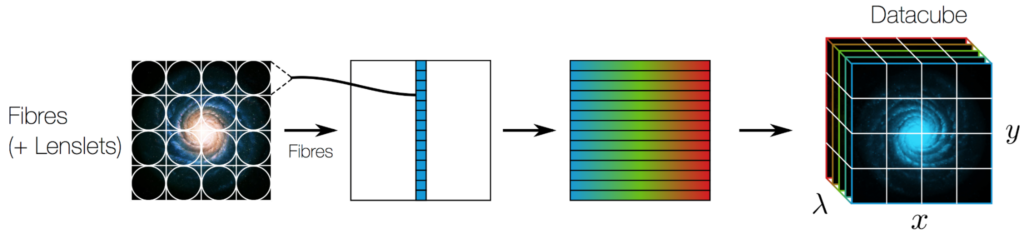
Figure 2: A common method of integral field spectroscopy, whereby the field is split into sub-apertures, each of which is dispersed to form a spectrum. This method requires complicated optics and loses spatial information within each sub-aperture.
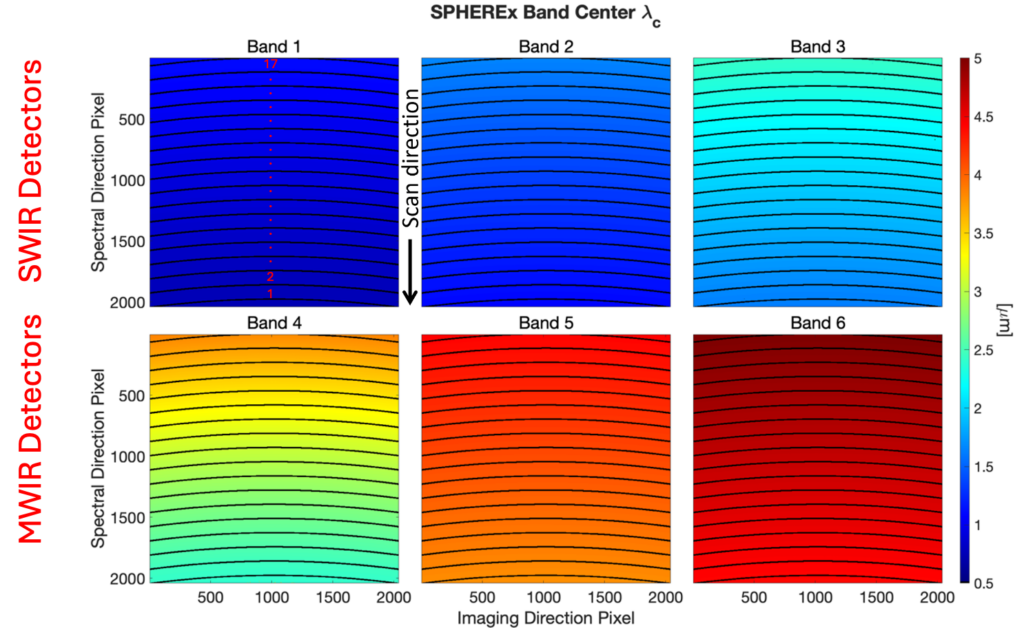
This approach is fairly complicated, relying on fancy optics, a prism or grating, and oftentimes optical fibers. From Fig. 2, note that you could also make the final “datacube” product if you simply took many images with narrow filters that let through different wavelengths of light. This takes to an extreme the approach astronomers use for spectral energy distribution (SED) fitting. Of course, this would require an exorbitant number of filters. Here, the SPHEREx team had a stroke of genius: instead of having many different filters, what if you had a filter where the transmitted wavelength changes linearly across the filter? Each row would let through a different wavelength. To get a full spectrum for all points in an image, you could take many exposures, moving the telescope slightly between each exposure so points in the image fall on different rows each time.
This is the SPHEREx survey strategy, with a few complications. First, before any filter, SPHEREx splits incoming light into two beams, with short-wave IR light (SWIR, with 0.75 μm < < 2.42 μm) going in one direction and mid-wave IR light (MWIR, 2.42 μm < < 5.00 μm) going in another. SPHEREx makes images with these two beams on different sets of detectors, so it can measure the brightness of an object at one SWIR and one MWIR wavelength simultaneously. The SPHEREx field of view covers 10.5° by 3.5°, with the SWIR and MWIR images each spread across three detectors. Every detector has a different linearly variable filter. To get a complete IR spectrum of a given point in the sky, SPHEREx moves that point to 17 different positions on each detector. This requires 51 different telescope (17 x 3 detectors) pointings in all and yields 102 spectral values (51 x 2 for the SWIR and MWIR beams). Fig. 3 shows the 17 bands on each of the six SPHEREx detectors, each corresponding to a different wavelength value.
While it would take decades to collect spectra for every point on the sky with conventional methods for integral field spectroscopy, the SPHEREx team devised a nifty solution that will collect this dataset in a few years. Soon, SPHEREx will start answering questions about cosmic inflation, interstellar ices, and extragalactic background light, while its rich dataset will be relevant for decades to come. So tell all your friends about SPHEREx (even if you can’t remember what the acronym stands for)!
Astrobite edited by Veronika Dornan
Featured image courtesy of NASA/JPL–Caltech