
Title: Theories of Spiral Structure
Authors: Alar Toomre
First Author’s Institution: Massachusetts Institute of Technology
Status: Published in the Annual Review of Astronomy and Astrophysics [closed]
The beauty and mystery of spiral galaxies
“Much as the discovery of these strange forms may be calculated to excite our curiosity, and to awaken an intense desire to learn something of the laws which give order to these wonderful systems, as yet, I think, we have no fair ground even for plausible conjecture.”
– Lord Rosse (1850), mathematician and astronomer
For decades, astronomers have been fascinated by the striking beauty of spiral galaxies and the mystery of how their intricate structures form and persist. Although spiral galaxies rotate, their spiral arms are not stable enough to simply spin with the rest of the galaxy, raising a long-standing question in astronomy: how do these galaxies maintain their distinctive patterns over billions of years? Understanding the formation and evolution of spiral galaxies is also essential to our broader picture of galaxy evolution. In the traditional Hubble Sequence, spiral galaxies—rich in gas and young stars—were thought to gradually evolve into elliptical galaxies, which are dominated by older stellar populations. While this view has since been challenged, spiral galaxies remain central to our understanding of the universe and the processes that shape it.
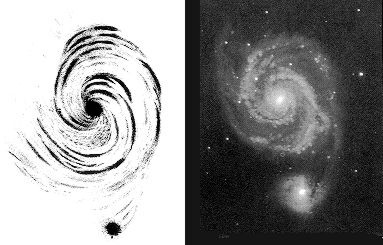
Figure 1: Drawing of the Whirlpool Galaxy by Lord Rosse, along with a telescope image.
Image Credit: SEDS Messier Database.
Theories of Spiral Structure by Alar Toomre from 1977 highlights this ongoing mystery. It reads as both a historical review and a reflection on the many ways astronomers have attempted to explain the origin of spiral galaxies. It remarks that the problem “continues to taunt theorists” and that “the more they manage to unravel it, the more obstinate seems the remaining dynamics,” emphasizing that, despite decades of progress, no single theory could fully capture spiral structure. Spiral patterns are observed in roughly 60% of galaxies. Nevertheless, the central question remained unresolved: why do spiral galaxies develop and maintain these structures in the first place?
Early ideas explaining spiral structure
Bertil Lindblad was one of the first astronomers to develop a dynamical theory of spiral structure, and his ideas laid the foundation for many of the models astronomers use today. In his “circulation theory,” the spiral arms were thought of as patterns that rotate together through the galaxy at a constant speed, much like the hands of a clock. Later work expanded on these ideas by introducing the concept of kinematic waves. Instead of treating the spiral arms as fixed structures, this model described them as patterns that emerge because individual stars and gas clouds follow their own orbits, naturally spreading out or clustering together as they respond to the vibrations of spiral arms.
The breakthrough came with the work of C. C. Lin and Frank Shu, who proposed what is now known as spiral density wave theory. Their key insight was that spiral arms are not made up of the same stars and gas forever. Instead, they are regions where matter is temporarily more concentrated—much like a traffic jam on a highway. The traffic jam moves along the road even though the individual cars continuously enter and leave it. In the same way, stars and gas pass through spiral arms while the spiral pattern itself persists.
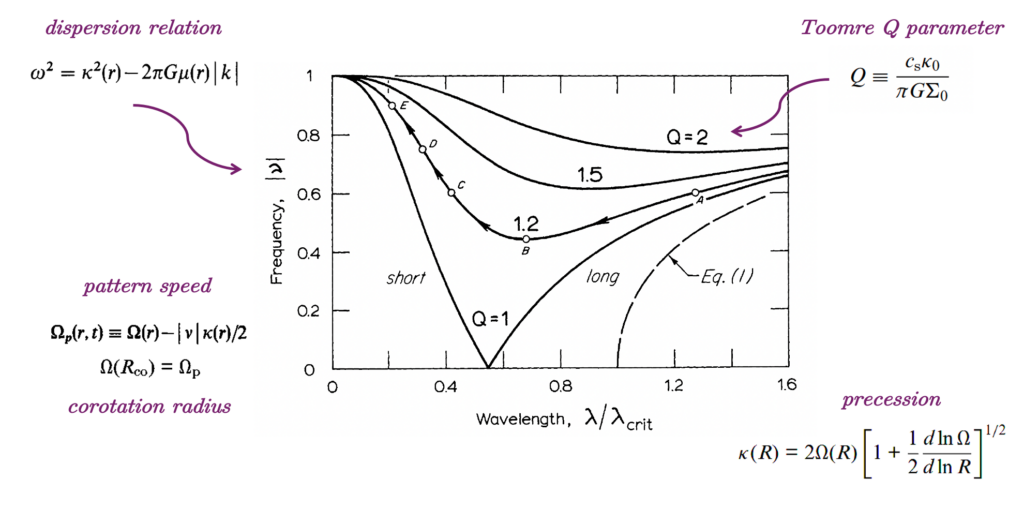
Figure 2: The wave equation describes a relation between frequency and wavelength, for different values of the Toomre Q parameter. A value of Q ~ 1.5 produces a spiral structure that persists over millions of years.
Figure 4 in today’s paper.
To describe this idea mathematically, Lin and Shu developed a a dispersion relation (Figure 2), which relates the wavelength and frequency of spiral density waves and determines how these wave pattens travel through a rotating galactic disk. Although this equation was a major advance, it took years of refinement to match observations. Toomre later introduce the Q parameter, which measures the stability of a galactic disk against gravitational collapse Subsequent work refined the theory by improving predictions for precession of stellar orbits, and refined the wave’s pattern speed and the location of the corotation radius—the distance from the galactic center where the spiral pattern rotates at the same speed as the stars.
One of the most important consequences of the Lin–Shu theory is that stars can slowly exchange angular momentum with the spiral density waves. Near the corotation radius, this interaction allows stars to gradually move inward or outward within the galaxy over billions of years. As a result, the spiral arms can survive for long periods even though the individual stars that make them up are constantly changing.
“Some grand driving forces are indeed at work.”
Many astronomers now think that density waves alone are not the whole story, and that additional processes may continually strengthen or regenerate spiral patterns. One clue comes from observations of spiral galaxies themselves. Spiral arms contain a lot of H II regions—clouds of glowing ionized hydrogen that mark the birthplaces of young stars. As gas flows into a spiral arm, it is compressed by the density wave, creating shock fronts that can trigger new episodes of star formation. The result is a chain of bright, young star clusters strung along the spiral arm, which Toomre poetically described as “strings of pearls.” Other large-scale processes may also contribute. The differential rotation of a galaxy naturally shears gas and stars into elongated structures, much like cream stretched into swirling patterns when stirred into a cup of coffee. Many spiral galaxies also contain a central bar, which suggests that bars may help drive spiral structure by redistributing stars and gas throughout the galactic disk.
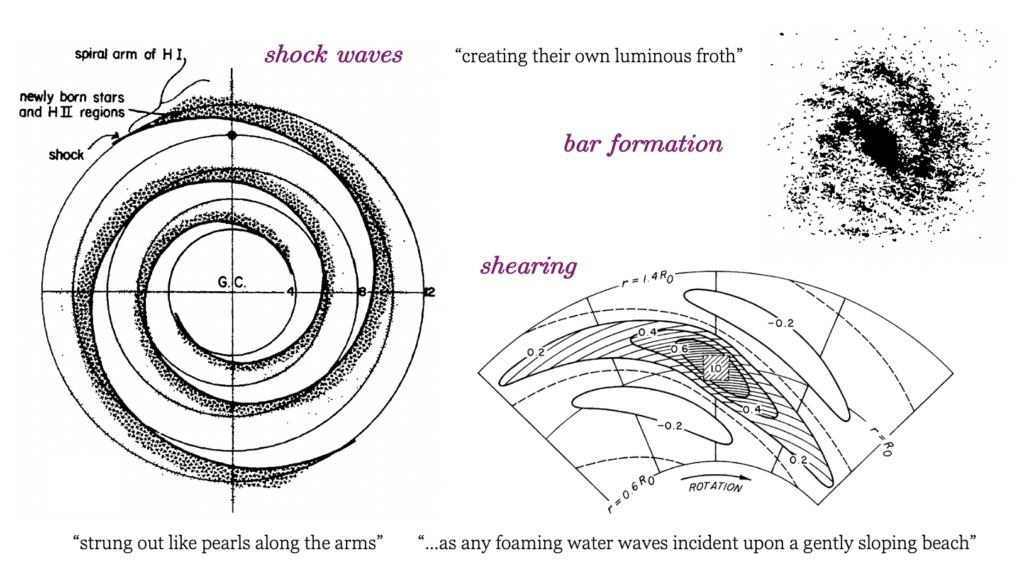
Figure 3: Different mechanisms for maintaining spiral structure. Gas compressed within spiral density waves triggers star formation, while galactic shear and central bars may also help strengthen and sustain spiral arms over time. Adapted from today’s paper.
Recent advances in numerical simulations have greatly improved our understanding of spiral galaxies. Unlike the early models of Lindblad and Toomre, modern simulations include the effects of the galaxy’s dark matter halo—once considered only an unseen source of mass—and can incorporate the physics of star formation and gas clouds. These models show how shocks, shear, and gravity shape the formation and evolution of spiral arms. Overall, these simulation suggest that spiral arms are dynamic features shaped by gravity, gas dynamics, and star formation helping to explain the remarkable diversity of spiral galaxies observed today.
Article edited by Niloofar Sharei.
Featured image credit: Whirlpool Galaxy (NASA).
