
Authors: Lauren Rhodes, Ben Margalit, Joe Bright, Hannah Dykaar, Rob Fender, David Green, Daryl Haggard, Assaf Horesh, Alexander van der Horst, Andrew Hughes, Kunal Mooley, Itai Sfaradi, David Titterington, David Williams-Baldwin
First Author’s Institution: Trottier Space Institute/Department of Physics, McGill University, Montreal, Canada
Status: Published in ApJ (open access)
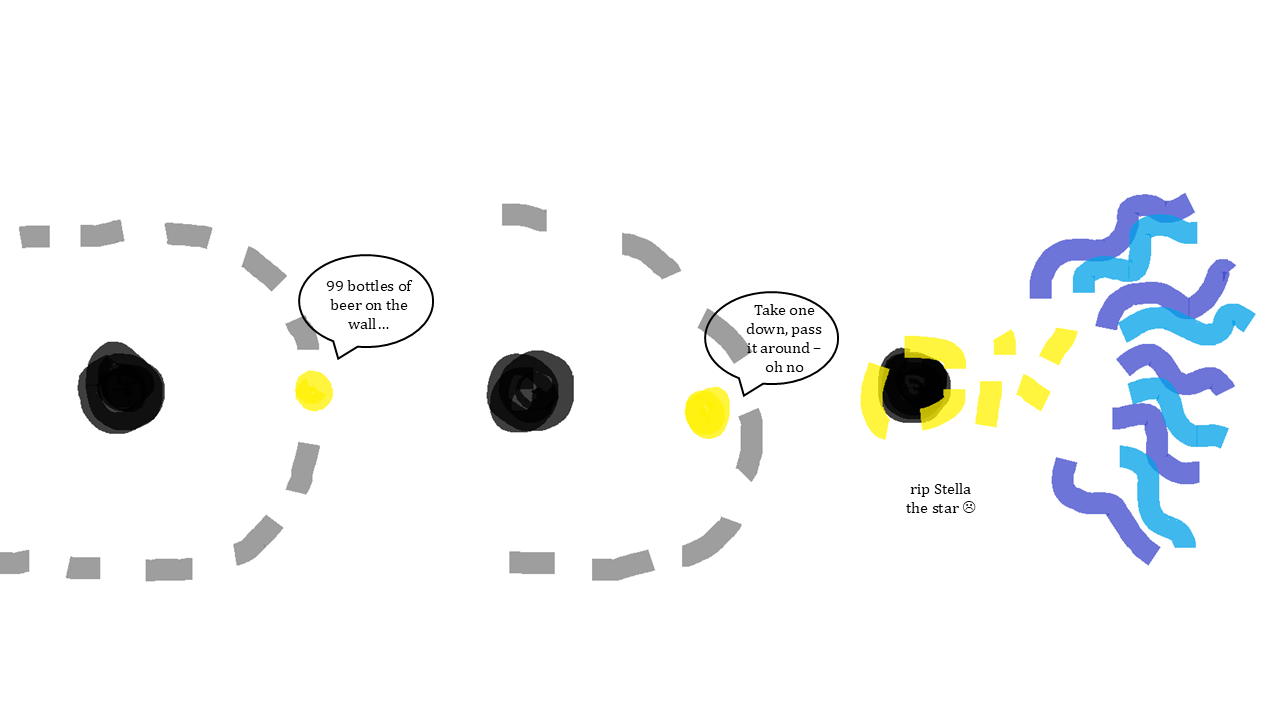
Tidal disruption events (TDEs, see Figure 1), which occur when a star gets a little too close to the supermassive black hole (SMBH) at the center of its galaxy and gets ripped apart, are a hot topic across the electromagnetic spectrum. During a TDE, the star can no longer hold itself together under the gravitational force from the SMBH. Some bits of the star end up accreting onto the black hole, which can launch a temporary outflow, or, in especially dramatic cases, a relativistic jet. Aside from being cool transients (as far as spectacular stellar deaths go, they are rivaled only by the supernova), TDEs are valuable to study for a variety of reasons. They likely play a role in galaxy evolution, SMBH growth, and even the life cycles of active galactic nuclei (AGN, in which material is constantly swirling onto the SMBH). Not to mention, they are a great tool for eyeballing the mass of the SMBH responsible for the TDE; if one is any bigger than ~1 billion times the mass of the Sun, its event horizon – the point at which not even light can escape its gravity – extends too far, and a star will disappear across the event horizon before it ever gets ripped apart.
How to spot a TDE
Usually, TDEs are discovered in the X-ray (after all, not many transients are powerful enough to generate an X-ray flare) or in the optical (thanks to high cadence, wide field surveys like the Zwicky Transient Facility and the Legacy Survey of Space and Time). However, radio is a particularly useful regime for TDE searches, especially in dusty host galaxies where we cannot see the optical TDE signatures at all; while dust obscures optical light, the radio is unaffected! There is just one catch: how exactly can we identify a TDE based on only its radio emission?
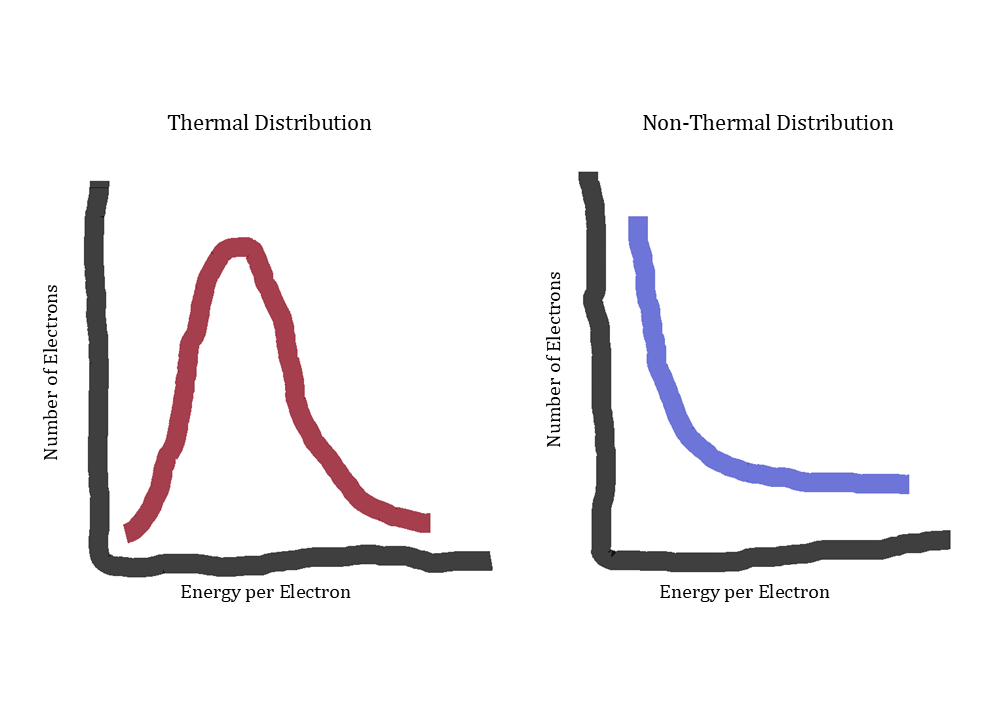
The radio light in a TDE is generated via synchrotron radiation – which is caused by fast moving electrons in strong magnetic fields – and originates in jets or shocks. Unfortunately, this is also the case in AGN, the primary extragalactic source of variable radio emission, and it can be difficult to distinguish between the two. Additionally, the amount of light we see from synchrotron radiation at a given frequency depends on how energy is distributed among the electrons in the source, which is unknown. Perhaps the simplest case – or at least the one you’ll learn about first in your undergraduate statistical mechanics course – is that the energy is distributed among the electrons thermally (left panel in Figure 2). However, most radio transients associated with black holes are assumed to have non-thermal electron energy distributions, usually where there are exponentially many more low-energy electrons than high-energy (right panel in Figure 2).
As a further challenge, very few TDEs have had extensive follow-up observations in the radio, so we don’t have strong characterizations on how most TDEs should behave, especially in the long-term. Luckily, some astronomers are working to change this.
This includes today’s authors, who have focused on one particular TDE, ZTF22aaajecp/AT2022cmc (I’m sure everyone mispronounces her name), or 2022cmc for short. 2022cmc is a special TDE: it is one of only five TDEs suspected to have launched a relativistic jet, and it has the highest redshift (z~1.2) of the five. It was observed first in the optical, and then followed up with X-ray and radio observations. The X-ray emission was highly variable for 400 days post-TDE, and then disappeared, and the first 100 days of radio emission indicated there was a relativistic outflow. At the time, it was concluded that the jet shut off and the X-ray emission ceased. However, the story doesn’t end there; the authors of today’s paper continued to observe 2022cmc in the radio for an additional 900 days at frequencies spanning ~1GHz to ~100 GHz.
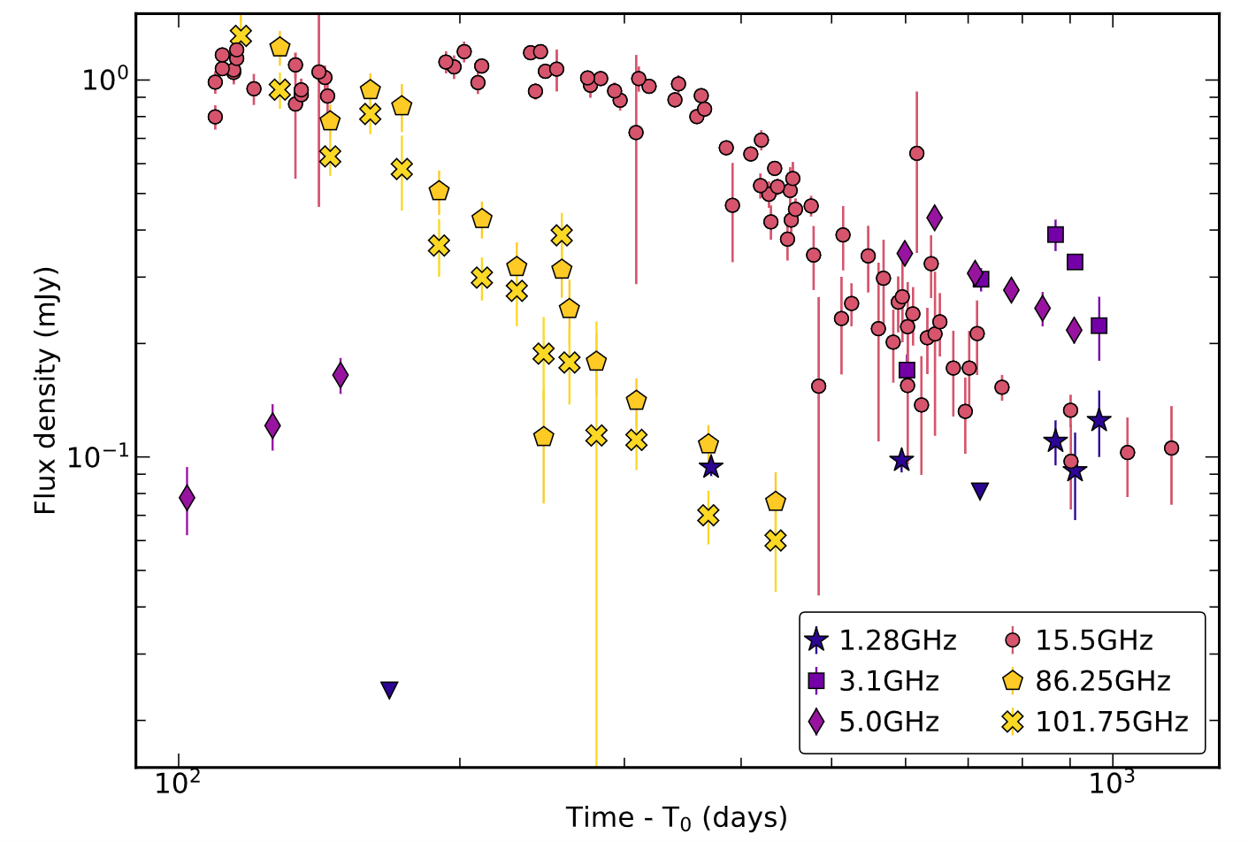
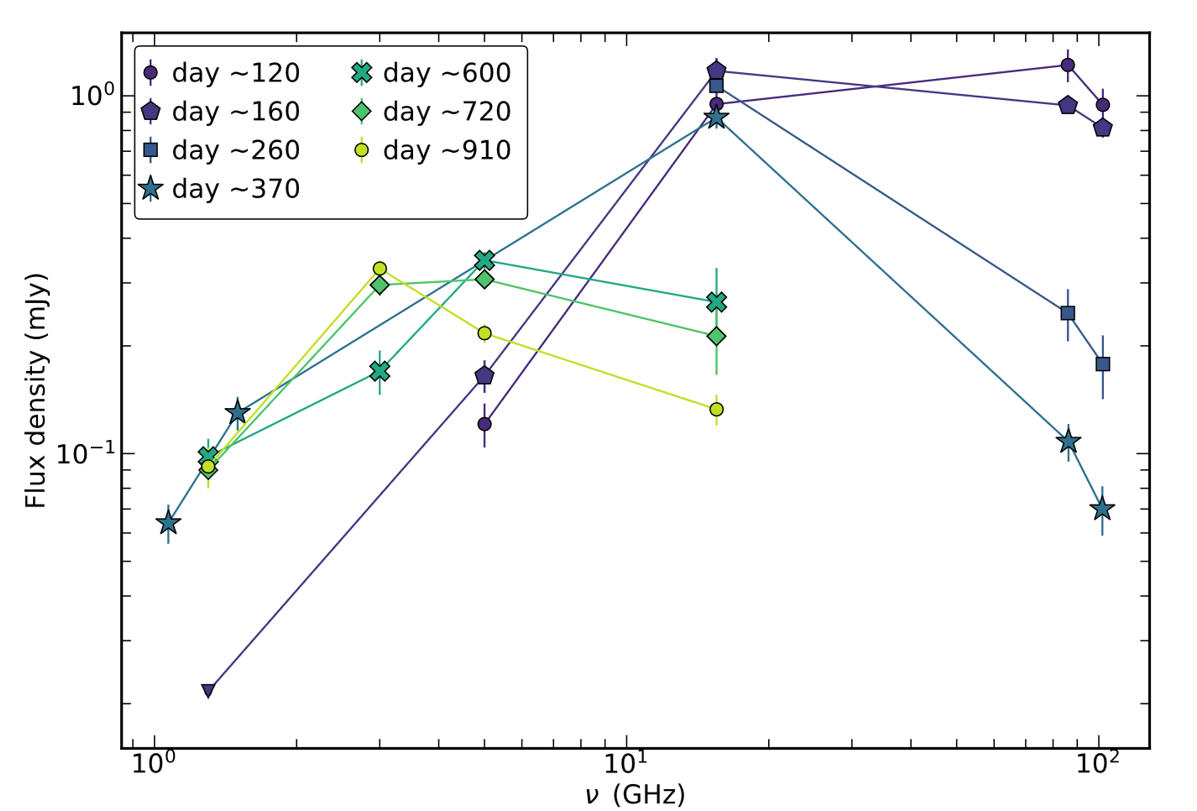
Our authors had two key observing strategies: wide frequency coverage and long duration. Measuring the change in brightness with observing frequency, or the spectral energy distribution (SED), is important for determining which processes are responsible for the radio emission, since thermal electrons and non-thermal electrons will produce different SEDs. On the other hand, measuring the change in brightness over time, or the light curve, is important for determining what is happening at the source, such as whether there is a jet and, if so, how long it lasts. Here, our authors combine light curves at six different frequencies (Figure 3) and SEDs at nine different epochs (Figure 4) to investigate both.
The findings
Our authors find a couple of interesting results. First, in the time-domain, they find the highest frequency light curves fade with time, while the lower frequency light curves increase initially, hit peaks at different times (after 300 days at 15.5 GHz, and after 800 days at 1.3GHz), and then begin to decay. The spectral evolution is even more intriguing; the SED is always peaked, and the peak shifts to lower frequencies over time, which is typical for an expanding emission region. At frequencies below the peak, the SED doesn’t change much. However, the high-frequency side of the SED shows confusing behavior; early on, it has a very steep slope (the amount of light drops off sharply at higher frequencies), but it eventually flattens.
Investigations begin
Next, our authors consider three possibilities to explain these observations. They first consider synchrotron from only non-thermal electrons in a relativistic jet (Figure 5), which is the canonical model for a gamma-ray burst radio afterglow. Initially, the jet is so fast that all its radio light is relativistically beamed in one direction (like a flashlight), and we can only see the jet if it’s pointed directly at us. Eventually, the jet slows down enough that it is no longer beamed, and light is emitted in all directions (like a light bulb). At this point, we see the light fade over time, which is exactly what happened in the high-frequency light curves. However, there is one glaring problem: this model cannot possibly explain the observed long-lasting steep SED at high frequencies. So, our authors discard this theory.

Instead, our authors consider a jetted outflow which has both non-thermal and thermal electrons both independently generating synchrotron emission1, giving us the superposition of two radio spectra. This model is also not a great fit to the data. The peak of the SED moves too slowly, a very dense local environment is required, and, once again, they cannot reconcile that steep high-frequency SED.
Lastly, our authors keep the thermal/non-thermal electrons combo and ditch the jet entirely, modeling a spherical outflow. Excitingly, this model best fits the observations, and, most importantly, can explain the mysterious high-frequency behavior. Initially, most of the radio emission originates in the thermal electron population, which produces more light at higher frequencies. As the outflow expands, the non-thermal electrons begin to dominate, and the SED transforms into the classic non-thermal synchrotron shape.
Next steps
Ideally, our authors want to compare 2022cmc to other TDEs, but few TDEs have such thorough follow-up observations. They speculate that thermal electrons were important in the radio evolution of one of the few such TDEs, Swift J1644, and recommend we revisit its emission models. More broadly, they recommend two future priorities: first, we need extensive radio observations for larger samples of TDEs, especially at ~100GHz, where the thermal electrons contribute most to the SED; secondly, we should stop neglecting thermal electrons not just in TDE models, but in models of any black hole jets, including gamma-ray bursts and X-ray binaries. While this work addresses only one event, one thing is clear. For theorists and observers alike, there is a myriad of exciting work to be done, so it’s no wonder TDEs have garnered so much attention lately.
Featured image: how I imagine TDEs transpire.
Astrobite edited by Flavia Pascal
- A convenient property of extragalactic synchrotron sources is that all their electrons radiate independently of one another, even if they are part of the same electron population. This is called incoherent emission (galactic sources are another story, but I’ll save that for another time). ↩︎
