
Authors: Avinash Tiwari, Aditya Vijaykumar, Shasvath J. Kapadia, Sourav Chatterjee
First Author’s Institution: Inter-University Centre for Astronomy and Astrophysics, Post Bag 4, Ganeshkhind, Pune – 411007, India
Status: Available on arXiv
If an exoplanet astronomer needs a reason to care about future gravitational-wave detectors, here’s one.
Current gravitational-wave detectors, like LIGO, have been extremely successful in observing signals coming from the orbit of two dense astronomical objects, like neutron stars or black holes. These systems, known as compact binaries, are also a top priority for future detectors, such as DECIGO and the Einstein Telescope (ET), which promise to observe gravitational waves with extraordinary precision.
If gravitational waves are loudest coming from these dense objects with very strong gravitational fields, can they reveal anything about exoplanets, which are relatively tiny?
Today’s paper explores a scenario where they can. From the thousands of exoplanets that have been discovered to date, a small fraction of them, known as circumbinary exoplanets, orbit two stars instead of one. A handful of these have been claimed to orbit compact objects. As an exoplanet orbits a binary system, the binary wobbles around, and this wobble leaves an imprint on the gravitational-wave signal.
By studying the imprint on the signal, today’s authors show that gravitational waves provide a new avenue for detecting exoplanets, one that could lead to the discovery of exoplanets outside our galaxy, which are out of reach for existing methods.
How to “hear” a planet
You’ve likely heard of the Doppler shift, the same effect that causes sound waves to change frequency as their source moves towards or away from you. A circumbinary exoplanet causes the center of mass of the binary to move around slightly. As a result, the observed gravitational wave is Doppler shifted, and the shift changes as the planet goes around. Although these frequency shifts are small, future gravitational wave detectors will be sensitive enough to measure them.
Today’s authors model how the shifts in the gravitational-wave frequency depend on properties like the mass of the exoplanet and the size and shape of its orbit. Using this model, along with the projected sensitivities of an upgraded version of LIGO, ET, and DECIGO, they can predict how precisely we’ll be able to pin down the exoplanet properties for a range of masses and orbit sizes with each detector.
The bar for a meaningful measurement is a relative uncertainty of less than 100% on the exoplanet mass. Anything worse than this and you can’t tell a planet apart from something much heavier. There’s also a limitation this method shares with the radial velocity detection method: it is only sensitive to movements along our line of sight. Therefore, it measures a combination of the exoplanet’s mass and how tilted its orbit is. The authors assume the most favorable, edge-on orbit, which means the results are best-case scenarios.
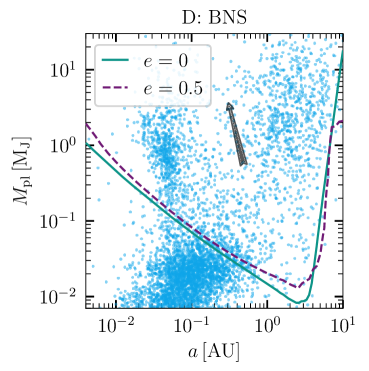
They consider exoplanets in circular or eccentric orbits around a binary with two neutron stars, two black holes, or one of each. As an example, the exoplanets with masses and orbit sizes lying above the curves in Figure 1 could be measured with DECIGO if they were orbiting a binary neutron star system 1 gigaparsec away from Earth. That’s around 3.3 billion light-years, much further away than any known exoplanet!
What might we actually find?
From the analysis above, the authors find that if extragalactic exoplanets resemble those we know of in the Milky Way (blue dots in Fig. 1), then the upgraded version of LIGO is unlikely to make new detections. However, ET would detect several, and DECIGO would detect even more, up to distances farther away. This is partly because it would observe the inward spiral of the binary for years, whereas ET gets only hours.
For a closer look, the authors simulate what the signal at different detectors would look like if known exoplanets, such as Kepler-80 f, PSR J1719-1438 b, or GJ 676 A c, were in eccentric orbits around different types of compact binaries. They find that, in this best-case scenario, the true values of the exoplanet masses, semi-major axes, and eccentricities can all be recovered within the 90% credible interval of the measurement.
In the end, this method is best suited for detecting hot Neptunes, Saturns, and Jupiters. Only DECIGO, observing binary neutron stars, could reach down to super-Earths.
Conclusions
Unlike electromagnetic waves, gravitational waves are not scattered or absorbed as they travel through dust and gas in space. This gives them a unique ability to reveal what lies beyond our galaxy.
Earlier studies along these lines were limited to systems in our galaxy and could only recover a rough estimate of the exoplanet’s mass. Today’s results demonstrate the high potential that future gravitational-wave detectors have to identify and characterize extragalactic exoplanets, which would greatly advance our understanding of the formation of planetary systems.
Astrobite edited by: Nathan Whitsett
Featured image credit: Viviana A. Cáceres
