Title: Search for Dark Matter Annihilation and Decay with Hα Line Emission
Author: Rebecca K. Leane
First Author’s Institution: SLAC National Accelerator Laboratory & Kavli Institute for Particle Astrophysics and Cosmology
Status: Accepted in PRL (Open Access), available on arXiv
Making things glow in the dark
Dark matter is hypothesized to lurk in and around almost every galaxy in the universe, but scientists are not quite sure what it is: it could be an invisible form of matter or an yet unexplained phenomenon. This phenomenon is evoked to explain observations such as the speed of rotation in galaxies, the motions of galaxies within clusters, and even the Big Bang itself. In the most widely accepted model of dark matter, it is only expected to interact with itself and with other particles through gravitational attraction. If dark matter is a fundamental particle of our universe, such as the electron, scientists expect it to have an anti-particle, the way electrons have positrons. If anti-particles are brought close enough together, they annihilate and release high energy photons. Another theory suggests that dark matter particles could decay into particles such as electrons and positrons which then would annihilate as described above. One place scientists expect these annihilation events to exist is in dwarf galaxies, as scientists think they should have a tremendous amount of dark matter. In this paper, the author proposes a new indirect method of detecting these annihilations at the hearts of dwarf galaxies.
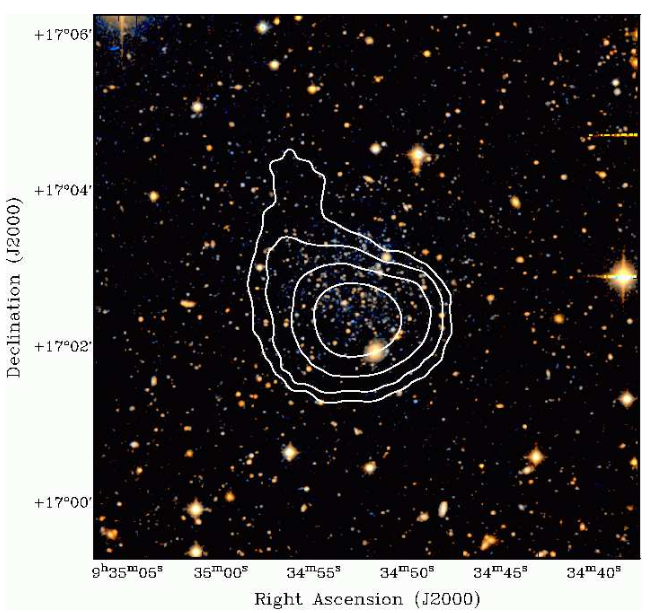
Dwarf galaxies could be useful in studying dark matter annihilation as some of them are rich in atomic, neutral hydrogen gas. That hydrogen gas could then indicate the presence of dark matter. If dark matter annihilates releasing a high energy photon, it can knock out the single electron from the hydrogen atom and ionise it. That single electron is released into a higher energy state or even may be completely removed. It then drops back down to its normal, lower energy state by releasing a photon. If it were ionised and was then captured again, the process is called recombination. 46% of ionized hydrogen will drop to this lower energy level by releasing a photon at 656 nm (red light). This is the famous red H α spectral line that astronomers often use to detect the presence of ionized hydrogen.
If we are able to see this line, this red glow from dwarf galaxies, and compare it to the expected glow from theoretical models, we might be able indirectly detect hints of dark matter! Or at least, that’s the broad idea.
A new dwarf dark matter detection doctrine
Dark matter is not the only process that could create this ionized hydrogen: star formation processes, supernovae, or just very large stars can also emit the H α spectral line. This may contaminate the dark matter annihilation or decay signal.
The ideal test bed to minimize contamination from stellar processes would be to study this in a galaxy with no young stars or has very little stellar activity, and the nearby dwarf galaxy Leo T fits the bill perfectly. Only 420 kiloparsec away, right in our local group, it is expected to be dark matter dominant, has a lot of neutral hydrogen gas, and has almost no star formation, hence reducing contamination.
Leo T was also a perfect candidate as archival data already existed that could potentially show H α emission. The data came from the MUSE spectrograph on the Very Large Telescope, which is one of the most advanced optical telescope suites on the planet.
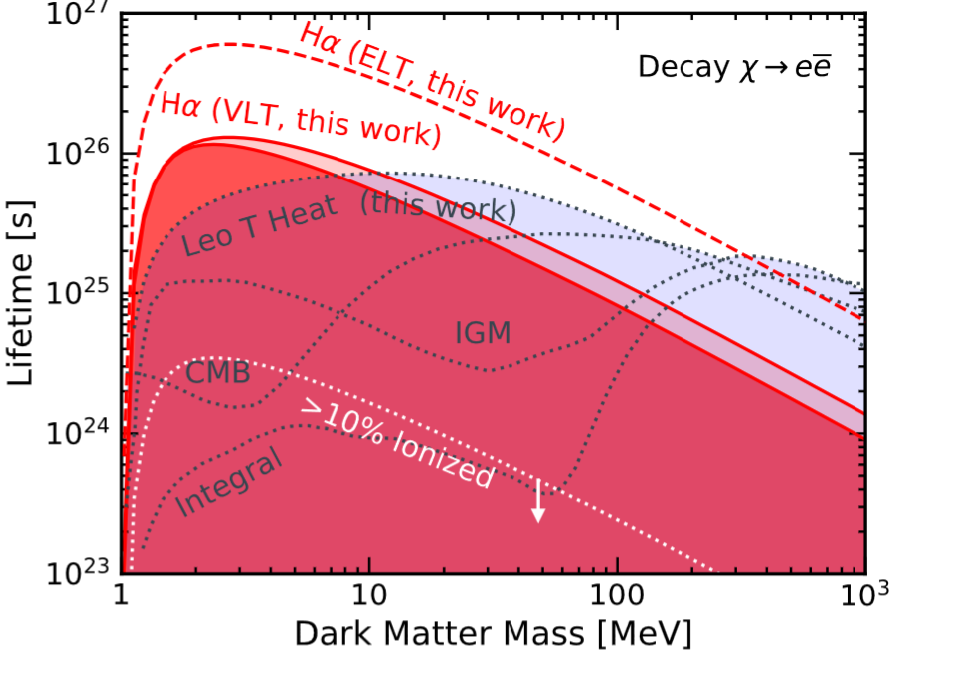
Unfortunately, no emission was found. However, the author was able to set new limits on certain dark matter annihilation scenarios and narrow down which types of dark matter particles fit the explanation of no emission. Let’s see what these new limits look like and how this new proposed method stacks up to some other similar dark matter detection methods.
The Cosmic Microwave Background (CMB) is the afterglow of the hydrogen recombination which took place right after the big bang. If dark matter was annihilating or decaying in the early universe, the extra energy from it would leave its mark in the recombination process and therefore the CMB. For dwarf galaxies in particular, another signature of dark matter interacting with the gas that is often sought after by astrophysicists is just simply an unexpected extra “heat source”. Annihilation and decay should not only cause atoms to ionise, the excess photons should also increase the temperature of the gas, which should be detectable. Similarly, dark matter annihilation or decay is also expected to heat up the very sparse ionized medium between galaxies (IGM), which should also be detectable.
As seen in Figure 2 which compares decay time and the mass of the possible particle , the red and orange regions highlight 2 dark matter profiles in fit to Leo T and detectable by H α . Both these have a peak higher than the limits set by the CMB, IGM heating and the heating of the gas in the galaxy. If dark matter does take this decay path, the H α method is a more rigorous test for particle candidates in the few MeV mass range.
Apart from these new limits, the paper proposes something very bold for the future. Rubin Observatory is expected to detect many dozens of such quiet dwarf galaxies, many of which may be similar to Leo T. It would be possible to stack many of these observations on top of each other and increase the strength of the possible H α signal to detect it. Along with Rubin,the Extremely Large Telescope (ELT) is expected to be operational by the end of the decade. With its gigantic 39 meter mirror and next-generation instruments like HARMONI, extremely faint H α emission will be detectable.
Detecting dark matter and understanding its true nature has proven to be a remarkably resilient problem to tackle. Bold new creative approaches such as this one lead the way, especially as it will be possible to execute with no additional cost with existing surveys, the Rubin observatory, and the future ELT.
Astrobite edited by Annika Salmi.
Featured image credit: the source pre-print, Ryan-Weber et al. 2007