
Title: Can planet–planet binaries survive in star-forming regions?
Authors: Richard J. Parker, Simon P. Goodwin, Jessica L. Diamond
First author’s institution: Astrophysics Research Cluster, School of Mathematical and Physical Sciences, The University of Sheffield, UK
Status: Accepted to MNRAS Letters [open access]
Understanding star and planet formation is required to make sense of the populations that we observe today. Star-forming regions, like the nearby Orion Nebula, are massive complexes of dust and gas that collapse to form infant stars and planets. The James Webb Space Telescope (JWST)’s discovery of Jupiter-Mass Binary Objects (JuMBOs), which are binary free-floating planetary-mass objects in the Trapezium Cluster at the heart of the Orion Nebula, is one of the most perplexing findings in a star-forming region in the recent past.
JuMBOs are seemingly widely separated (~30 – 300 AU) planet-planet systems, and the original paper claimed to find 40 of them! There has since been a vigorous debate over whether JUMBOs exist and, if they do, how they form. Some astronomers have claimed JuMBOs might actually be background stars reddened by the copious amount of dust in the Orion Nebula. The formation debate revolves around whether these objects form “like stars,” from the collapse of molecular clouds, or “like planets,” around stars and are then ejected from the system. Both options are problematic since nature does not tend to produce Jupiter-mass objects from molecular clouds, and it is difficult to imagine how planets might be ejected in binaries or later end up in binaries.
Today’s paper investigates not the question of formation but whether JuMBOs are dynamically stable given the dense, chaotic environment of star-forming regions. They do this by running N-body simulations of a star-forming region with 1500 systems: either single stars drawn from a realistic initial-mass function or planet-planet binaries with masses drawn from what is known about JuMBOs.

They run five simulations (A, B, C, D, E, as shown in Figure 1) that differ in a few key parameters: the lower mass of single stars (simulation C includes single brown dwarfs), the separation between the binary planets (A, B, C use the observed JuMBO distribution while D and E use a flat distribution), and how dense with stars each region is (B and E use a value close the present-day density of the Orion Nebula while A, C, and D use a much higher density the Orion Nebula might have had in the past).
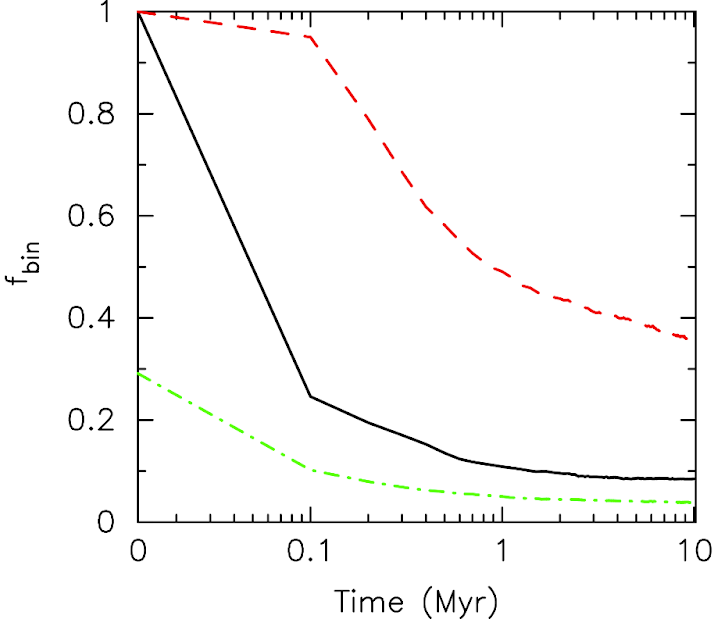
The authors investigate how the binary fraction of the sample changes over time, as shown in Figure 2. While the extent varies, each simulation shows substantial dynamical disruption, resulting in 50 – 90% of planet-planet binaries being destroyed in a few million years.
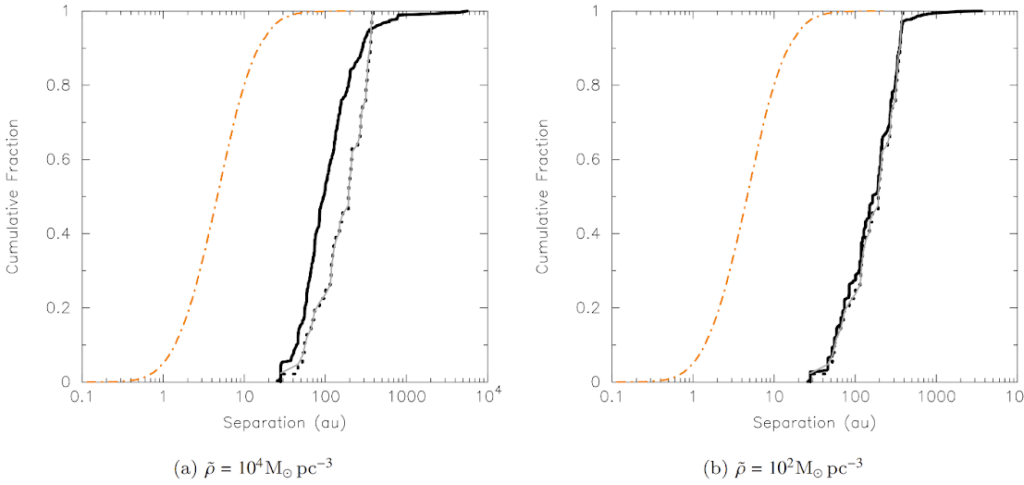
The authors of today’s paper also look into how the dynamical destruction of binaries affects the distribution of their orbital separations. The results for a high-density (left panel) and lower-density (right panel) simulation run for one Myr are shown in Figure 3. In the lower-density scenario, the shape of the distribution does not change much, but wider binaries are preferentially destroyed in the higher-density scenario. This result suggests that if the Orion Nebula was denser in the past, the orbital separation distribution of JuMBOs we observe is not their birth distribution.
Clearly, the JuMBO picture becomes even more complicated when we consider dynamical effects. If even some of the JuMBOs claimed are real, nature must make many more of them than we observe. We also might be observing a population of JuMBOs that has dynamically evolved from their birth properties, adding another layer of difficulty to using JuMBOs to constrain star and planet formation.
Astrobite edited by Neev Shah
Featured Image Credit: K.L. Luhman (Harvard-Smithsonian Center for Astrophysics, Cambridge, Mass.); and G. Schneider, E. Young, G. Rieke, A. Cotera, H. Chen, M. Rieke, R. Thompson (Steward Observatory, University of Arizona, Tucson, Ariz.) and NASA/ESA
