
Title: Inclusive teaching strategies are not widely used by male physics instructors
Authors: Md Sanyat Rabby & Charles Henderson
First Author’s Institution: The Mallinson Institute for Science Education, Western Michigan University, Kalamazoo, Michigan 49008, USA
Status: Published in Physical Review Physics Education Research Volume 21 [open access]
As an undergraduate student in astronomy or physics, do you ever look around at the people in your physics classes and feel like nobody looks like you? If you’ve ever felt this way, you’re not alone! Statistics show that physics is one of the least diverse STEM fields, with low percentages of both women and minorities completing undergraduate degrees in physics. STEM in general has an attrition problem: between 2003 and 2009, almost half of students who entered STEM bachelor’s degree programs had left the field by 2009 (per the STEM Attrition: College Students Paths Into and Out of STEM Fields report in 2013). So as undergraduate and graduate students who will eventually become the next generation of STEM teachers, how do we change these patterns to retain more students?
What is Inclusive Teaching?
Education research shows that one of the ways STEM fields can retain and improve diversity of students is by changing the way we teach our classes to be more inclusive (see Tanner 2017, Drewsbury & Brame 2019, Sathy & Hogan 2019). But what is inclusive teaching and what are some examples of what it looks like in practice? Broadly defined, inclusive teaching describes instructional methods that create an equitable learning environment for all students. While some may think that these types of teaching methods favor students of particular backgrounds, identities, or abilities, research shows that all students benefit from inclusive teaching. Some examples of inclusive teaching methods include simple things like learning and using students names during classes, or surveying students throughout the course to ask how they think the course is going. More examples from today’s paper are highlighted in Table 1.
Today’s paper explores what inclusive teaching methods college level physics instructors implement in their classes most often, if teachers want to implement more inclusive teaching approaches in their classes, and what barriers prevent teachers from adding inclusive teaching practices to their classes.
| Inclusive Teaching Strategy | Description |
| Wait Time | After posing a question pause for several seconds before soliciting verbal responses from students. |
| Interact with Students | Create opportunities to interact with students on a personal level. For example, through short conversations before class or sending a quick email. |
| Timely Feedback | Provide feedback in a timely fashion. |
| Use Names | Learn and use students’ names. |
| Praise with caution | Praise student responses with caution, so that other students feel they still have something to add. |
| Respectful Climate | Develop a positive and respectful classroom climate. For example, by demonstrating warmth, respect, and interest for the students. |
| Solicit multiple responses | When asking a question, solicit verbal responses from multiple students without immediate judgment. |
| Pre- and post-classroom assessment | Assess students before and after the class. For example, a vocabulary quiz before class and a short essay after class. |
| Promote collaboration | Enhance cooperation and reduce competition among students. |
| Open-ended questions | Ask open-ended questions during class. |
| Share own difficulties | Acknowledge that learning is difficult and share some of your own difficulties. |
| Learn about racism and sexism | Educate yourself about the history of racism and sexism within higher education. |
| Low stake assessments | Use more low-stake assessments and fewer big tests. |
| Think-pair share | Use “think-pair-share.” After posing a question, allow students time to think, then talk with nearby peers, and then share with the whole class. |
| Survey students | Survey students to find out how they think the course is going. |
| Ensure everyone’s participation | Ensure that all students participate during class. For example, by allowing anonymous participation, using random calling, or inviting students to participate who do not volunteer regularly. |
| Learn about the culture of higher education | Educate yourself about the cultures and norms of higher education that shape students’ experiences. |
| Small group work | Use structured small group activities where you provide clear instruction about the task, explicitly discuss how to participate in a group, and assign and rotate roles. |
| Culturally diverse examples | Integrate culturally diverse and relevant examples. |
| Share pronouns | Share your pronouns. |
| Understand students’ backgrounds | Carefully understand your students within their sociocultural and institutional contexts. |
| Explain your teaching practices | Be explicit about your inclusive teaching practices and why you use them. |
| Share your positionality | Write a positionality statement and share it with your class, for example, on the syllabus |
The Sample of Instructors
Researchers reached out to introductory college-level physics instructors in the state of Michigan who were teaching a class in the Spring of 2022. Out of all the professors they reached out to, only 11 professors agreed to participate in the study, all of whom were male. The authors acknowledge that there are fewer female faculty in physics and that women are more likely to use innovative teaching methods in their classes, so future research on implementation of inclusive teaching methods in women-taught college physics classes is desirable.
Surveying the Use of Inclusive Teaching Methods
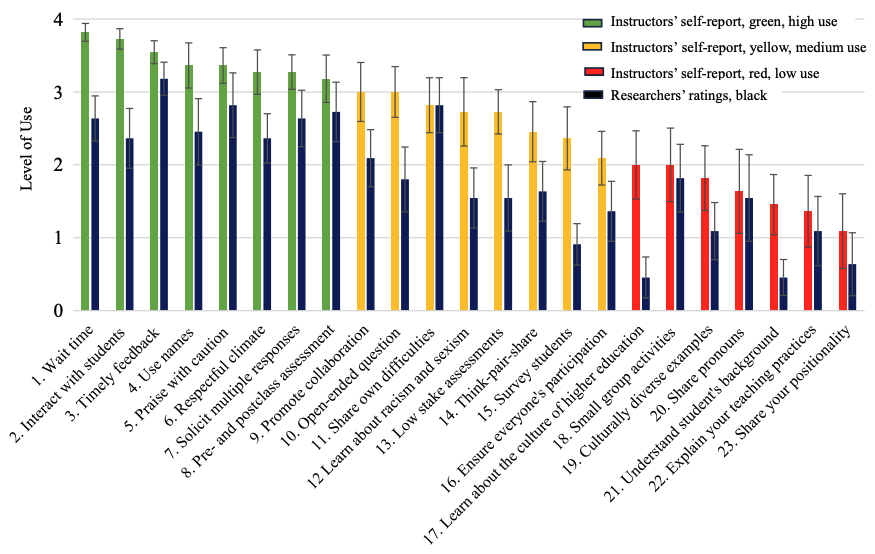
All of the instructors were asked to rate their usage of the 23 inclusive teaching methods (seen in Table 1) in their physics classroom on a scale of 1 to 4 (1 being “not at all descriptive of my teaching” and 4 being “very descriptive of my teaching”). The authors then asked follow-up questions to learn more about how each strategy is actually used in the classroom. Since research shows that self-reported levels of the use of instructional techniques is not often accurate, the authors used the follow-up questions to adjust the self-reported scores for each strategy. Figure 1 shows the average of each instructor’s self-reported score for each teaching method as the green, yellow, or red bar and the adjusted score by the authors as the navy blue bar. We can see that the authors always found a lower average score for each technique than the professors self reported, which suggests that the instructors are not using the inclusive teaching techniques as much as they think they are in their classes.
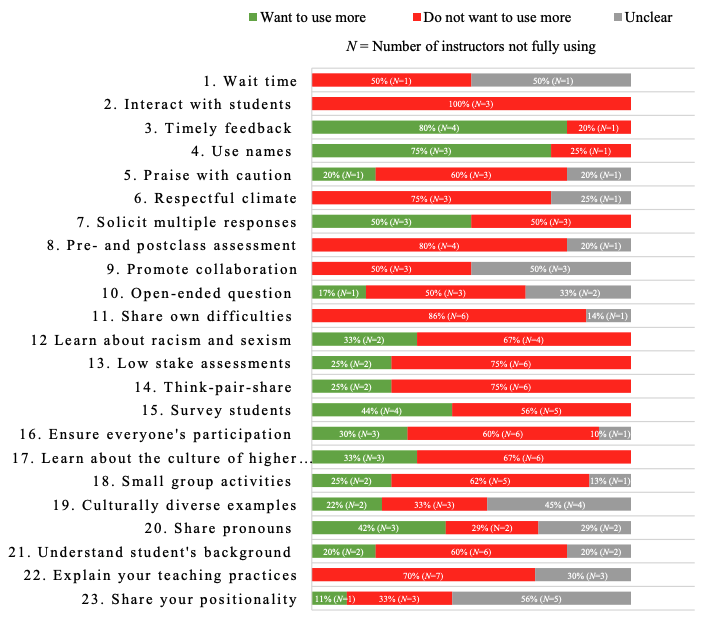
For each inclusive teaching method the professor did not describe as “very descriptive of my teaching”, the authors asked if the professor wanted to use that teaching strategy more often in the future. The results are summarized in Figure 2 for each inclusive teaching technique. The authors largely found that professors who did not already view themselves as using a particular strategy in their classroom were not interested in beginning to use or increasing their use of that strategy in their classroom. Out of the 23 total methods instructors were surveyed about, only 2 of the strategies had a majority of professors respond that they wanted to include these teaching practices in their classrooms more: providing more timely feedback and using students’ names.
Why Are Some Methods Implemented Over Others?
The authors asked professors about their reasons for using or not wanting to use specific teaching methods in their classroom. For highly used methods, highlighted in green in Figure 1, instructors most favored these strategies because they viewed them as helping students learn physics content. However, instructors also noted challenges with using some of these techniques, such as student resistance (e.g. students not being willing to participate–like when asking open ended questions to the class), having a limited amount of time to give to the class based on their other responsibilities, and lack of knowledge and skill. Instructors responded similarly for medium-used strategies, highlighted in yellow in Figure 1, as well. However, for low used strategies, highlighted in red in Figure 1, instructors primarily indicated they did not know much about the techniques and/or that they didn’t view these strategies as being relevant in a physics classroom.
The some of the lowest-used strategies (learning about racism and sexism, learning about higher education culture, using culturally diverse examples, sharing your pronouns, understanding students backgrounds, explaining your teaching practices, and sharing your positionality) are primarily teaching practices that “require instructors to acknowledge the role of identity in physics teaching and learning.” The authors also commented, “While only a minority of these male instructors explicitly stated that things such as students’ cultures or backgrounds are not relevant in a physics classroom, most chose teaching strategies as if they believed this.”
Recommendations
The authors make three primary recommendations to encourage the wider use of inclusive teaching practices in physics classrooms:
- Encourage instructors to promote students’ sense of belonging: Professors in this study showed that their primary goal for implementing various teaching strategies was to help students learn physics, and evidence shows that students who feel a sense of belonging learn better! (see Walton & Cohen 2007 and Walton, G., et al 2012)
- Teach instructors that identity is relevant in physics, and help them become more comfortable talking about their identity in physics classrooms: It’s difficult for students to relate to their instructors when they know very little about their professors other than that they teach physics and do research. This also includes erasing the view that promoting equitable, diverse, and inclusive learning environments is inherently political and thus, has no place in science.
- Provide professional development for professors to learn how to implement the full range of inclusive teaching strategies: Currently instructors are not using all of the inclusive teaching practices, and the ones they do implement are sometimes not being used in the recommended ways. Providing a space for instructors to learn these teaching methods makes them more approachable, more likely to be implemented correctly, and lessens the time burden for instructors to learn these methods on their own.
Summary
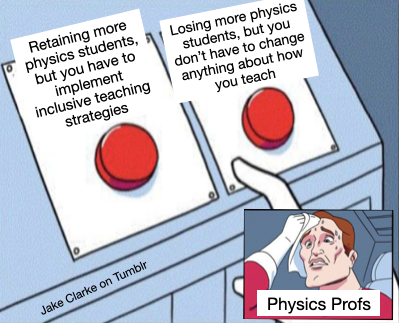
But on a more serious note, while there is research that inclusive teaching strategies improve the learning experience for all students (see Drewsbury & Brame 2019, Molbaek 2017), the authors found that introductory college-level physics instructors only implement some inclusive teaching practices and had little interest in introducing more inclusive teaching methods to their classrooms. In particular, the lowest-used teaching strategies, that many professors said did not feel relevant for implementing in physics classrooms, involve acknowledging the role of identity in physics teaching and learning. Finally, the authors make several recommendations that, when implemented, they hope will encourage instructors to use more inclusive learning techniques in undergraduate physics classrooms.
In the comments below, I would love to hear about your experience as a student or instructor with inclusive learning techniques. If you’ve been in a class that implemented them, did you feel like you learned physics better? As an instructor do you implement these in your classroom? If not, why not? Would you consider implementing them in the future?
Astrobite edited by Alexandra Masegian
Featured image credit: Pixlr Image Editor & my meme dreams

I am neither a physics student nor a teacher but thoroughly enjoyed your article about inclusive teaching methods in higher learning settings. Your graphs were not only easy to read but also showed pertinent information about your topic. Even though I am reading it on a small iPhone screen, I had no trouble accessing your graphs because they focused on your key points. As a life long learner and educator, I wondered about the instructors who volunteered for this project but so no need to consider the inclusive methods in their classroom strategy. I wonder if some wanted to prove their own methods were what is required and no accommodations needed and that would have been proven in the outcome. I suppose those interviewed were not asked why they wanted to be part of this project. Your article offered me continuing food for thought as I engage with my four year old granddaughter in her Pre-kindergarten class. I know her parents and supporting family encourage her to learn by seeking school environments where she will be more able to focus on the topic because she is respected for her own needs. Thank you for writing this.
Thank you so much for your kind words on the article! I also thought it would’ve been interesting for the authors to ask information about the average scores and drop out rates in each instructors class, that way we could see how successful the instructors already were with teaching and retaining students students. Maybe the professors in this study who implement the most inclusive teaching strategies have the highest scores and most diverse retention demographics, but we can’t tell from this study! I hope we see more studies like this for physics and astronomy education in the future!