
Paper Title: Late accretion offers pathway to misaligned disk around the planet-hosting IRAS 04125+2902
Authors: L.-A Hühn, H.-CJiang, C. P. Dullemond
First-author institution: Institut für Theoretische Astrophysik, Zentrum für Astronomie der Universität Heidelberg, Albert-Ueberle-Str. 2, 69120 Heidelberg, Germany
Status: Accepted for publication in Astronomy & Astrophysics
Like the solar system, we expect exoplanets to be orbiting in more-or-less the same plane as each other and roughly perpendicular to their star’s rotation (although sometimes weird things happen!). In other words, we expect planets to have similar orbital inclinations. If this is the case, it follows that these planets were likely formed in the same plane. This is the idea behind a protoplanetary disc, which is full of dust and gas. This means that we can’t have a planet and disc that aren’t at the same inclination – it just wouldn’t make sense, right?
No, it wouldn’t. So, why, why, why does this star system have a planet and gaseous disc orbiting at a different inclination to an orbiting planet?!
The Problem
The star of the show is IRAS 04125+2902, a 3 million year-old M-type star with a binary companion star (with an equally-memorable name: 2MASS J04154269+2909558). A young planet, which is less than half the mass of Jupiter, orbits the primary star. The planet’s inclination is consistent with the binary star, which matches nicely with planet formation theories. The primary star, however, has a misaligned disc. Did it not get the memo to stay in line?
According to the authors of today’s paper, yes, the disc in fact did not get the memo, because it was rather late to the party. When protoplanetary discs build planets, they don’t do it alone: when stars form, they can interact gravitationally with the material in their environment. This includes other stars and clumps of gas, meaning clouds of material can make the star and planet formation process a whole lot messier.
The Solution
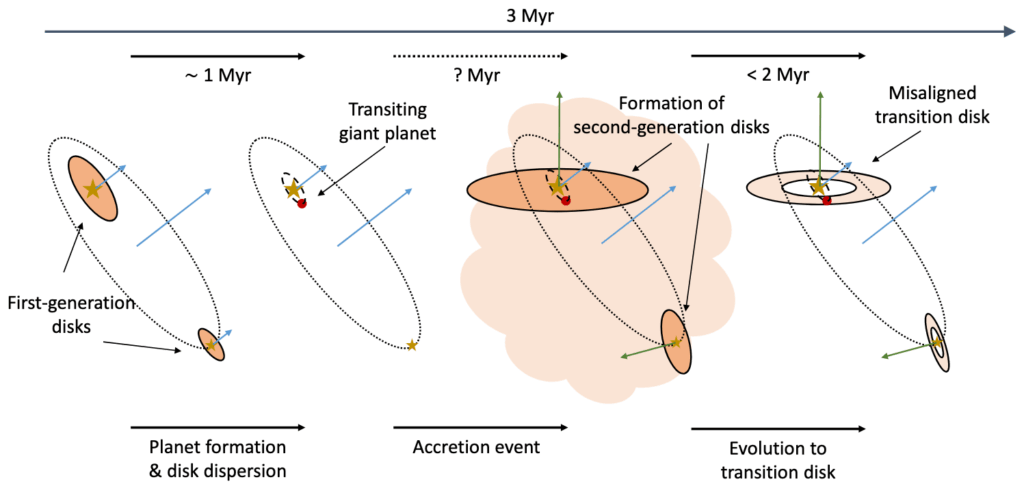
In the case of today’s star system, the authors theorise that the system formed its planet exactly how we expect most systems should form – a protoplanetary disc around a nascent star – which explains why the binary star and planet are coplanar. Then, thousands-to-millions of years later, the star system encountered a cloud of gas (a “cloudlet”) in the interstellar medium. The stars then accreted material and built up the misaligned disc different angular momentum vector to the original system around the primary star as we have observed it. The authors illustrated this process in Fig. 1 (Fig. D1 in the paper). But how do we know this?
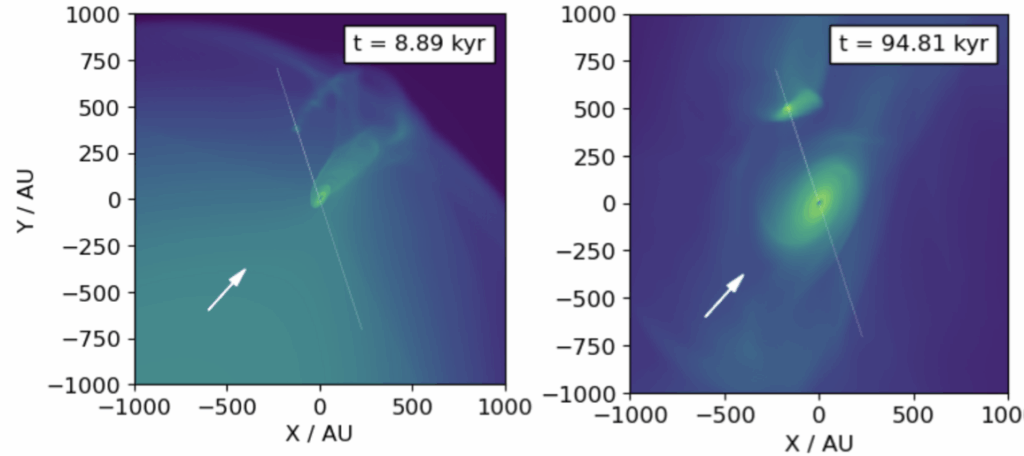
The authors utilised the open-source simulation software FARGO3D to simulate this accretion event. The star system, with its planet, peacefully drifts through the gaseous cloud and then the stars gobble up the material into a disc. The authors find that they can well-reproduce the misalignment of the disc with their simulation, and have provided a video of the accretion event!
This approach is not without caveats, however. The authors note that the observed disc is a “transition disc” (it has a big hole in the middle), whereas their simulations do not mimic this; they suggest that the disc must evolve further to achieve this structure, including the evolution of dust (not just gas, which the authors only consider in their simulations). Furthermore, they emphasise that this might not be the only explanation – other formation pathways, like a nearby star flying past the star system, could misalign an already-existing disc. But, this might disturb the binary and planet into a configuration – throwing their inclinations out of line – possibly making it an unlikely scenario. The author’s simulations also generate a disc around the binary star, although one has not yet been observed around the star.
Finding these misaligned discs is terribly confusing, and understanding where they come from and how they form is also a challenging task. The work by today’s authors has elucidated on another formation pathway, one that doesn’t require messing up the system with gravitational effects, showing a promising solution to the muddled history of IRAS 04125+2902.
Astrobite edited by Drew Lapeer.
Featured image credit: Bill Saxton/NRAO/AUI/NSF
