
Title: The First Day of a Type Ia Supernova from a Double-degenerate Binary
Authors: Gabriel Kumar, Logan J. Prust, and Lars Bildsten
First Author’s Institution: College of Creative Studies, University of California, Santa Barbara, CA, USA
Status: Published in The Astrophysical Journal [open access]
Much like distance markers along the highway, type Ia supernovae have long been used as distance indicators in space. These supernovae were originally theorized to form in binary systems. In this system, a white dwarf star (a dense, collapsed remnant of a star) steals surface material from a non-degenerate star like our Sun and then explodes. Because of the initial conditions and properties of those two stars, the explosion would shine with the same brightness regardless of the binary system’s location in space.
Research and observations, however, show that this is not entirely true; not all type Ia supernovae produce similar luminosities. There are various theories regarding the different formation scenarios and explosion mechanisms that might create a type Ia supernova. Developing ways to sleuth out the origins of these systems can be useful because it may tell us more about their luminosity.
One emerging theory of formation is the “double-detonation scenario.” In this case, two white dwarfs exist in a binary system. The more massive primary (the “accretor”) steals material from the less massive white dwarf secondary (the “donor”). After the primary steals the donor’s outer thin shell of helium, the helium outside the accretor detonates. This explosion induces a shock wave that travels into the dense core of the accretor and causes another detonation. The two detonations—one on the surface and one in the core—produce enough energy to explode the star into a supernova, a powerful stellar explosion. When the shock happens, it forms a mysterious, conical wake within the gaseous material, or “ejecta”, expelled from the accretor. This wake might be an important clue for distinguishing a supernova’s origins.
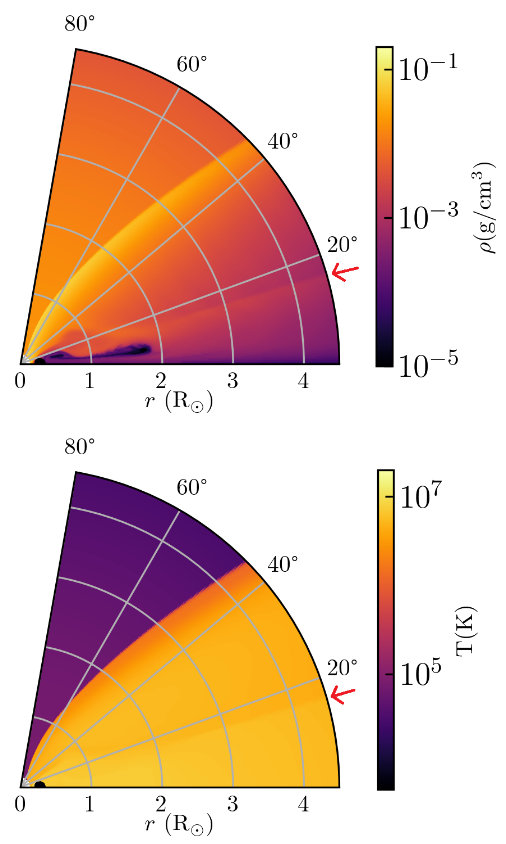
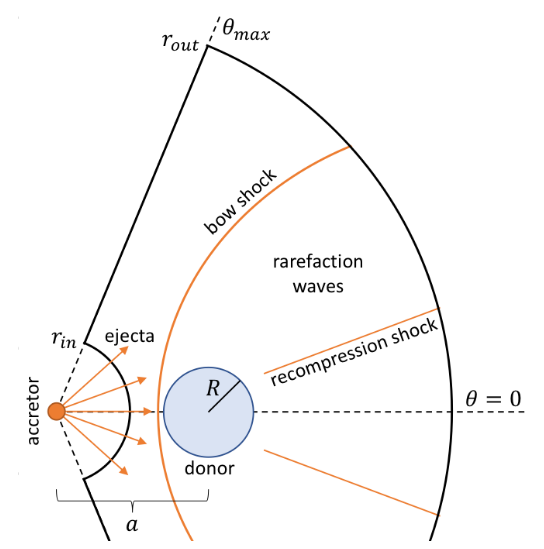
Since these explosions are incredibly powerful and would be difficult (and dangerous!) to perform in a lab, astronomers turn to computer simulations to model these events. Hydrodynamical simulations, in particular, are helpful for researchers because they model how fluids “flow” by solving complex equations that are too tricky to do by hand. (Remember that stars are just balls of gas, and hence fluid!) The authors of today’s paper ran hydrodynamical simulations of the explosion and subsequent evolution of the ejecta from a double-detonation scenario. In the diagram of their setup (see Fig. 1), you can see a “bow shock”. This shock is from the wave produced in the accretor’s detonation and is bowed since it bends around the donor star. This shock moves quickly through the cone of ejecta, modifies its structure, and leaves clues within the ejecta as it settles. After simulating 1000 seconds after the explosion, the authors recreated a high-density, low-temperature “wake” from the shock. You can see imprints of this wake in Fig. 2, as denoted by the red arrow.
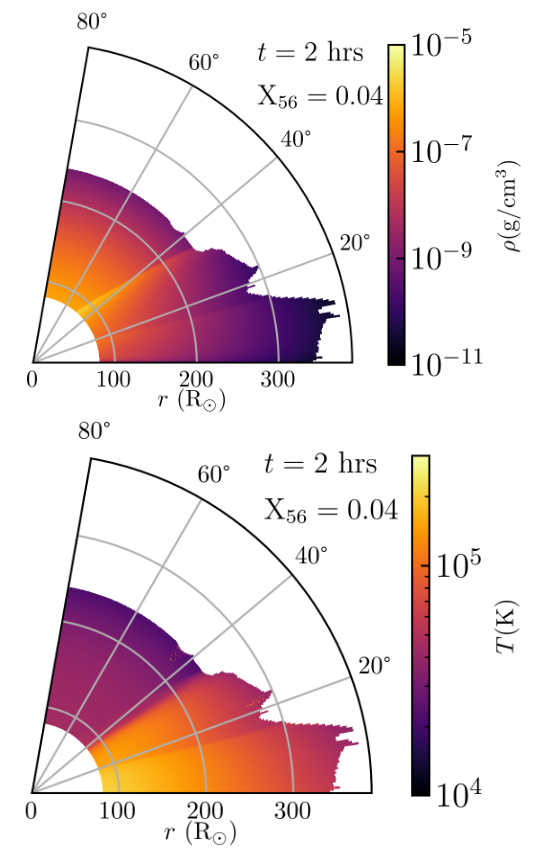
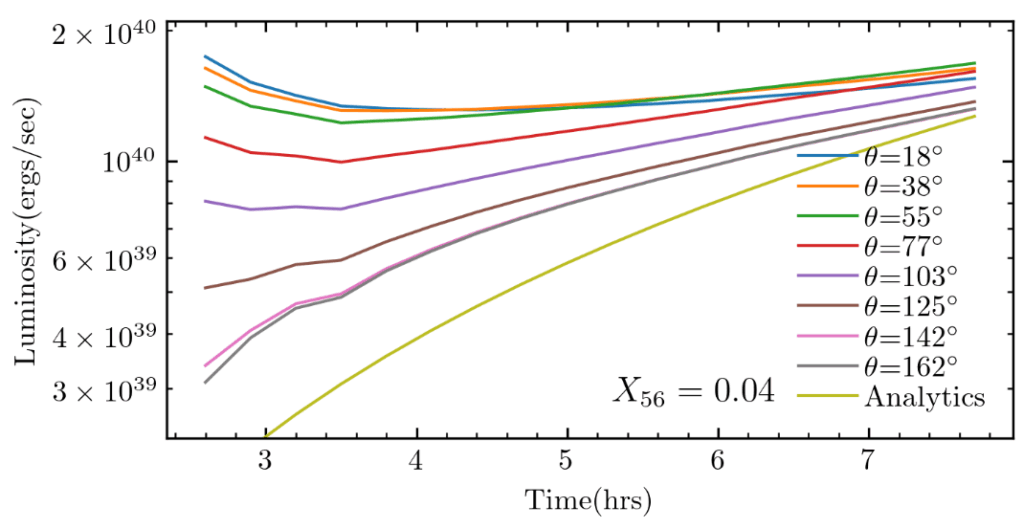
Once they were able to produce this wake, the authors evolved the ejecta over time to see what the radiation from this material might reveal. They discovered that the “shocked”, or compressed and heated, ejecta flew out much further than the unshocked ejecta (see Fig. 3). This ejecta can be seen from different viewing angles, influencing an observer’s measurement of the explosion’s luminosity. The strongest features of the wake are visible up to ~55 degrees, while some effects can still be seen up to ~140 degrees–almost half of the sky (see Fig. 4). Overall, an observer’s position relative to the explosion axis might change their reported luminosity of the explosion. The authors estimate that this wake might cause type 1a supernovae from a “double-detonation” scenario to appear up to 15% fainter, depending on the observer’s viewing angle. Therefore, if scientists use type Ia supernovae as cosmic distance indicators, their calibrations might be slightly off. This isn’t the best news for those using measurements of type Ia supernovae to measure the expansion rate of the Universe.
We’ve talked a lot about the accretor and ejecta in this scenario, but what might happen to the donor star? One idea is that the donor star is “kicked” away by the high velocity of the blast. In this simulation, the authors were able to calculate a “kick” velocity, or speed imparted by the blast to the donor star, that was much higher than estimates from other detonation models. One observed type Ia supernova, SN 2021aefx, is believed to have the fastest observed ejecta to date. The mechanism that today’s authors modeled might explain how the ejecta of this event got its super-fast “kick”.
While there is always more work to be done, this work presents a first step at identifying double detonation type Ia supernovae from early observations. With an influx of observations from new observatories, like the Vera C. Rubin Observatory, we should expect to see many more early supernova detections.
Astrobite edited by Ansh Gupta
Featured image credit: Mckenzie Ferrari (made in Canva)

Cool! Thanks for writing this. I’m a 15 year old girl fascinated with space, and I never understand those articles. Thank you for making science acessable.
Is there any explanation why the explosion generates such an asymmetric “conical wave” of expelled material? (I can imagine this happens along the poles of rotation, but then it would be unlikely to hit the donor, as the plane of the mutual orbits and the spins are usually somewhat aligned. Or am I mistaken in this assumption?)
Or is this cone an observational fact?
(Something completely different: I cannot see “Figure 3” in the article. Is this just me?)