
Title: Optical polarization properties of the closest tidal disruption event AT2023clx indicate origin from tidal stream shocks
Author(s): Karri I. I. Koljonen, Kari Nilsson, Ioannis Liodakis, Elina Lindfors
First Author’s Institution: Institutt for Fysikk, Norwegian University of Science and Technology, Høgskloreringen 5, Trondheim, 7491, Norway
Status: Published in MNRAS [open access]
Accretion from a TDE
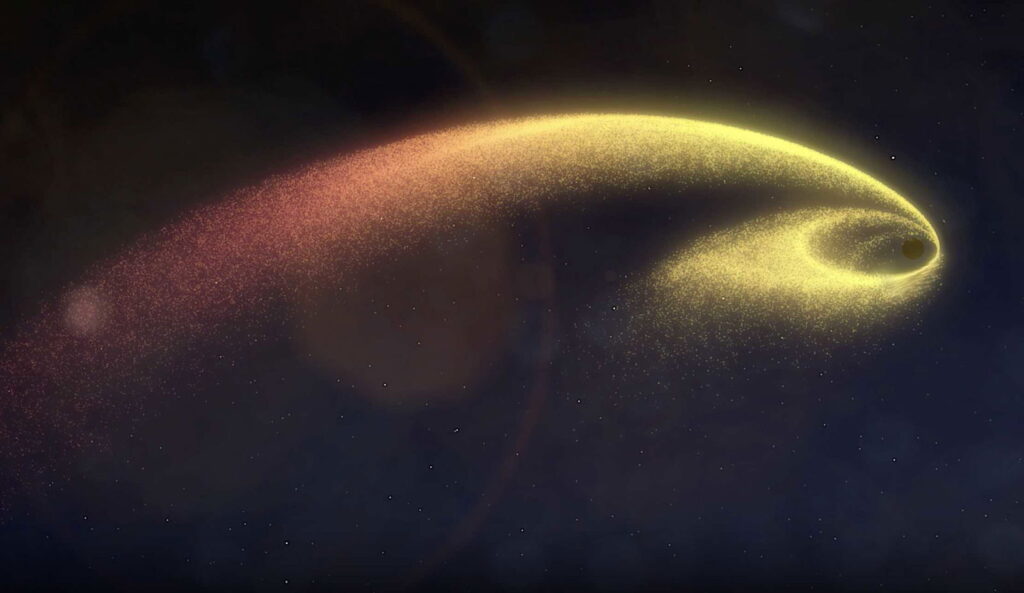
A tidal disruption event (TDE) occurs when a star is on a deadly plunge toward a massive black hole, eventually leading to the gravitational force from the black hole exceeding the star’s self-gravity holding it together. This tidal force results in the complete and extraordinary destruction of the star, observable via various methods across the multi-wavelength spectrum. When the star is disrupted, some of the material is energetically ejected away from the black hole into the “circumnuclear medium”–the region surrounding the black hole–and interacts with the ambient material there, creating shocks which we can observe in the radio. However, the other material remains bound to the black hole’s gravitational potential, forming ellipsoidal accretion streams (see the featured image of this bite). Over time, the stellar remains in these streams will collide with each other–also creating shocks–and introduce friction with one another that will enable the streams to settle down into an accretion disk around the black hole. Under these special conditions, the black hole’s consumption rate (mass accreted per time) can sometimes exceed a theoretical maximum value known as the Eddington Limit. (One should note that this doesn’t break any laws of physics and is actually expected; many simplifying assumptions enter into the calculation of this value that we know aren’t relevant for all black hole accretion scenarios!) Observing TDEs provides a unique opportunity to study some of the most extreme conditions in the universe and the phenomena associated with them, such as the launching of relativistic jets.
Polarization
In today’s bite, we’re focusing on a novel method of inferring properties about the emitting material in the TDE. Today’s authors observe one of the nearest TDEs known to date (48 mega-parsecs), called AT2023clx, using the Nordic Optical Telescope (NOT) to measure the light’s optical polarization properties. Since light is simply an electromagnetic wave, that wave can be oriented in different directions with respect to the observer. If the electric field oscillates in a single plane, the light is said to be linearly polarized. Circular polarization is also possible, in which the electric field traces a circle. If we mix both phenomena simultaneously, we might observe elliptical polarization. Observing polarization can be a handy tool for inferring the geometry of the process that created the light because it encodes information about the exact orientation of the electromagnetic wave–sometimes even the orientation as a function of time. However, this also means that observing polarization is uncommon, as most astrophysical objects emit unpolarized light due to the significant variation in the orientation. If this is confusing, check out the links above on polarization, which include many excellent diagrams and figures to visualize it!
The origin of optical light from a TDE
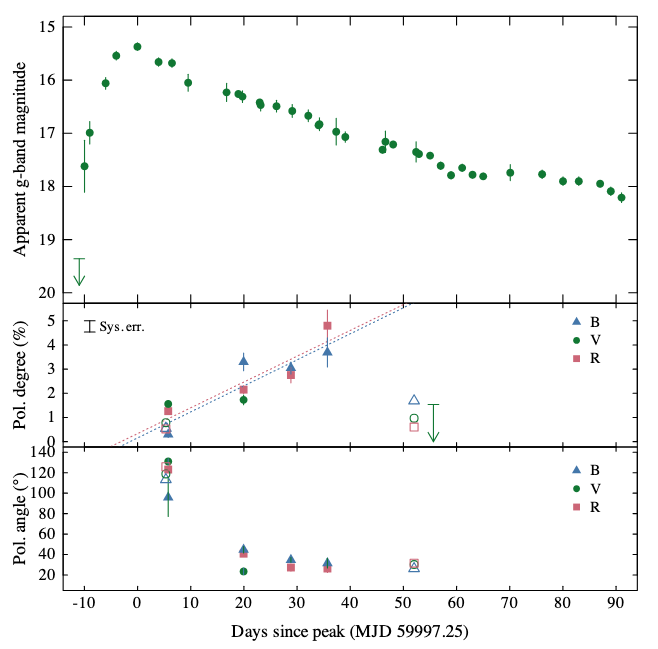
By observing the polarization of the TDE AT2023clx, today’s authors were able to infer the likely origin of the optical flare from this event. They observed the event four times with NOT and included a fifth observation collected with the Liverpool Telescope in their analysis. In the first observation at six days after the light curve’s peak, the linear polarization fraction–the fraction of linearly polarized light detected as a percentage of the total observed light–was approximately 1.5% with an angle of about 120 degrees in the V and R filters, with no detectable polarization in the B band. However, further observations–shown in Figure 1–displayed rapid convergence toward approximately 30 degrees and a linearly increasing polarization fraction with a growth rate of 0.11% per day, eventually reaching 5% in the R band in the fourth observation. The Liverpool Telescope later observed the source at 55 days, approximately three weeks after the final NOT observation, and found no detectable polarization in any filter band.
By observing these variable linear polarization signals, today’s authors compared their results with predictions from two primary classes of models for how optical emission might arise in a TDE. In the first scenario, the disrupted stellar material still bound to the massive black hole rapidly converges into an accretion disc whose temperature is so high that it emits X-rays. The other unbound material ejected during the disruption obscures those X-rays but gets heated by them, radiating in the optical, called reprocessing. In such models, the polarization degree is always less than 14% and shows minimal, slow variability in both degree and angle. In the second scenario, stellar tidal streams collide, producing shocks. These models predict much greater polarization degrees and variability on short timescales (days to weeks), much more closely aligned with the observations of AT2023clx and another TDE, AT2020mot, which had a very similar evolution of polarization fraction and angle to AT2023clx.
Higher-cadence multi-wavelength polarimetric observations are needed for more TDEs to determine the prevalence of optical polarization in TDEs. These observations–combined with advanced modeling–will enable us to understand the relative roles of tidal stream shocks and reprocessing in creating the observed signals.
Edited by Skylar Grayson
