
Authors: B. Dinçel, G. Paylı, S. K. Yerli, A. Ankay, R. Neuhäuser, M. Mugrauer, S. Sheth, S. Buder, S. Hüttel, F. Edelmann, K-U. Michel, J. Bätz
First Author’s Institution: Astrophysikalisches Institut und Universitäts-Sternwarte Jena, 07745 Jena, Germany
Status: Submitted to Astronomy & Astrophysics [open access]
Many massive stars spend their life coupled with another star in a binary system. Usually born together, they’ll go through the motions of stellar evolution side-by-side until eventually one of them departs in a supernova explosion. This explosion sends an expanding shell of once-starstuff out into the interstellar medium in a dynamic display called a supernova remnant (SNR) – visible as a beautiful nebula across the electromagnetic spectrum.
What happens to the original star after it’s exploded? The leftover neutron star or black hole will sometimes be shot out into the Milky Way with some velocity, sometimes even more than 1000 kilometres per second if the remnant is a neutron star! As these neutron stars zip through the galaxy, their winds interact with the surrounding gas to produce a bow-shocked pulsar wind nebula whose geometry reveals the motion of the neutron star. This helps astronomers figure out how fast they’re moving, where they’re going, and importantly: where they came from.
This explains the fate of the exploded star, but what about its star-crossed companion? When the more massive star in the binary undergoes a supernova and is ejected at hundreds of kilometres a second, the other star in the system no longer feels the gravitational pull that held it in the binary in the first place. Therefore, we expect it too should shoot off into the galaxy at a high velocity albeit lower than its exploded kin – it should now be moving at the speed that it held during its orbital dance. These high velocity stars are called ‘runaway’ stars, since they’re usually moving fast enough to shoot out of the Milky Way altogether, running away from the pain of the breakup (or in this case, the location of the supernova).
Knowing that each of the stars in the original binary system are shot off in a straight line at the time of the supernova begs the question of whether we can do some smart sleuthing to locate pairs of these runaway stars. That is exactly what today’s authors strive to do with the supernova remnant ‘Jellyfish Nebula’ IC 443 (Figure 1). For years now, astronomers have known of the ejected neutron star that was formed in this supernova, but the location of its past companion (if any) was unknown… until now! Let’s meet HD 254577…
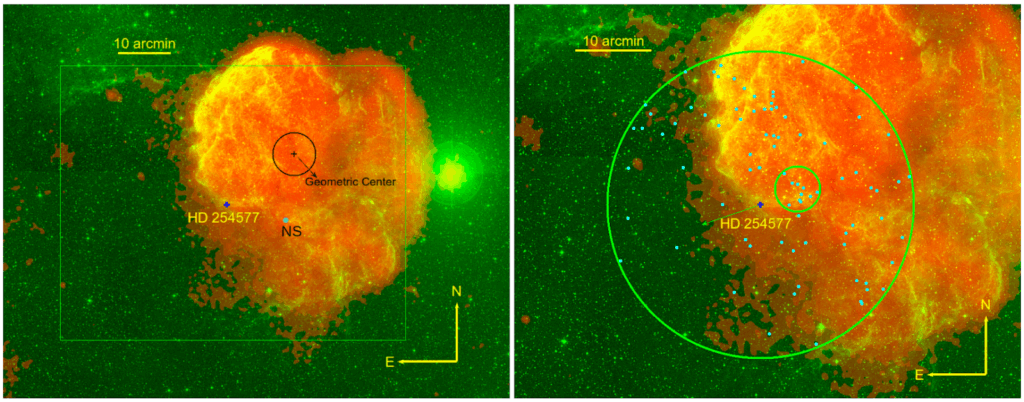
Figure 1: Each panel shows the supernova remnant IC 443 in optical light (green colour in the image) and in X-rays (red colour in the image). The left panel shows the geometric centre of the supernova remnant, along with the location of the neutron star that spawned it and the proposed once-binary companion HD 254577. The right panel shows the locations of other stars in the region enclosed by a 10 parsec wide circle – as well as a possible cluster of stars enclosed within a 1.5 parsec radius circle – that the original binary system may have belonged to. Source: Fig. 1 in today’s paper.
The authors identify HD 254577 as a runaway star with a velocity of just over 31 kilometres per second in the direction away from the supernova remnant. Given that the expanding supernova remnant is somewhere between 10 and 30 thousand years old, the authors trace the motion of the runaway and neutron stars back in time to find that their positions coincide at roughly the same time! As we see in Figure 2, this places their original position roughly within the possible cluster of stars (of 1.5 parsec radius) shown in Figure 1, and well within the broader possible-cluster within 10 parsec.
Associating our runaway pair as part of a cluster allows astronomers to learn a lot more about their past. Stars within clusters all tend to form at the same time and hence all have about the same age when we look at them today. With this in mind, today’s authors used isochrone fitting – a method of modelling the evolutionary track of clusters based on their age and metallicity – to determine the age of the parent star cluster that gave rise to the original binary. They find that the cluster is in the range of roughly 4 to 7 million years old, meaning that the original neutron star would have been between about 60 and 30 solar masses.
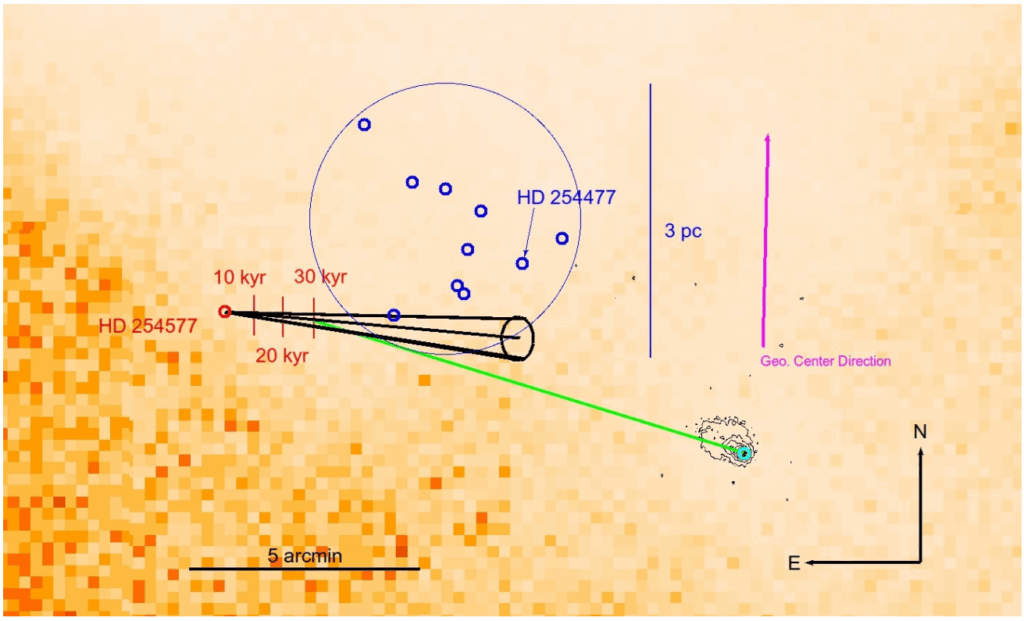
Figure 2: Tracing the motion of the runaway star HD 254577 and the neutron star (aqua circle) back in time shows that they match up roughly 10-30 thousand years ago. This shows that they were likely a part of a dense cluster of stars (dark blue circles) with a cluster radius of about 1.5 parsec (blue circle). The grey contours around the neutron star signify the X-ray emission of the bow shock, revealing the motion of the star. Source: Fig. 6 in today’s paper.
Modelling the histories of massive binary systems is crucial to understanding their role in our galaxy. Binary interactions can fundamentally change the course of a system, impacting the type of compact remnants they produce and where they end up, as well as the type of supernova that ejects them. The authors of today’s paper have achieved the rare feat of finding the once-companion of a neutron star and in the process have learned about the last days of their complicated relationship.
Astrobite edited by Annelia Anderson
Featured image credit: [Neutron star:] NOIRLab/NSF/AURA/J. da Silva/Spaceengine, [Blue giant star:] Baperookamo/Wikimedia Commons, [Background:] Dinçel et al, edited by R. White
