
Paper Title: Diagnosing interstellar magnetic turbulence with TeV pulsar halos
Authors: Chao-Ming Li, Ruo-Yu Liu, and Huirong Yan
First-author institution: Nanjing University, Nanjing 210023, China
Status: Published in Physical Review D [Closed Access]
The interstellar medium (ISM) is an oft-overlooked but essential piece to our understanding of the cosmos. A cocktail of ionic, atomic, and molecular gas; dust; cosmic rays; and radiation, the ISM fills the space between stars, forming stellar nurseries, creating reddening effects on observations, blowing bubbles, and much more. In addition to the existing matter and radiation, magnetic fields play an important role in ISM structure and evolution, but have historically been difficult to observe. Previous research searches for polarization from otherwise-unpolarized light sources to identify and quantify magnetic fields in the space between stars. The authors of today’s paper report a new method to search for magnetic field influence in pulsar halos.
Pulsar halos are the result of electrons (or positrons) diffusing into the ISM from the relatively compact, high-energy wind nebulae which surround pulsars. The high-energy relativistic electrons which escape these pulsar wind nebulae (PWN) interact with nearby, relatively-low-energy photons via inverse Compton scattering. The scattering interaction gives the photons a huge boost in energy, into the 1-100 teraelectronvolt (TeV) range (the very-high-energy gamma ray regime). These TeV gamma rays can then be observed from Earth with gamma-ray telescopes. So far, three pulsar haloes have been confirmed, with many more candidates popping up in gamma-ray surveys of the galactic plane.
Today’s authors make use of the observable morphology of these halos to probe the properties of the interstellar magnetic field they form in. Pulsar halos are extended, with a physical size of at least 20–30 pc, making it fairly simple to identify any asymmetries in their structure. On their own, PWNs emit relativistic electrons isotropically (equally in all directions), but when those electrons interact with the magnetic fields of the ISM, it can create observable asymmetries in the resulting halo. The observed spatial distribution of the electrons corresponds to the properties of the mean magnetic field. Namely, the direction relative to the line of sight, and the strength relative to the local magnetic turbulence (the chaotic, swirling magnetic fields that occur due to plasma motion) in the ISM. The former is just an angle (denoted Φ), and the latter is reflected in the Alfvénic Mach number (MA). In this case, if MA < 1, the local magnetic field has a preferential direction, and the relative strength of that mean field increases as MA decreases. Using a version of the diffusion-loss equation for electron diffusion in the presence of a magnetic field, today’s authors derive that an MA < 1 field like this causes the electrons form an ellipsoid-shaped halo, where the longest (“major”) axis points along the direction of the mean field. Figure 1 shows a diagram of how these properties relate to the observations taken from Earth.
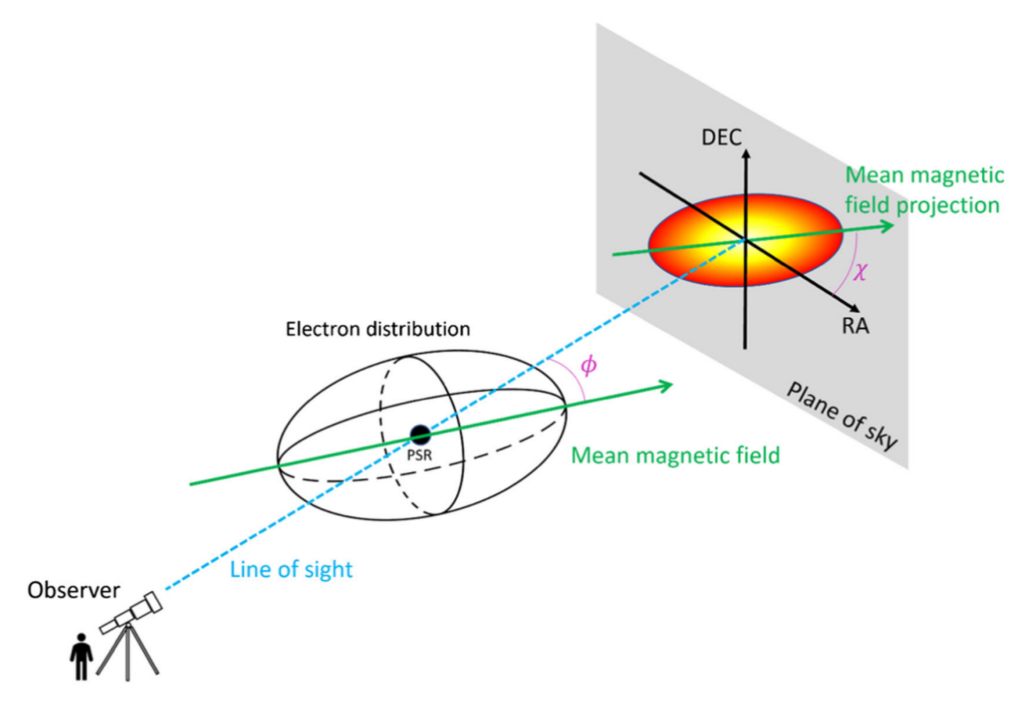
The important features obtained from the TeV observations are the lengths of the longest and shortest axes of the image. Today’s authors denote these as a and b, respectively, and describe them as the “typical length scales” of the source. Because astronomical observations are necessarily 2-dimensional, the 3D morphology of the halo is projected into 2D space. Importantly, this means that the image is not a perfect ellipse, and the ratio of a to b is not the same as the ratio of the major to minor axes in the 3D halo. Using coordinate transformations, and assuming the distance to the halo is significantly longer than typical length scales, today’s authors derive an analytical relationship between the observables, a and b, and the physical parameters, Φ and MA, of the halo:
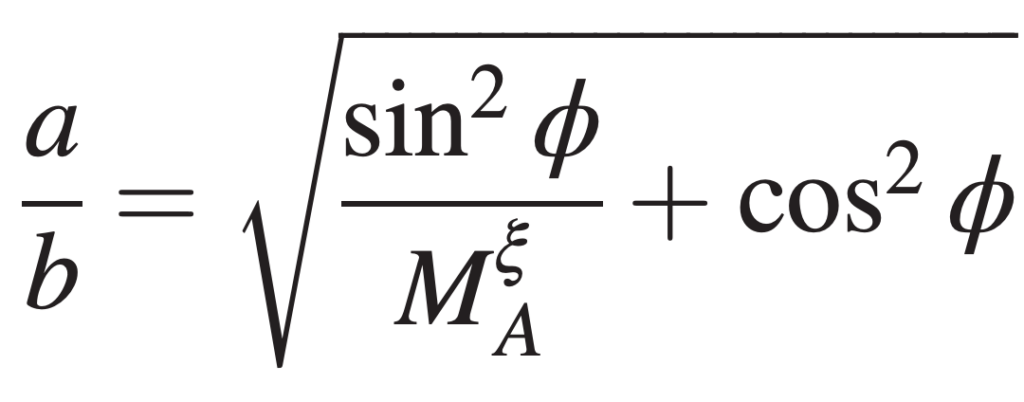
This result highlights a common issue with 2D observations of 3D sources. In the process of projecting from 3 to 2 dimensions, some information is necessarily lost. In this case, it is not possible to independently obtain Φ and MA by only measuring a and b. For example, a halo with Φ = 0 will always appear circular (a=b) regardless of the value of MA.
For future work, the authors focus on ways to break the degeneracy between Φ and MA. In particular, they highlight multi-wavelength observations, with particular focus on radio and x-ray emission. Radio polarization observations can be used to better quantify the contribution due to the turbulent magnetic field, giving insight into MA, in particular. Additionally, x-ray observations would allow researchers to measure the synchrotron emission (which, in this case, comes from the acceleration of the relativistic electrons in the magnetic field) from the halo. While inverse Compton emission is isotropic, the brightness of synchrotron emission will vary depending on the observing angle. The ratio of the fluxes of the inverse Compton and synchrotron emissions, therefore, could provide an independent constraint on Φ. The authors additionally highlight the potential utility of new observations of the numerous pulsar halo candidates in untangling this particular web.
Astrobite edited by: Veronika Dornan
Featured image credit: Figure 1 from today’s paper
