
The dynamics of three bodies under gravity is a notoriously chaotic problem – they don’t call it the ‘three body problem’ for nothing. For a certain configuration of these bodies, however, there exist 5 points in space where the three bodies can move in harmony. These points, where the gravitational forces balance out nicely, are called the Lagrange points.
Why are they and where are they?
Everything in space feels the gravitational influence of everything else, with nearby bodies exerting more force than those of comparable mass further away according to the equation for gravity. If there are two massive bodies in the same system, the forces can balance at some precise locations to yield an orbit for a third body that has the same period as the other masses in the system (provided the third body has comparably negligible mass to the two massive ones).
Three such points, now named L1, L2, and L3, were found by Leonhard Euler to lie along a line intersecting the two massive bodies (see Figure 1). For simplicity, let’s consider the Earth and the Sun, as well as a satellite orbiting with them. L1, lying between the Sun and Earth, is at a point where the gravitational force of the Earth somewhat counteracts that of the Sun. This means that a third body orbiting at L1 can have the same orbital period as Earth despite being deeper in the gravitational potential well of the Sun. Conversely, L2 is at a point where the potential of the Earth and Sun add together, and so a body orbiting the Sun at L2 can have the same orbital period as the Earth despite being further out of the solar potential well. This is true, too, for L3, which is an analogous but almost mirror image of L2.
Each of these three Lagrange points are unstable. This means that if an object laid perfectly on one of these points was slightly bumped off course, it would eventually find itself in a different orbit altogether. This is in contrast to the remaining two Lagrange points, L4 and L5, which are stable provided that the ratio of the masses of the two bodies are greater than about 25 (which is indeed the case for the Sun and each planet in the solar system – see this minutephysics video for more information). Provided this is true, bumping an object in L4 or L5 will make it oscillate around the Lagrange point rather than ejecting it entirely. These last two points each form an equilateral triangle with the two masses in the system at the prograde and retrograde vertices respectively (see Figure 1).
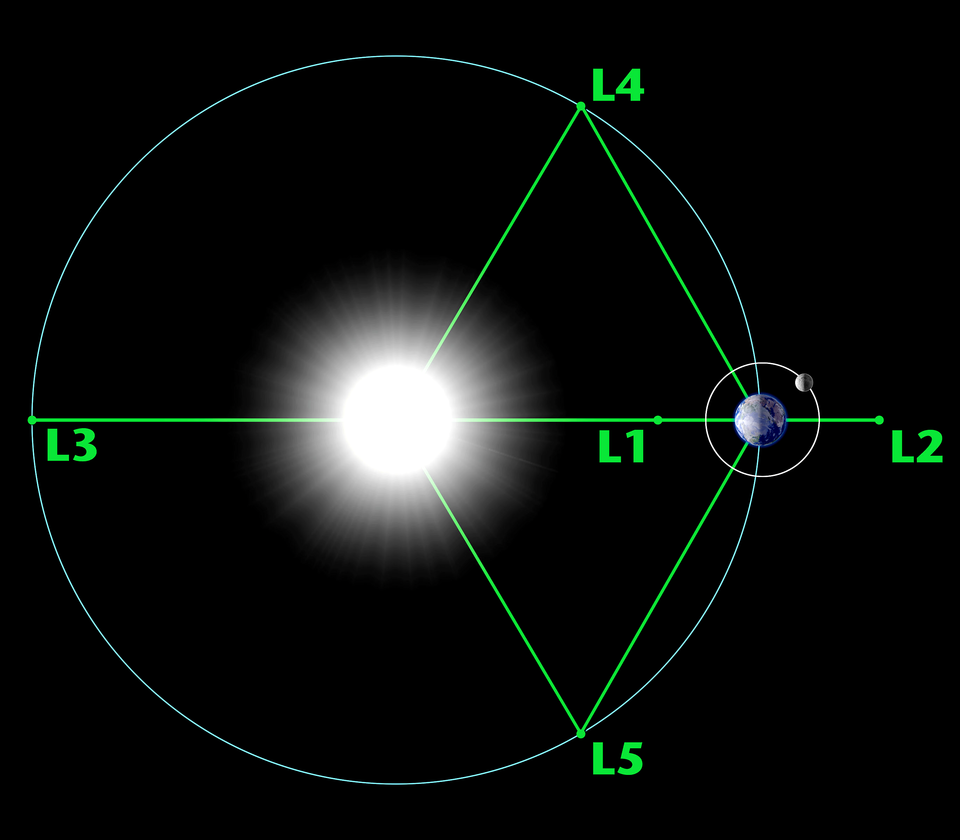
Figure 1: Shown here for the Sun and the Earth, for two massive bodies there exist 5 Lagrange points. At each of these, a third object can sit stationary relative to the other two while still orbiting the most massive body. In this configuration, the orbit of the Earth is in the counterclockwise direction. Image credit: NASA / WMAP Science Team, Wikimedia Commons
Lagrange Points for Satellites
There are a multitude of reasons to ‘park’ a satellite at an Earth-Sun Lagrange point. L1 in particular is very popular for Earth- and Sun-observation satellites alike; a satellite at L1 will constantly view the sunlit hemisphere of Earth (utilised by the Deep Space Climate Observatory, for example), and similarly will have an uninterrupted view of the Sun while keeping a consistent distance from the Earth (useful for e.g. the Solar and Heliospheric Observatory).
Similarly, many space observatories are sent to the Sun-Earth L2 point. Unlike the Hubble Space Telescope – which is in a low orbit around the Earth and must constantly avoid the sunlight and earthlight (reflected and emitted light from Earth) – the James Webb Space Telescope is in a solar orbit around L2. This is great for JWST, and indeed other infrared telescopes like the Herschel Space Observatory, so that it can be far enough away from Earth to avoid infrared contamination but also not so far away in its solar orbit so as to drift away from Earth over time. Orbiting in a Lissajous or halo orbit around L2 is particularly useful for these telescopes sensitive to thermal changes, like Euclid, as in these orbits they receive a stable flux from the Sun and never intercept the Earth’s shadow.
In contrast to the multitude of satellites at the unstable L1 and L2 points, there are no permanent man-made residents of the other Lagrange points. Parking a satellite at L3 would introduce a host of communication issues because of the intervening solar radiation. While some satellites have passed near to the stable L4 and L5 points in their journeys, as-of-yet there has been no pressing need to park permanent satellites there; each mission comes with a planned duration, and the fuel onboard on said satellites is usually ample enough to keep them around L1 and L2 well beyond the designed mission timeline (and the satellites are then closer to the Earth, too!).
Lagrange Points in Astrophysics
Aside from their applications to spaceflight, Lagrange points also have great significance in astrophysics. Perhaps the most widely known natural inhabitants of Lagrange points would be trojan asteroids (especially the Jupiter trojans). These are small rocky bodies that had found their way to the L4 and L5 points and were ‘captured’ in a stable orbit there. The origin of Jupiter’s trojans in particular is a debated process, though it has a uniquely large number of trojan bodies that orbit along with it around the Sun – likely over a million asteroids with a diameter larger than 1km! Theories for how they accumulated in the stable Lagrange points range from co-formation with Jupiter to capture as Jupiter may have migrated in the early solar system.
Outside of our solar system, one particular Lagrange point has a particular relevance to mass transfer between stars. In a binary system, one star will usually evolve faster than the other (in particular, the more massive star in the binary). As this happens, its radius balloons and, depending on the configuration of the system, it may begin to fill its Roche lobe. Once it expands past it, mass from the evolved ‘donor’ star will flow through the inner L1 point towards the less evolved ‘accretor’ star. The ins-and-outs of this process has been covered in a recent astrobite, and mass transfer is one of the most important concepts in stellar astrophysics and evolution.
To the point…
Orbital mechanics is at the centre of many areas of astrophysics, from human spaceflight all the way up to stellar and galactic evolution. There is plenty more to know about the intricacies of Lagrange points, especially the orbits that natural and artificial bodies alike have around them, but we hope this has been an interesting introduction to these astrophysical islands of stability.
Astrobite edited by Brandon Pries
Featured Image credit: Wikimedia user Xander89, Wikimedia Commons
