
Title: Binary mass transfer in 3D — Mass Transfer Rate and Morphology
Author(s): T. Ryu, R. Sari, S. E. de Mink, O. David, R. Valli, J.-Z. Ma, S. Justham, R. Pakmor, H. Ritter
First Author’s Institution: Max-Planck-Institut für Astrophysik, Karl-Schwarzschild-Str. 1, Garching, 85748, Germany
Status: Submitted to Astronomy & Astrophysics [open access]
Binary stars are ubiquitous, accounting for a significant fraction of all stars (estimates vary between one and two-thirds of stars in the Milky Way). The advanced evolution of “close” (small separations and short periods) binary systems leads to some of the most pervasive events, such as Type Ia supernovae, as well as the rarest and most exotic, like binary neutron star mergers. The life of a binary is defined by two key parameters: its orbital separation and the mass ratio of one star to the other. If the two stars are close enough when one of them begins to exit the stellar main sequence and expands to have a radius many times its original size, the second star may capture some of the primary’s envelope once it fills the Roche lobe.
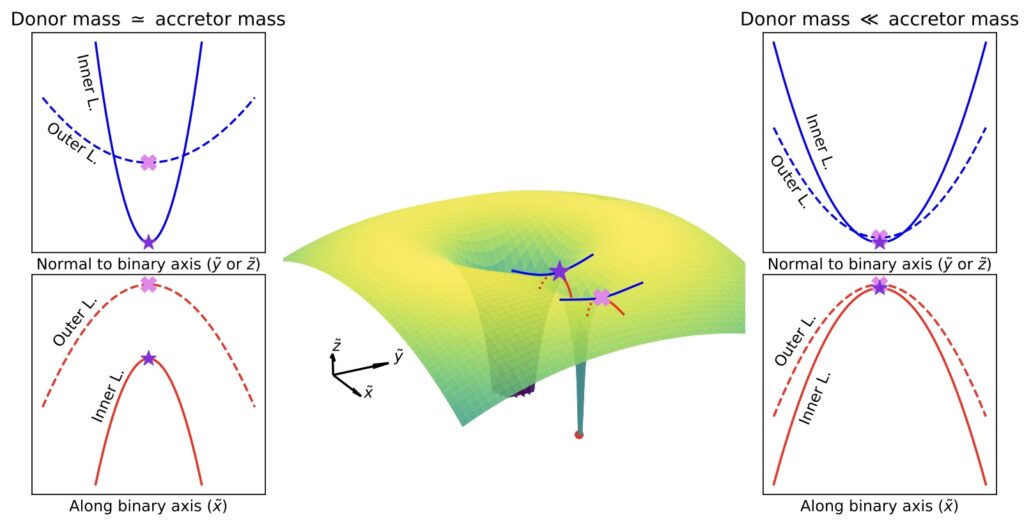
Mass transfer is caused by the evolution of one star, resulting in material from one star (called the donor) crossing over to the other star (called the accretor), and will significantly change how each star continues to evolve due to the loss (or gain) of additional mass. The first two Lagrange points–where the gravitational force from each star is equal–set the closest point (in between the binary) and the furthest point (on the opposite side of the donor) where material from the donor can flow to the accretor as its gravity begins to dominate. The field is illustrated in Figure 1 alongside these critical points. In today’s paper, the authors investigate how this material–called the accretion stream–flows from one star to another using 3D hydrodynamical modeling.
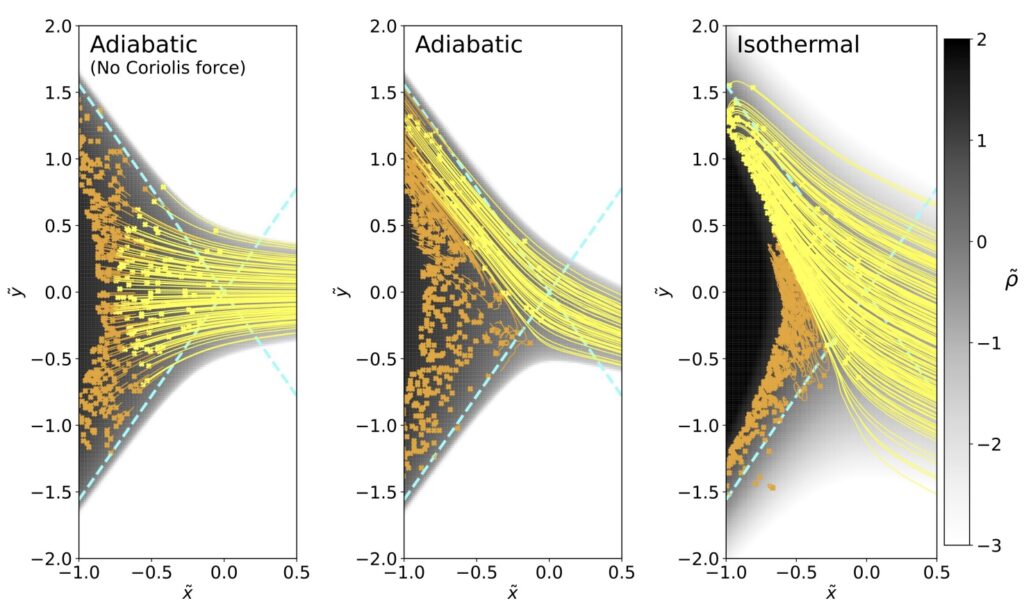
Our understanding of the evolution of binary stars has historically relied on assumptions about how quickly mass transfer occurs using simple analytic treatments of the accretion stream morphology. These methods usually ignore the Coriolis force, a “fictitious” force, like the centrifugal force, that results from the orbit of the two stars around each other. A 3D hydrodynamic simulation has the natural benefit of easily integrating this force into the model, as shown in Figure 2 under two different assumptions about the donor star’s atmosphere: adiabatic, which allows the temperature to vary with depth into the star, vs. a uniform temperature. The authors of today’s paper cleverly create animated versions of this figure in a library of online videos that show how the stream morphology changes with the ratio of the donor and accretor star masses.
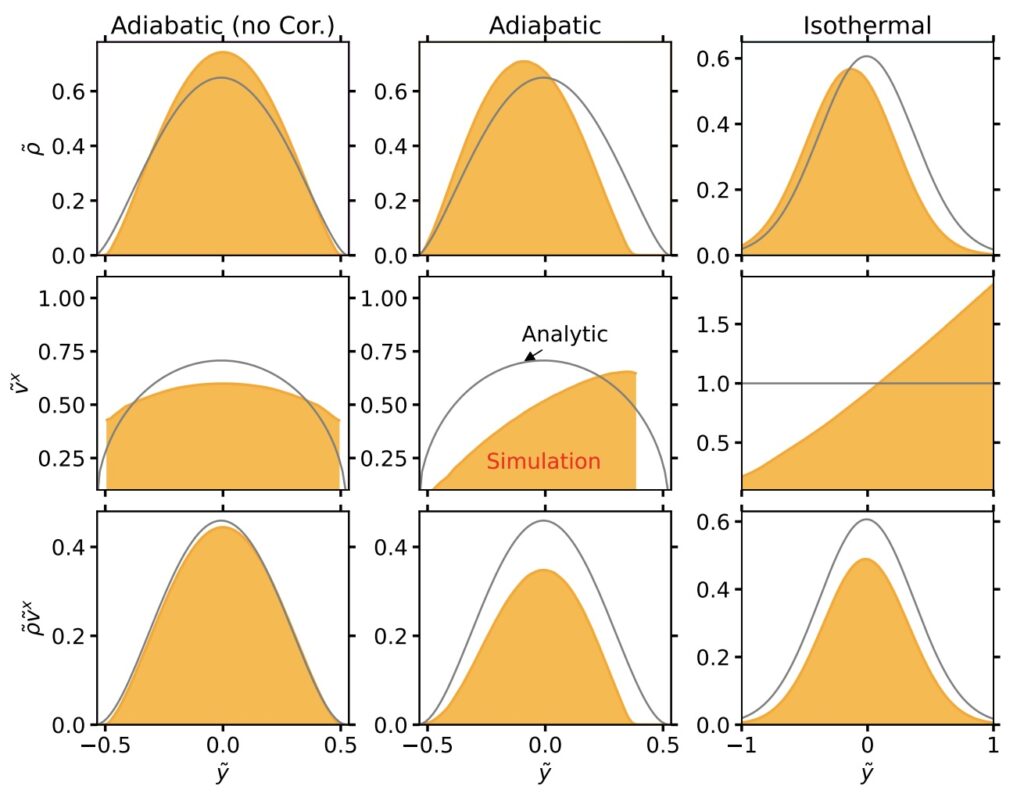
The authors of today’s paper then investigate how their predictions about the accretion stream morphology differ from those of the analytic models. In Figure 3, slices through the “vertical” axis of the accretion stream (the x-axis here is equal to the y-axis in Figure 2) are compared to the analytic models. Although most properties only show minor corrections, the velocity of the accretion stream (middle row) has a much different shape and is generally lower when accounting for the Coriolis force. This lagged shape causes the “sonic surface”–the location where the material exceeds the local speed of sound as it flows toward the accretor (Mach 1, or y=1 on the middle row)–to be an asymmetric, concave surface. Using these results, the authors of today’s paper propose some corrections to the analytic models to facilitate ease of use with existing stellar evolution simulation tools, such as MESA. Future work will be necessary to investigate whether these corrections improve the reliability of these models compared to real stellar populations.
Edited by Drew Lapeer
