
Title: The X-Ray Dot: Exotic Dust or a Late-Stage Little Red Dot?
Authors: Raphael E. Hviding, Anna de Graaff, Hanpu Liu (刘翰溥) , Andy D. Goulding ,Yilun Ma (马逸伦), Jenny E. Greene, Leindert A. Boogaard, Andrew J. Bunker, Nikko J. Cleri, Marijn Franx, Michaela Hirschmann, Joel Leja, Rohan P. Naidu, Jorryt Matthee, David J. Setton, Hannah Übler, Giacomo Venturi, and Bingjie Wang (王冰洁)
First Author’s Institution: Max-Planck-Institut für Astronomie, Königstuhl 17, D-69117 Heidelberg, Germany
Status: Submitted to the Astrophysical Journal Letters [open access]. Available on arXiv.
What are Little Red Dots?
One of the most intriguing results produced by James Webb Space Telescope (JWST) was the serendipitous discovery of a new class of object: “Little Red Dots” (LRDs). These objects started popping up everywhere in our early-Universe observations. Surprisingly, they look like compact (little) red dots in imaging data (astronomers are an incredibly creative bunch). The number of LRDs we observe drops drastically at redshifts less than about 4 (about 9 billion years ago), implying that LRDs are likely evolving into something else entirely. The luminous, compact nature of LRDs, paired with their disappearance from the cosmic stage has continuously puzzled astronomers in recent years.
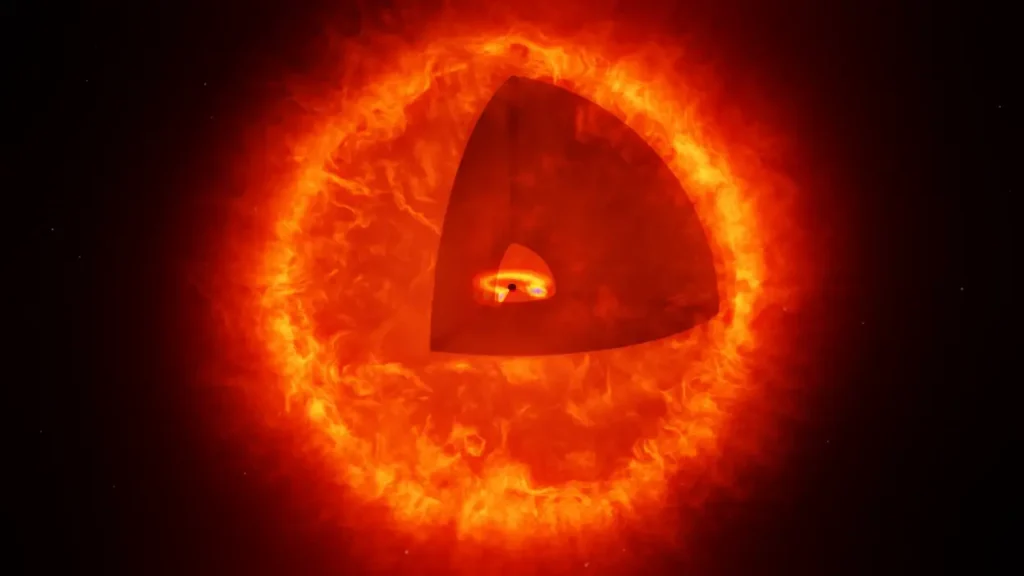
At least part of the LRD population has routinely been explained as a new class of Active Galactic Nuclei (AGN) . AGN are the central engines of many galaxies – luminous regions powered by actively accreting supermassive black holes (SMBHs). Recent evidence has increasingly pointed towards LRDs being a new class of AGN –black hole stars, or SMBHs surrounded by dense cocoons of gas. Figure 1 shows an artist’s impression of such a system. Naturally, this raises questions surrounding the placement of LRDs in our understanding of SMBH, and thus galaxy, evolution across cosmic time.
A hallmark of typical AGN is their X-ray brightness. X-rays are the most energetic of the bunch when it comes to electromagnetic radiation, and are primarily produced by the most extreme astrophysical situations (think neutron star mergers). One of the key challenges in explaining the nature of LRDs has been their lack of X-ray emission. Their lack of emission in this regime is a piece of evidence pointing towards a black hole star scenario – dense gas can block the X-rays being produced by the SMBH. However, the lack of LRDs in the present-day Universe implies that they likely shed their cocoons at some point. Catching a LRD in the act of shedding its cocoon would thus provide an important piece of evidence surrounding their nature and evolution. Thankfully, today’s authors may have done exactly that! Dubbed the “X-Ray Dot” (XRD), they report the discovery of a LRD-like object which is also X-ray luminous at a redshift of approximately 3.28.
New JWST Observations of the XRD
While archival observations of the XRD with the Hubble Space Telescope (HST), Canada France Hawaii Telescope, Spitzer Space Telescope, and Chandra X-ray Observatory existed, new spectral data from the James Webb Space Telescope was needed to study the system in depth. Spectral data has a huge advantage over photometric observations when it comes to modeling the system. With a good quality spectrum, astronomers can use sophisticated modeling tools to try and pin down the physical nature of the emission we’re observing, and thus understand its intrinsic nature.
Figure 2 showcases the archival data from HST, Spitzer, and Chandra, along with the XRD’s spectrum from JWST (black curve, bottom panel). Photometric observations of the source indicate that it is incredibly compact (radius 250 pc, about 100 times more compact than the Milky Way), and shows similarities to LRD spectra, but with some key differences (an example LRD spectrum is shown as the red curve in Figure 2). The impressive X-ray luminosity of the XRD – typical of standard AGN – is another key difference between it and standard LRDs.

So…what’s the deal with XRD?
To understand the nature of the XRD, authors fit a variety of models describing a wide range of physical systems to the available data. Surprisingly, their best-fit models indicate that, if the XRD is simply a typical AGN heavily obscured by astrophysical dust, its dust properties vary drastically from typical galaxies and AGN. Instead, trying to explain the system as an AGN embedded in a cocoon of gas (the black hole star model) provides better results(more aligned with observed LRDs), but still isn’t perfect.
Notably, the emission in the ultraviolet-to-optical regime of the electromagnetic spectrum differs greatly from that of LRDs. In LRDs, this emission is indicative of a single dense gas component around the SMBH, while in the XRD the authors find evidence suggestive of a patchier, less uniform distribution of gas. However, in order for this explanation to match the data, physical conditions of the model must be finely tuned, suggesting that this model may need to be further refined. These factors seem to suggest that the XRD is poorly understood in the context of our current paradigm of models describing AGN and LRDs. The potentially patchy nature of the XRD’s gas envelope could suggest that this object is a LRD in the process of shedding its outer envelope, evolving into a typical AGN.
Regardless of its true nature, the XRD opens up new doors in our understanding of AGN and LRDs. It provides an exciting glimpse at AGN evolution in action – a transitional fossil for early-Universe black holes. With a new piece of the puzzle slotted into our picture of AGN evolution, it’s only a matter of time before astronomers fully contextualize the stubbornly enigmatic LRDs.
Astrobite edited by Ansh R. Gupta
Featured image credit: Authors of today’s paper (Raphael E. Hviding et al.)
