
Title: MAGAZ3NE: Dust Deficiency in Ultramassive Quiescent Galaxies at 3 < z < 4 with ALMA Observations
Authors: Wenjun Chang, Gillian Wilson, Ben Forrest, Ian McConachie, Allison Noble, Adam Muzzin, Danilo Marchesini, M. C. Cooper, Tracy Webb, Gabriela Canalizo, Percy Gomez, Yongda Zhu, Adit Harin Edward, Han Lei, Aurelien Henry, Stephanie M. Urbano Stawinski, and M.E. Wisz
First Author’s Institution: Department of Physics and Astronomy, University of California, Riverside, 900 University Avenue, Riverside, CA 92521, USA
Status: Submitted to ApJ [open access]
Distant galaxies offer a unique window into how stars, gas, and dust evolve over cosmic time. Tracing this evolution requires understanding not only how galaxies form, but also how and when they stop forming stars, a process known as quenching. Understanding how, when, and why galaxies quench is a fundamental question in astrophysics, and one that requires observations of star-forming, quenching, and fully quenched galaxies alike. Unfortunately, one complication is that identifying truly quenched galaxies is challenging: galaxies that appear “dead” may instead be actively forming stars, hidden behind a thick veil of dust.
In today’s paper, the authors use observations from the Atacama Large Millimetre/submillimetre Array (ALMA) to investigate five ultramassive galaxies (UMGs) at redshifts, z, between 3 and 4, asking a deceptively simple question: are these massive red galaxies genuinely quenched, or are they secretly forming stars behind the scenes?
Meet the Suspects: Ultramassive Galaxies at the Edge of Cosmic Noon
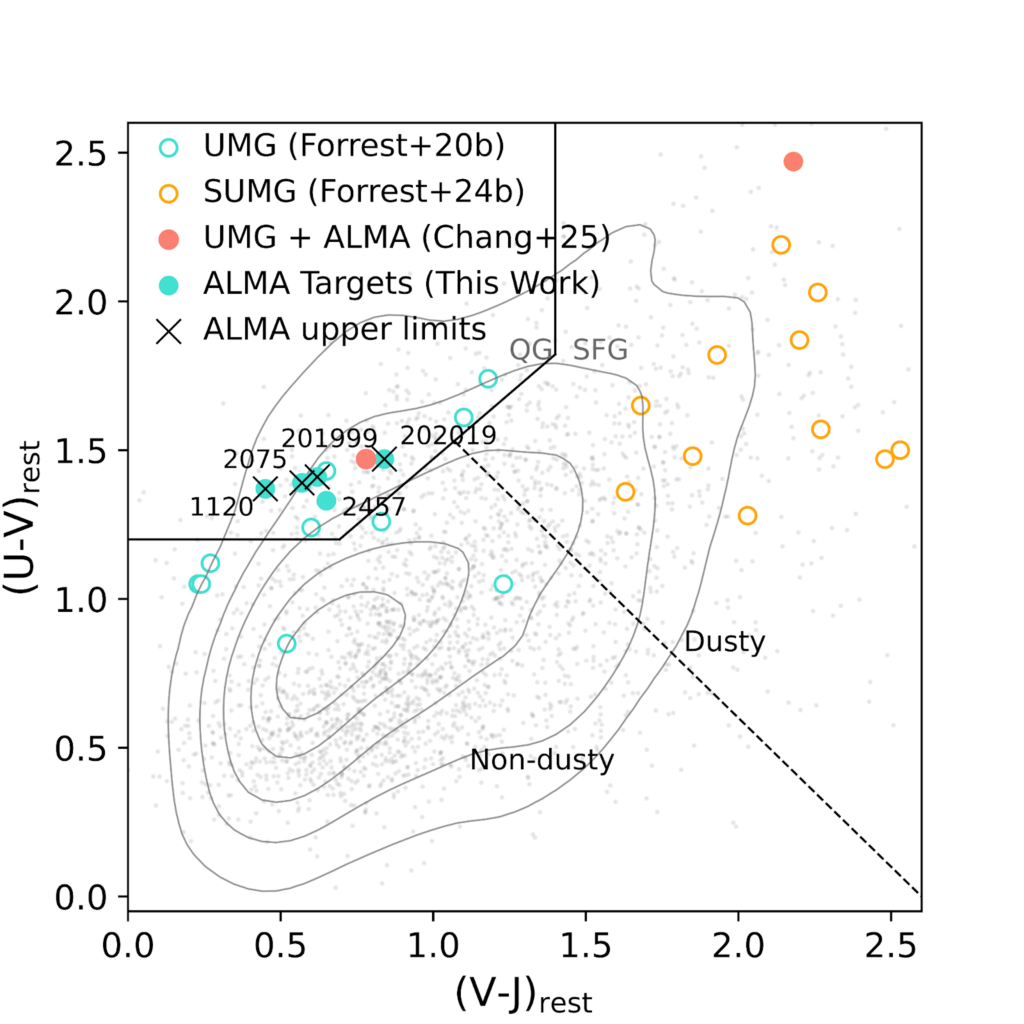
The five galaxies in this study are drawn from the Massive Ancient Galaxies at z > 3 NEar-infrared (MAGAZ3NE) survey, which targets some of the most massive galaxies known at early cosmic times. All five have stellar masses exceeding 100 billion Suns and have been confirmed at z > 3. At these redshifts, we are observing the galaxies as they were when the Universe was less than 2 billion years old. This is just before an epoch known as Cosmic Noon, when star formation across the Universe reached its peak.
These galaxies also benefit from extensive multiwavelength observations from a range of observatories, including the VISTA ground-based telescope and the Spitzer Space Telescope. By combining imaging across wavelengths from the ultraviolet (UV) to the near-infrared (NIR), astronomers can measure the “colours” of galaxies and use them to infer their star-forming activity.
Galaxies that have quenched their star formation are dominated by older stellar populations, which makes them appear red (hence why they are often referred to as ‘red and dead’ galaxies). However, dust can redden galaxies in a similar way by absorbing blue light and re-emitting it at longer wavelengths — meaning that a dusty, star-forming galaxy can easily masquerade as a quenched one. To uncover any hidden star formation, the authors turn to ALMA to search for far-infrared dust emission.
ALMA on the Scene
ALMA observes light at sub-millimetre wavelengths, which at these redshifts traces emission from star-forming regions that are obscured by dust. Of the five UMGs in this sample, only one is detected with ALMA. Even when the remaining four galaxies are stacked together, no dust emission is recovered, indicating that if any dust is present, it must be extremely faint.
To better quantify what these ALMA non-detections imply, the authors perform spectral energy distribution (SED) fitting (see a recent overview bite on SED fitting here) using CIGALE, a code that enforces energy balance between absorbed starlight and dust emission to estimate physical properties such as a galaxy’s star formation rate and dust content. With the ALMA constraints included, all five galaxies are found to lie more than 10 times below the star-forming main sequence. Even the single ALMA-detected galaxy remains formally quenched, showing only weak residual star formation.
In other words, these galaxies really are dead (or at least extremely dormant).
Extremely Dust-Poor Galaxies
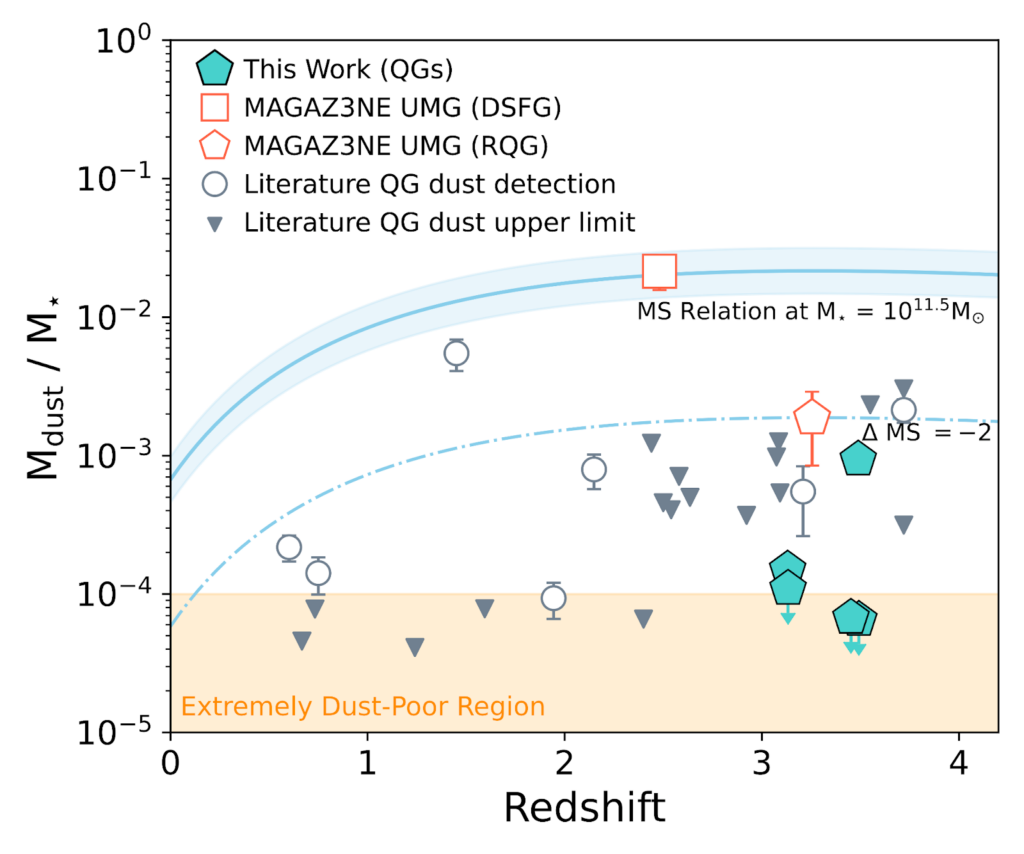
The SED fitting also allows the authors to measure how much dust these galaxies contain relative to their stellar mass. This dust-to-stellar mass ratio provides a simple but powerful way to assess how much interstellar material remains in a galaxy — and therefore how much fuel is left for future star formation.
Three of the five UMGs have dust-to-stellar mass ratios of Mdust/Mstar<10-4 (Figure 2), placing them among the most dust-poor quenched galaxies confirmed at z > 3. The lone galaxy detected by ALMA contains slightly more dust, with Mdust/Mstar10-3, but even this is far below what would be expected for an actively star-forming galaxy. For comparison, typical star-forming galaxies at similar stellar masses host >100 times more dust.
These results raise important questions about how galaxies can become ultramassive, quenched, and nearly dust-free within the first two billion years of cosmic history.
For now, ALMA has delivered a clear answer to the question of “dead or in disguise?”: at least some candidate UMGs in the early Universe really are quenched, and they are strikingly dust-poor. By ruling out the dusty impostor scenario, this study shows that deep ALMA observations can cleanly distinguish genuinely quenched galaxies from dusty star-forming ones, even at the highest stellar masses and earliest cosmic times. How these galaxies lost their dust remains an open question, but one thing is clear: by the time Cosmic Noon arrived, some galaxies had already finished forming stars and quietly faded into dormancy.
Astrobite edited by Viviana Cáceres
Featured image credit: ESO, APEX (MPIfR/ESO/OSO), A. Weiss et al., NASA Spitzer Science Center
