Title: High Efficiency UV/Optical/NIR Detectors for Large Aperture Telescopes and UV Explorer Missions: Development of and Field Observations with Delta-doped Arrays
Authors: S. Nikzad, A. Jewell, M. Hoenk, T. Jones, J. Hennessy, T. Goodsall, A. Carver, C. Shapiro, S. Cheng, E. Hamden, G. Kyne, D. C. Martin, D. Schiminovich, P. Scowen, K. France, S. McCandliss, R. Lupu
First Author’s Institution: Jet Propulsion Laboratory, California Institute of Technology, Pasadena, California, United States
Status: Published in the the Journal of Astronomical Telescopes, Instruments, and Systems [closed access]
Ultraviolet astronomy is hard.
We can learn a lot about the universe through ultraviolet light (light with wavelength between 100–400 nanometers, just shorter than what we can see with our eyes). Many fascinating objects and poorly understood phenomena, such as massive metal-poor stars, hot gas in the interstellar medium, and explosions like kilonovae or supernovae, emit copious amounts of ultraviolet light. However, detecting this light is quite the challenge. First of all, our atmosphere absorbs any light with wavelength less than 300 nanometers. So to detect much ultraviolet light, you have to put your telescope above the atmosphere, using a satellite, high-altitude balloon, or sounding rocket. The challenge doesn’t stop there: even if you can collect ultraviolet light with your telescope, it’s very difficult to actually detect the ultraviolet photons. Today’s paper describes technological advances that have made it possible to measure ultraviolet light using the same advanced detectors that we use for visible light, with some modifications.
How do we usually detect photons?
Astronomers typically detect visible light by exploiting the photoelectric effect, whereby a photon carrying enough energy knocks an electron out of the atom it’s bound to. In some materials, called semiconductors, when the electron is knocked out of its atom, it becomes free to wander the material or to be pushed along by electric fields. The most common detector used in astronomy, the charge-coupled device (CCD), is a hunk of semiconductor (most frequently silicon) split into many pixels. Each photon collected from the cosmos can interact with a semiconductor atom in a CCD to create a wandering electron. The CCD is designed to carefully shape the electric field in each pixel, so that all wandering electrons generated in one pixel collect in the same place. After an astronomer finishes an observation, the collected charges get measured to reconstruct an image—see this Astrobite for more about how that happens.
What goes wrong with ultraviolet photons?
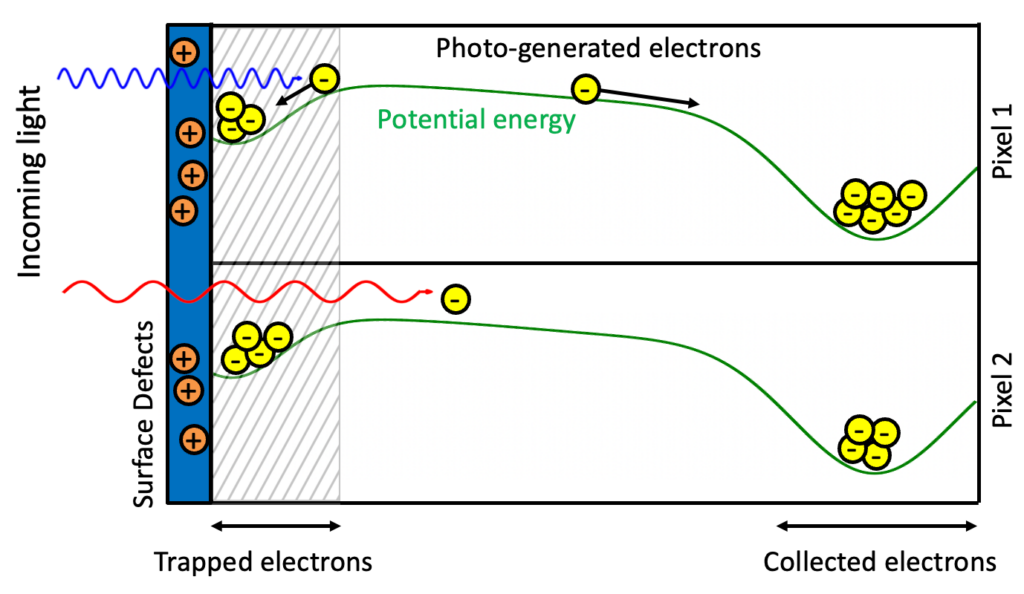
No matter how well-made a CCD is, it will always have some defects near its surface. For example, some silicon atoms near the surface will be missing one of the four bonds they desire. These lonely silicon atoms desperately want another electron to hold their hand, so they grab any nearby photo-generated electrons they can find, trapping them and keeping them from being properly collected. This is a huge problem when you’re trying to detect ultraviolet light. Ultraviolet photons don’t penetrate very far in silicon. Instead, they interact with silicon atoms very close to the surface, creating wandering electrons that are likely to get yanked back by the surface defects (see Figure 1). For this reason, conventional CCDs are bad at detecting light with wavelength less than 350 nanometers.
What is delta-doping?
The authors of today’s paper pioneered a technique called delta-doping to modify the detector surface and push all electrons to the correct location. In the context of semiconductor manufacturing, “doping” refers to implanting atoms with different properties into the semiconductor’s crystal structure. Adding dopant atoms like phosphorus and boron to a silicon crystal is the key to the transistors that power all modern digital electronics. In the case of delta-doping, an incredibly thin layer of boron atoms is added to the silicon surface using a process called molecular beam epitaxy. The process is called “delta-doping” because if you plot the concentration of boron atoms versus the depth below the surface, the profile looks like a delta function. These boron atoms have one fewer electron than silicon, so, like the defects where a silicon atom is missing a bond, they try to grab a final electron to fill their valence shell. Unlike the fickle surface defects, however, each boron atom forms a stable partnership with its electron: they mate for life (or at least for a very long time). As soon as the delta-doping layer is added, the boron atoms grab electrons from the surrounding neutral silicon, creating a negatively charged sheet right at the detector surface. Photo-generated electrons are repelled by this sheet and away from any surface defects. Now you can reliably detect ultraviolet photons!
What’s next for ultraviolet astronomy?
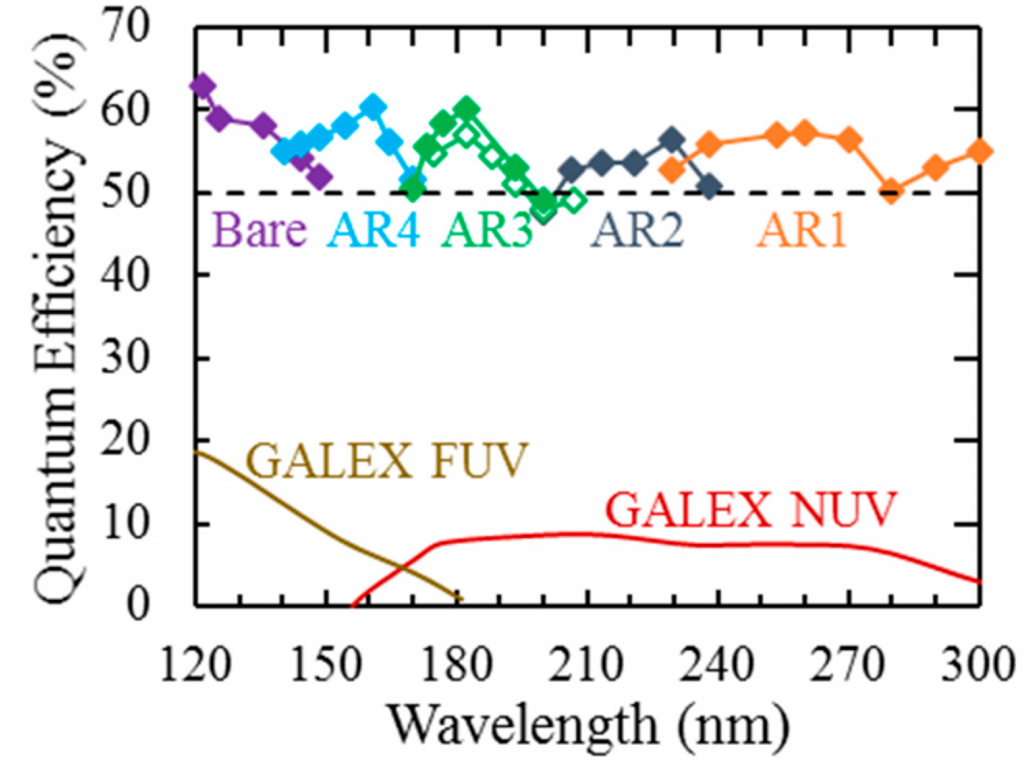
Delta-doping has actually been around for a few decades, although the authors have been continually refining the process. Their paper also describes advances in detector coatings to prevent ultraviolet light from reflecting off the surface of silicon and filters to prevent any visible light from leaking through in ultraviolet-specific observations. Figure 2 shows how much better delta-doped CCDs with these anti-reflective (AR) coatings are at detecting ultraviolet light than previous detectors, like those used for the GALEX space telescope. These advances have enabled many current and upcoming ultraviolet astronomy missions, such as the FIREBALL balloon and the UVEX satellite. If the Habitable Worlds Observatory (NASA’s planned flagship mission focused on ultraviolet, optical, and infrared characterization of exoplanets) comes to be, then it too will rely on delta-doping and specialized AR coatings to detect ultraviolet photons. While the Olympics are going to great lengths to eliminate doping, astronomers are happy to do whatever they can to juice up their detectors!
Astrobite edited by Evan Nelles Henderson and Ansh Gupta