Title: Impact of merger histories on the timing argument estimate of the Local Group mass
Authors: Istiak Akib, François Hammer, Yanbin Yang
First Author’s Institution: Observatoire de Paris, Université PSL, CNRS, Place Jules Janssen 92195, Meudon, France
Status: Published in A&A [open access] , available on arXiv
Long live the two body problem?
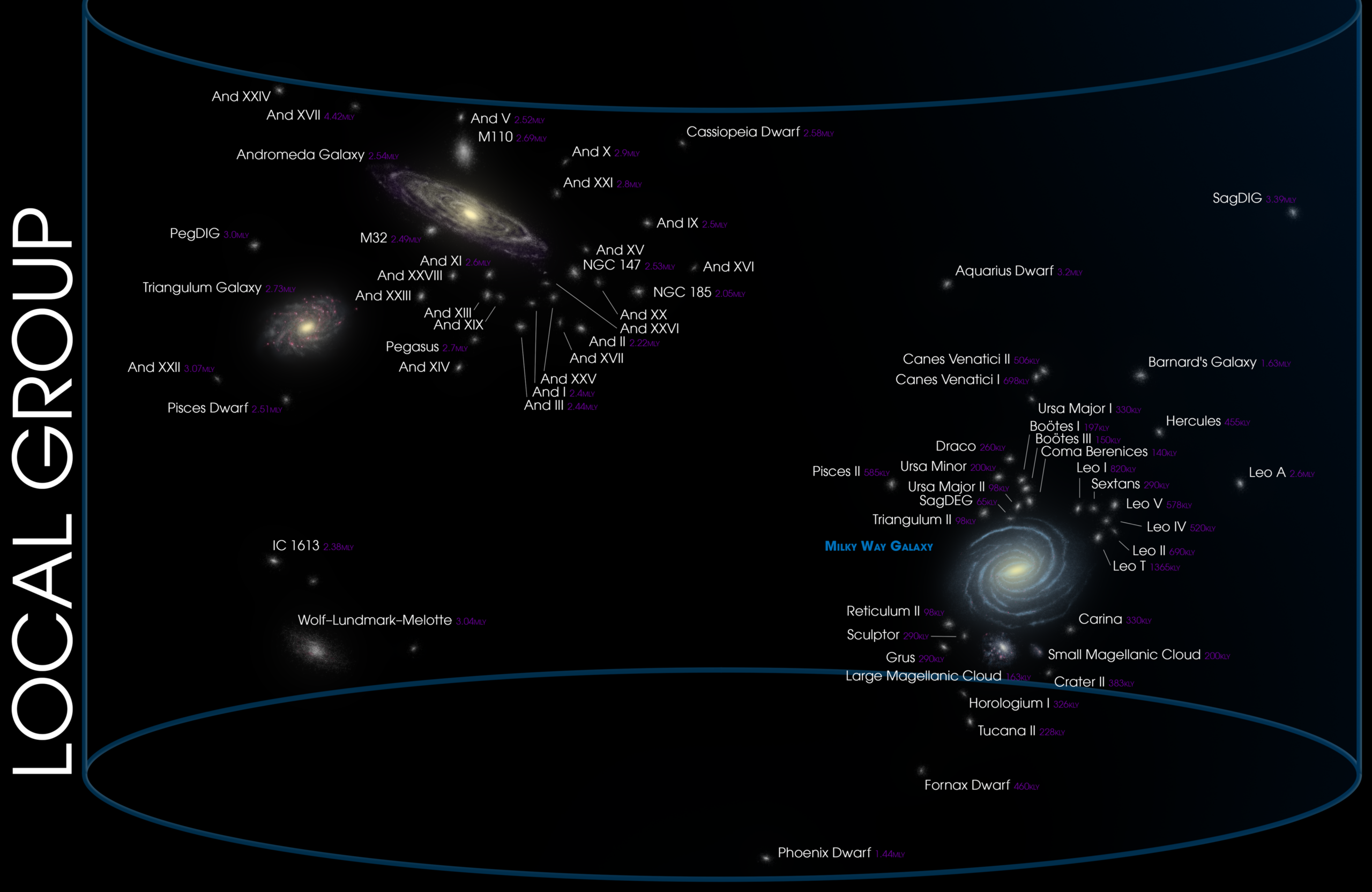
Our Milky Way galaxy and the Andromeda galaxy are the two most massive objects in our Local Group of loosely associated galaxies. Though it is dotted with other objects such as the Triangulum galaxy, the Large Magellanic cloud (LMC) and the Small Magellanic Cloud (SMC), the Milky Way and Andromeda galaxies are orders of magnitude more massive than them. An illustration of the Local Group can be seen in Figure 1.
The ‘timing argument‘, as astronomers refer to it, is a very simple and elegant proposition: Through cosmic time, if galaxies end up close enough in space, they would eventually start falling toward each other. From our perspective sitting here on Earth, embedded inside the Milky Way galaxy, the Andromeda galaxy seems to be approaching us. It is reasonable to assume that their mutual gravity is bringing them together.
If you know the relative velocity and the distance between the two galaxies, just by solving the simple Newtonian two body problem, we should be able to get a very realistic estimate for the mass of the local group. This assumes the two galaxies to be two mutually attracting bodies, with all their masses concentrated at a single point each.
Various approaches to the timing argument give us a total mass of the Local Group to be between 4 to 6 trillion times the mass of our sun. However, other independent approaches to estimating the mass of the Local Group, such as simply adding together masses of individual galaxies derived from accurate modelling of their rotation curves and including the ionized gas between galaxies in the mass budget give us a total mass of 2 to 3 trillion times the mass of our sun. That is almost half of the timing argument estimate.
So what gives?
Mergers all the way down.
The authors of this study suggest that the key to bridging this discrepancy lies in the merger histories of the main characters of the timing argument. Galaxies the size of the Milky Way and Andromeda get as large as they are due to past mergers; smaller galaxies coming together and forming a larger galaxy. A galaxy like ours is expected to have undergone about sixteen mergers on average through its entire evolutionary history over cosmic time. Every time a merger happens, all the matter and angular momentum from its progenitors is transferred to the newly formed object. For a large galaxy like Andromeda which seems to be moving towards the Milky Way, a minor merger with a much smaller galaxy may not affect its path towards the Milky Way very much; however, a merger with a large galaxy of a comparable size certainly would.
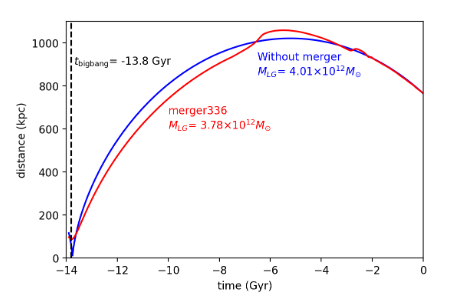
Andromeda is known to have undergone one such major merger in the recent past, so the authors start their detective work here. Some recently developed models very accurately reproduce this major merger which formed the Andromeda galaxy as we see today. This merger started 7-10 billion years ago and concluded 2-3 billion years ago. A simulation demonstrating this can be seen in Video 1. The authors are able to use these models which describe this merger and calculate how the galaxy’s present motion is impacted by it. They are able to add corrections to the past velocities and positions of the Andromeda galaxy. How the distance between them would vary is illustrated in Figure 2. This lets them revisit the timing argument, and after propagating the substantial error in the tangential velocity measurement of the galaxy, the change in the predicted mass ranges from a decrease by 20% to an increase by 30%. So the approximate lower limit of the total corrected mass from this revised timing argument is 3.5 trillion solar masses, closer to the observations, but not quite there yet, so the authors dug deeper.
Spiral out, keep going.
There is another major interaction happening right now in the Local Group. The LMC , the dwarf galaxy which dazzles the sky in the southern hemisphere, is falling into the Milky Way system, which shifts the motion of the Milky Way in the classical “timing” scenario. Accounting for the LMC’s effects on the Milky Way, and then recalculating the timing argument with the Andromeda major merger, inches the authors closer into the mass range of the observations. To make an airtight case for their approach, if each merger of the expected 16 for each galaxy shifts the mass estimate from the timing argument by 10% either way, they simulate how much the mass would change statistically with 16 random instances of 10% change. This firmly roots the total mass to be between 2 to 3 trillion times the mass of the sun.
Therefore, the authors show that the straightforward approach of the timing argument of assuming just two gravitating bodies overestimates the mass, and the Local Group is a more complex system than has been previously assumed. To correctly reproduce the observed values, a consideration of the merger histories of galaxies is necessary. This highlights how robust the predictions of hierarchical galaxy formation scenarios are.
Astrobite edited by Chloe Klare, Brandon Pries and Nathan Whitsett
Featured image credit: NASA, ESA, Z. Levay and R. van der Marel (STScI), T. Hallas, and A. Mellinger with edits by Neel Kolhe.
Disclaimer: N. Kolhe is a member of the same faculty as the authors, but was not involved in the research carried out in the presented article in any capacity.