Title: GW231123: a Binary Black Hole Merger with Total Mass 190-265 M⊙
Authors: The LIGO Scientific Collaboration, the Virgo Collaboration, and the KAGRA Collaboration
Status: Published in ApJL [open access]
Just over ten years ago, scientists at the LIGO-Virgo collaboration found a signal that changed astrophysics forever: the first detection of a gravitational wave. This “chirp”-like signal, produced by the merging of two black holes, allowed for a direct look at their properties: their masses and spins. The era of gravitational wave astronomy had begun.
Since then, the LIGO-Virgo-KAGRA (LVK) collaboration (the KAGRA detector was finished in 2019) has detected over 290 gravitational wave events over four observing runs, the fourth of which (O4) finished in November 2025 with some data already released to the public. With so many events, we have been able to obtain an increased understanding of the black hole populations throughout our universe.
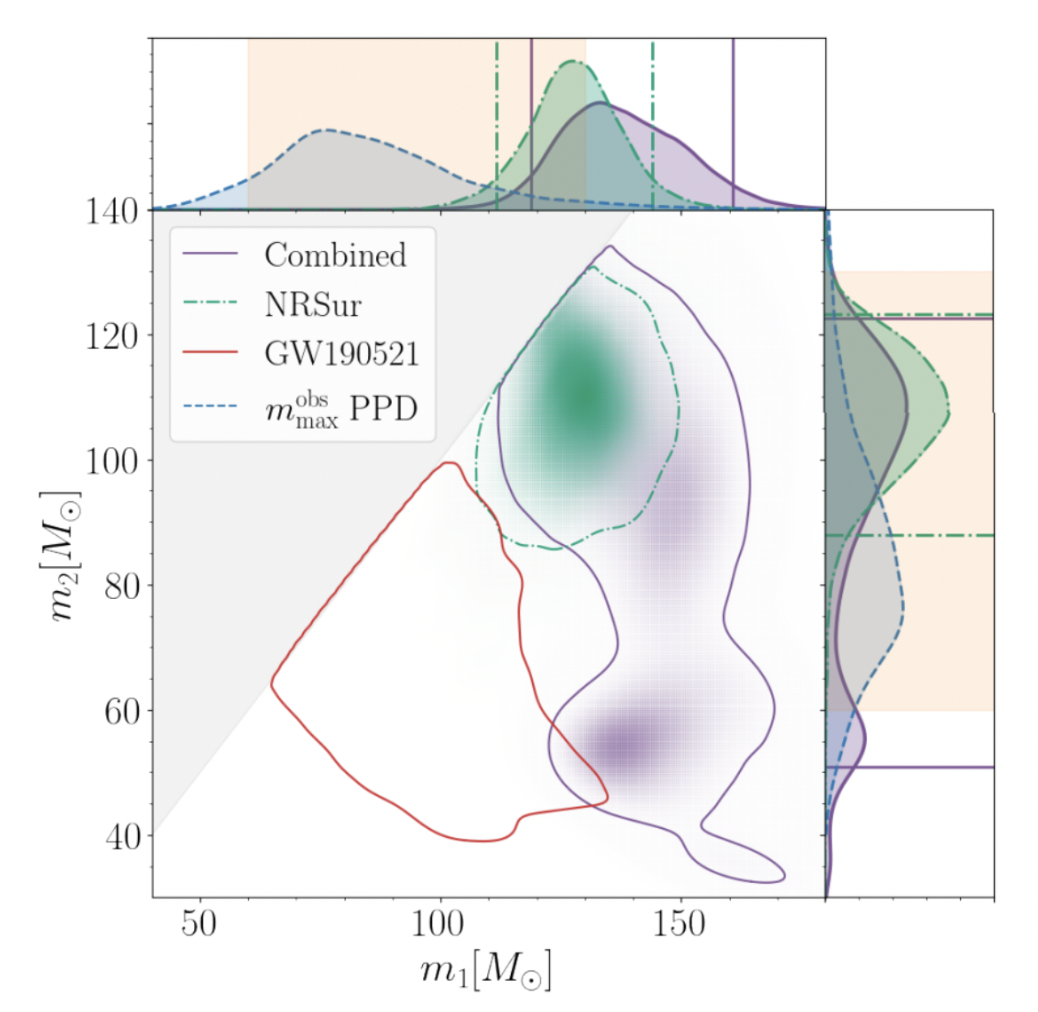
While every detection is important in developing our understanding of black hole populations, some events stand out. One such event is GW231123, a signal detected in November 2023 with a measured primary (i.e. larger black hole) mass of 137 solar masses and a measured secondary (i.e. smaller black hole) mass of 101 solar masses. This makes GW231123 the largest mass gravitational wave event to date (assuming a false alarm rate of less than one per year).
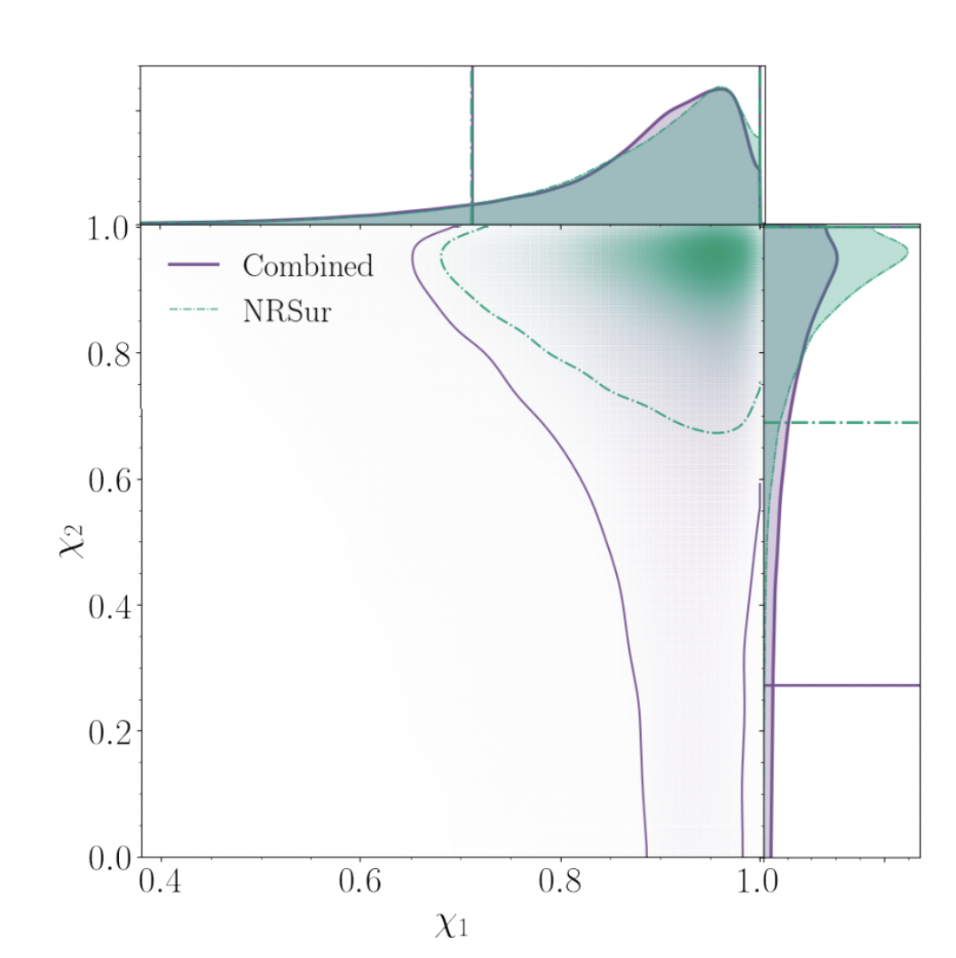
What’s more is that the signal has high spin, with the primary having a dimensionless spin of .9 and secondary having one of .8. In tandem with the high masses, these extreme parameters make GW231123 a uniquely difficult signal to understand, both on the relativity side and on the astrophysical side. Yet, difficulty is where good science happens, so let’s explore why this matters!
A Challenging Signal
When the LVK collaboration infers the masses and spins of the black holes that produced a gravitational wave, they use Einstein’s theory of general relativity to develop the models used to determine the binary’s parameters. There’s just one problem: binary black hole mergers are highly complicated systems with a lot of parameters and Einstein’s equations are hard to solve.
For this reason, the LVK employs numerous scientists to work on numerical relativity, in which computational techniques and theory-based approximations are used to create non-analytical models for merger-produced gravitational waves; these models are called waveforms. Not all waveforms are created equal, for different choices in these techniques can lead to slight differences in the model’s predictions of black hole parameters.
In more typical signals, the predictions of multiple different waveforms tend to agree with one another at 90% significance. In the case of GW231123, however, when the collaboration used five different high-end waveform models to test for consistency, they found they disagreed at 90%.
This is clearly a problem if we expect accurate modeling, but it is an expected problem. All models predict spins of higher than .8 for each black hole, a region in which none of the models are properly calibrated. This suggests that the inconsistencies between the five models can be easily explained as errors in the numerical relativity model itself, not in the underlying theory of general relativity. This provides more incentive for better mathematical models at high spin!
Lying in the Mass Gap
Yet, even when accounting for the differences between waveform models, GW231123 is still causing confusion, this time due to its mass. The measured mass distributions suggest that one or even both black holes lie within a “mass-gap”: a range of masses in which black holes should rarely be formed.
In this case, the mass-gap is between 60-130 solar masses, and follows from our theories of stellar collapse. Theoretically, we expect that most stars in this mass range do not leave behind black holes, but instead blow up as pair-instability supernovae (PISN): the aftershock of a partial stellar collapse caused by the production of electron-positron pairs. Because most black holes are considered to be remnants of stellar collapse, this should prevent black holes from forming in the mass gap.
While high uncertainty in the masses prevents us from saying for certain if GW231123’s black holes lie in the gap, theorists are already offering some explanations if it does. Some theories allow for stellar collapse in the mass gap: short-period stellar binaries or stars with weaker stellar winds may be able to still form black holes. Others suggest GW231123 is a hierarchical merger, a part of a “family tree” of mergers, where at least one of the black holes was made from an earlier merger.
GW231123 has shown how uncertain we still are about the nature of black hole formation. Scientists truly have their work cut out for them, whether that be through developing more robust models, explaining mass gap observations, or further observational work. Yet, even with all this uncertainty, one thing at least remains true: the LVK collaboration’s work is still scientifically astounding. We have truly come a long way since the first detection.
Astrobite edited by Katherine Lee
Featured image credit: Adapted from Figure 1 of the paper.