
Authors: L. Gwebushe, T. Venturi, P. Merluzzi, G. Busarello, V. Casasola, O. Smirnov, M. Ramatsoku, J. Dawson
First Author’s Institution: Centre for Radio Astronomy Techniques and Technologies (RATT), Department of Physics and Electronics, Rhodes University
Status: Accepted to the Monthly Notices of the Royal Astronomical Society
Introduction
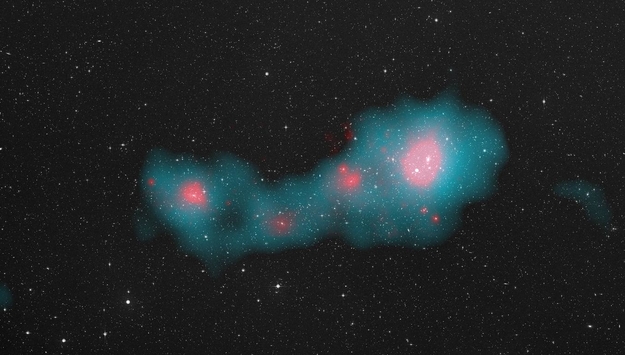
Superclusters are some of the most massive structures in the universe, home to thousands of galaxies. In this article, the authors use observations from MeerKAT to detect neutral hydrogen gas (HI) in galaxies in the Shapley Supercluster, which was one of the earliest discoveries of a supercluster!
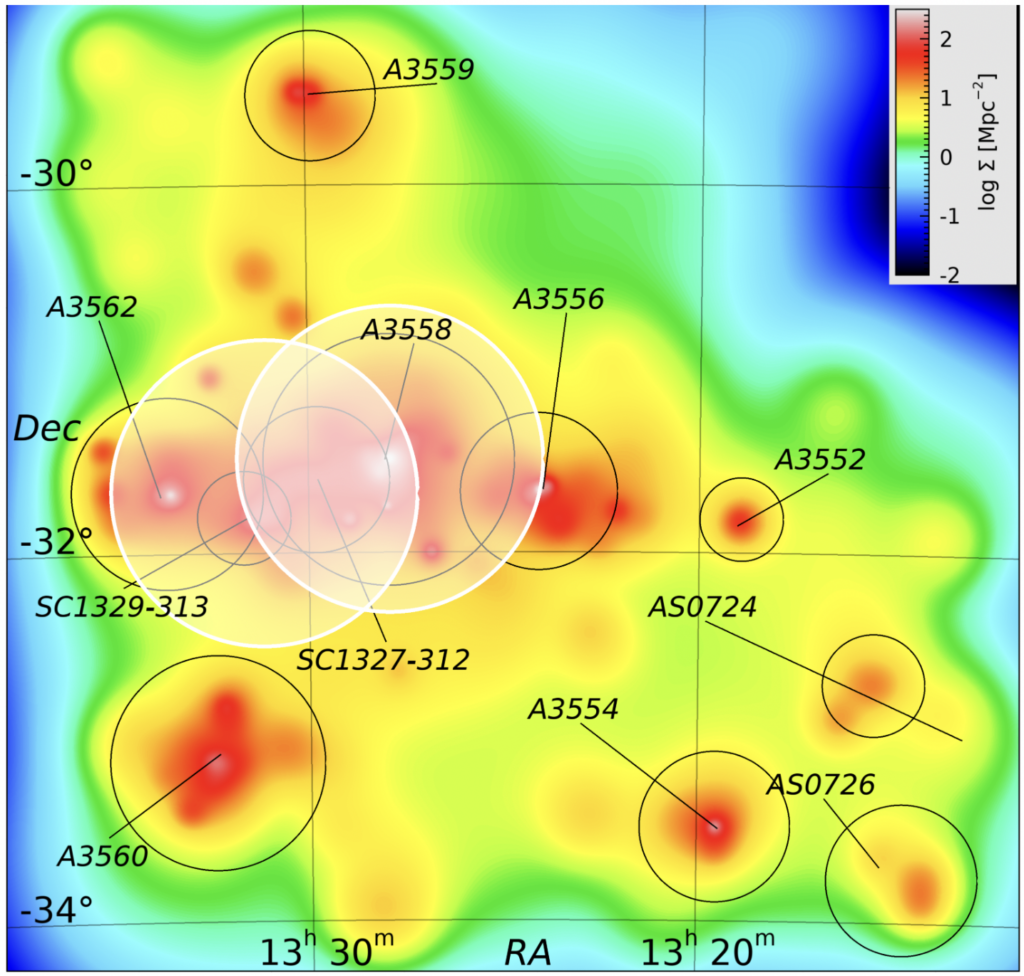
The Shapley Supercluster is widely recognised as the most massive gravitationally bound structure in the local universe.The supercluster is made up of 11 galaxy clusters and groups and extends across ~ 260 megaparsecs. At its core, which this paper focuses on, are five clusters. This core hosts several radio haloes, which are caused by shock-heated gas from the Intracluster medium (ICM) and is evidence of ongoing cluster merger activity. This supercluster core is highly dynamically active (full of cluster-cluster mergers), which could influence the evolution of galaxies within the core. This paper examines the evolution of galaxies by observing the cold gas within galaxies (i.e. the neutral hydrogen) and compares several galaxy properties to do so (see also: this previous Astrobite featuring ram-pressure stripped galaxies in the Shapley Supercluster).
How do galaxy environments shape galaxy properties?
The morphology-density relation is a phenomenon where the fraction of elliptical galaxies (also known as Early-type galaxies) increases as the density of galaxies decreases, and the fraction of spiral galaxies (i.e. late type galaxies) decreases as density increases. In other words, you’ll typically find more spiral galaxies on the outside of clusters than inside of them. This points to the fact that dense environments seem to transform galaxies from spiral galaxies to ellipticals. Quite often, this transformation occurs due to quenching of star-formation activity.
One of the ways to observe this is by looking at the gas content of galaxies. In this case, it is the neutral hydrogen (HI) gas that is observed. HI is more diffuse and typically extends far beyond the stellar disk of galaxies—-unlike molecular hydrogen (H2)— and thus may be more easily removed (or stripped) from galaxies. Because H2 forms from HI, and stars form from H2, removal of HI can be an indication that star formation will cease within a galaxy. Galaxy clusters remove HI from galaxies through evaporation or by ram-pressure stripping. Ram-pressure stripping occurs when a galaxy moves through the ICM and experiences a drag force, which pushes the cold gas out. This can be seen in (spectacular) jellyfish galaxies.
MeerKAT Observations
This paper uses radio observations from the MeerKAT Galaxy Cluster Legacy Survey and data from the Shapley Supercluster survey. The authors detect HI in over 300 galaxies in their field of view. However, by cross-matching their HI data with optical data, they confirm that 169 galaxies are part of the supercluster core system.
They then conduct a morphological classification of the galaxies in their HI-detected sample, dividing them into the star-forming main sequence (SFMS), starburst, transition zone, or red sequence to better link the HI properties to the star-formation state. The majority of the samples fall within the “transition zone” category. This differs from a comparison sample of field galaxies (i.e. galaxies not in the supercluster), where SFMS galaxies typically dominate. They also find very few starburst galaxies compared to the field.
The authors compute the gas depletion timescales (i.e., how long a galaxy would take to convert its current HI mass to stellar mass at its current star formation rate) and find that their SFMS galaxies have the shortest depletion times. They also calculate the offset from the gas fraction scaling relation, defined as the HI mass divided by the stellar mass (as a function of stellar mass), which differs from the relation for field galaxies.
Overall, they find that, despite galaxies maintaining their HI reservoir relative to field galaxies, their sample shows evidence of star-formation being suppressed – a process known as quenching.
What does this tell us about galaxy evolution?
These observations show that galaxies in dynamically active superclusters may be capable of maintaining their HI reserves, but that their star formation will still be quenched by environmental processes. They also highlight the need for multiphase observations of gas (such as H2 observations) to understand the mechanisms that drive quenching within these dense environments.
Astrobite edited by Ben Sherwin
Featured image credit: ESA & Planck Collaboration/Rosat/Digitised Sky Survey
