
Title: Cosmic dust fertilization of glacial prebiotic chemistry on early Earth
Authors: Craig R. Walton, Jessica K. Rigley, Alexander Lipp, Robert Law, Martin D. Suttle, Maria Schönbächler, Mark Wyatt & Oliver Shorttle
First author’s institution: Institute of Particle Physics and Astrophysics, ETH Zürich and the Institute of Astronomy, University of Cambridge
Status: Published in Nature Astronomy in 2024
How did life start on Earth? Scientists have long speculated about different origin scenarios, from Darwin’s “warm little pond” to hydrothermal vents. However, many of these scenarios have a large problem: some of the molecules we believe to be necessary for precursor forms of life were not available in these environments. For example, phosphine (PH3), an ingredient for DNA, was likely locked up in rocks and not around to be utilized by microbes (for more on phosphine, see this astrobite).
However, scientists have observed phosphine and other such molecules in asteroids, leading to the idea that maybe the ingredients for life came from space. The space dust on Earth is microscopic material made from rock, ice, and minerals left over from the origin of the solar system. Space dust is the key ingredient to it arriving from space: if the materials had come via meteor, the heat and pressure of a collision with Earth could destroy these chemically reactive ingredients for life.
This new paper by Dr. Craig Walton looks at how much space dust would initially arrive from space and explores where and how it could grow into a larger quantity on Earth. Previously, scientists have dismissed space dust as a possible way for prebiotic materials to arrive, since so little was expected to reach the surface of Earth. But about 4,700 metric tons land on Earth annually (about ten grams of space dust per square kilometer). And in the past, when the solar system was young and there were more asteroids zooming around and colliding to create dust, there was far, far more space dust. Dr. Walton’s paper estimated the amount of space dust arriving to be up to 100 to 10,000 times higher than today.
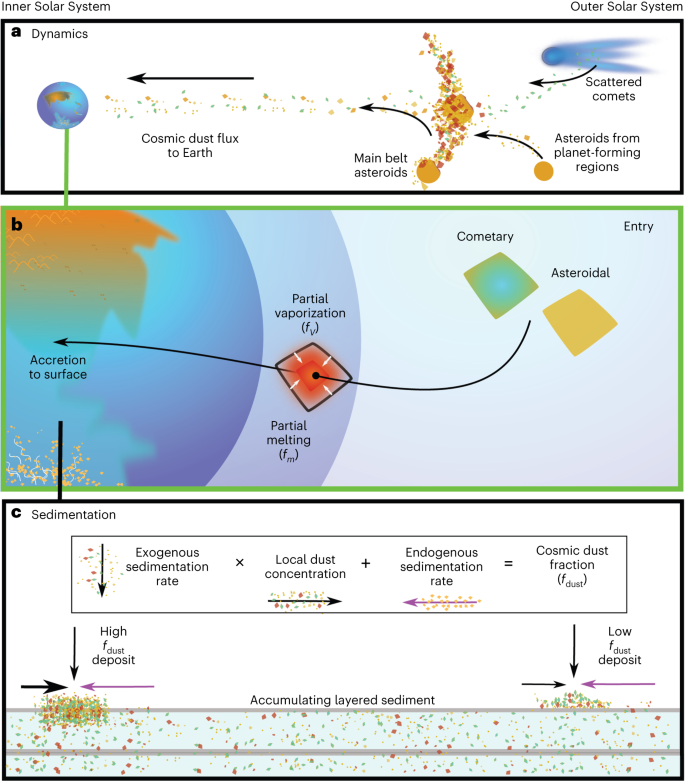
This figure illustrates where space dust comes from. Panel (a) demonstrates how asteroid collisions and comet trails create space dust. Panel (b) shows how space dust can sometimes be melted and vaporized while landing on Earth. Panel (c) indicates how the authors of the paper modeled the accumulation of dust over time, including how dust can mix with Earth dust (endogenous sedimentation). Figure credit: Dr. Craig Walton
Because this number alone may not be high enough for the required prebiotic chemistry, the paper then explored multiple ways space dust could be pushed around to create larger piles of dust, much like dust in a home gets concentrated in a drafty attic into dust balls. His paper looked at three possible explanations: deep sea currents, windy deserts, and glaciers.
Surprisingly, this research found that glaciers were the best location for preserving and concentrating molecules. In the popular imagination, the early Earth is a hot magma world, but there is actually evidence that glaciers could have existed four billion years ago. And on such glaciers, the dust that lands on the ice can get blown around and then get trapped in little holes (cryoconites), thus concentrating the material. That darker dust can then melt the ice, creating an environment primed for pre-biotic chemistry!
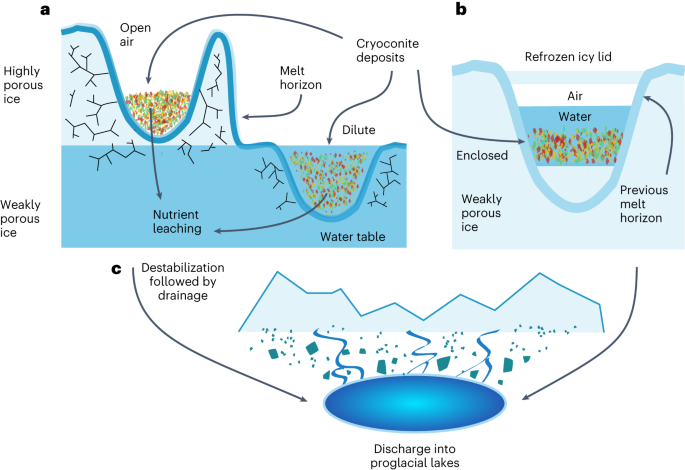
This figure demonstrates how prebiotic chemistry could begin on a glacier. In panel (a), the dust is trapped in cryoconites; panel (b) indicates that some dust could be trapped by refreezing. Regardless, eventual melt will lead to the concentration of dust either within the cryoconites or proglacial lakes, as demonstrated in panel (c). Figure credit: Dr. Craig Walton
This paper is unique in its focus on what happens after the molecules arrive from space. Many other chemistry or astrobiology papers only focus on how to get the molecules from space to Earth, not what happens after. Several other studies also emphasize the first initial prebiotic reactions, and do not consider what happens after the prebiotic reactions begin. In contrast, his research proposes that continually falling space dust feeds and continues the prebiotic chemistry.
Even if glaciers and space dust aren’t how life began, future research should incorporate the idea of a continual supply of molecules. And regardless, introducing a new idea, glaciers, helps broaden the field of possibilities.
Exploring the possible origins of life on Earth helps orient research on life emerging on other planets. Previously, astronomers have considered dust in other solar systems a nuisance that obstructs the view of potential exoplanets. However, according to this hypothesis, life can only exist in systems where dust exists, and therefore can only exist where asteroids have smashed together to create that dust.
Generally speaking, further research on ways life could begin can illuminate a key topic in astrobiology: On what types of planets could alien life emerge?
Astrobite edited by Nathan Whitsett
Featured image credit: rawpixel
