
Authors: Hossein Hatamnia, Bahram Mobasher, Sina Taamoli, Jeyhan S. Kartaltepe, Caitlin M. Casey, Hollis B. Akins, Malte Brinch, Nima Charta, Nicole E. Drakos, Andreas L. Faisst, Steven L. Finkelstein, Maximilien Franco, Finn Giddings, Ghassem Gozaliasl, Ali Hadi, Aryana Haghjoo, Santosh Harish, Olivier Ilbert, Pascale L. Jablonka, Shuowen Jin, Ali Ahmad Khostovan, Anton M. Koekemoer, Ronaldo Laishram, Daizhong Liu, Matteo Maturi, Henry Joy McCracken, Crystal L. Martin, Lauro Moscardini, Diana Scognamiglio, Marko Shuntov, Greta Toni, Alexander de la Vega, John R. Weaver, and Lilan Yang
First Author’s Institution: Department of Physics and Astronomy, University of California, Riverside
Status: Published in The Astrophysical Journal [open access]
Long before humans built the World Wide Web, the Universe built one of its own. Galaxies are not randomly distributed throughout the Universe, but instead form a vast cosmic web. Massive galaxy clusters act as the nodes of this web. These clusters are the largest known gravitationally bound objects in the Universe, consisting of hundreds to thousands of galaxies. They are connected by filaments of galaxies and dark matter, with voids of empty space lying in between. For decades, astronomers have been piecing together observations of the cosmos to try to understand the large-scale structure of the Universe (you can read other bites on the topic here and here). The cosmic web at high redshift, z, (early in the Universe’s history) is particularly interesting yet difficult to study. In order to understand how the first nodes of the cosmic web formed, astronomers observed very distant galaxies in dense regions of space, but previous studies limited their scope to very specific galaxy populations or small sample sizes. Luckily for us, the James Webb Space Telescope (JWST) is revolutionizing studies of the high-redshift Universe! The COSMOS-Web survey is JWST’s first wide-area survey specifically designed to study the cosmic web on large scales across cosmic history.
The authors of today’s bite use 164,000 galaxies surveyed with COSMOS-Web to map the cosmic web from redshift z=0 (today) to redshift z=9 (when the Universe was only 500 million years old). How did they do it?
Cosmic Cartography
To map the cosmic web, astronomers need to identify where matter is concentrated and where space is relatively empty. In other words, we want to create a density map showing the locations of high-density galaxy clusters and filaments compared to low-density voids. The authors begin by breaking up all the data into redshift slices so they can see how the cosmic web evolves over time. Each redshift slice is then treated as a two dimensional grid. Using a process called weighted kernel density estimation, the authors sum the mass of every galaxy on that grid to find the average surface density of that slice. Overdensities are identified by comparing the density at each grid point to the average surface density of the slice.
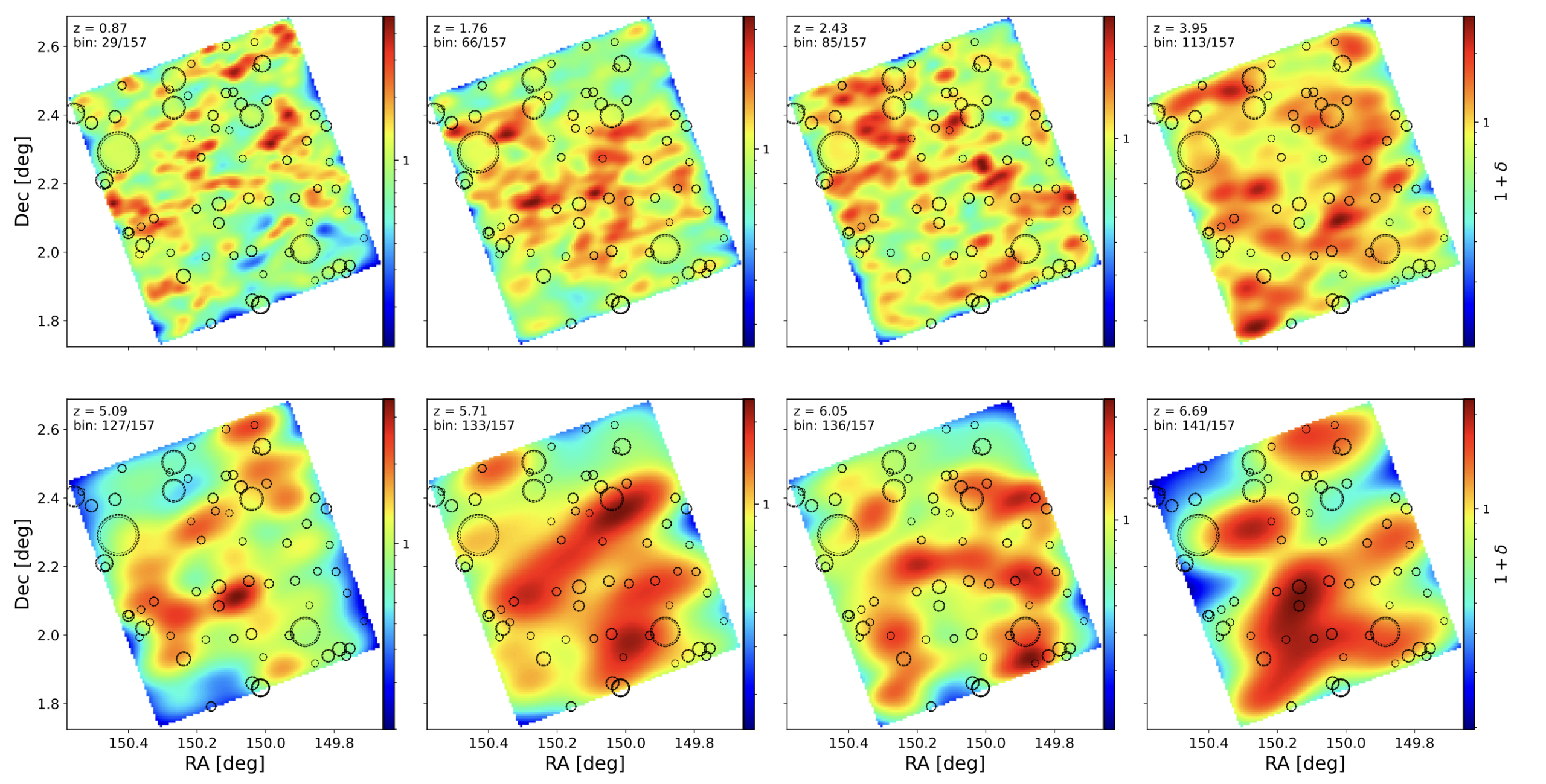
Figure 1 illustrates the final density map at different redshift slices. At low redshift, the highest density regions (shown in red) are fully formed cosmic structures, like galaxy clusters, that constitute the nodes and filaments of the cosmic web. At high redshift, however, overdense regions are still in the process of assembling under gravitational collapse. These regions are often protoclusters, which will eventually evolve into fully-formed galaxy clusters.
A map of the large-scale structure of the Universe has many applications in astronomy, but today’s authors have applied their map to the study of galaxy evolution.
Browsing (Galaxy Evolution Across) the Web
Is the evolution of galaxies driven by internal or external factors? Nature or nurture? With this map in hand, we can study how galaxies evolve across different density environments. The authors focused on two key galactic properties: stellar mass (the mass of all the stars in the galaxy) and star formation rate (how quickly the galaxy is forming stars).
The authors found that the galaxies with the highest stellar masses are preferentially found in the most overdense regions. This isn’t too surprising. Our current theories of galaxy formation predict that overdense regions correspond to the largest dark matter halos which can then host the most massive galaxies. Massive galaxies also form through the interaction and merging of smaller galaxies, which is more likely to happen in dense environments.
Star formation rate, on the other hand, distinctly changes with redshift, as can be seen in Figure 2. At high-z, overdense regions are dominated by galaxies with very high star formation rates. These galaxies are young and have large reservoirs of cold gas perfect for rapidly forming new stars. Additionally, when galaxy mergers occur, the gas in the two galaxies slams together, triggering fast bursts of star formation. At low-z, overdense regions are dominated by quiescent galaxies, or galaxies that are no longer actively forming stars. These galaxies likely formed early in the Universe and have since undergone quenching processes that have inhibited new star formation.
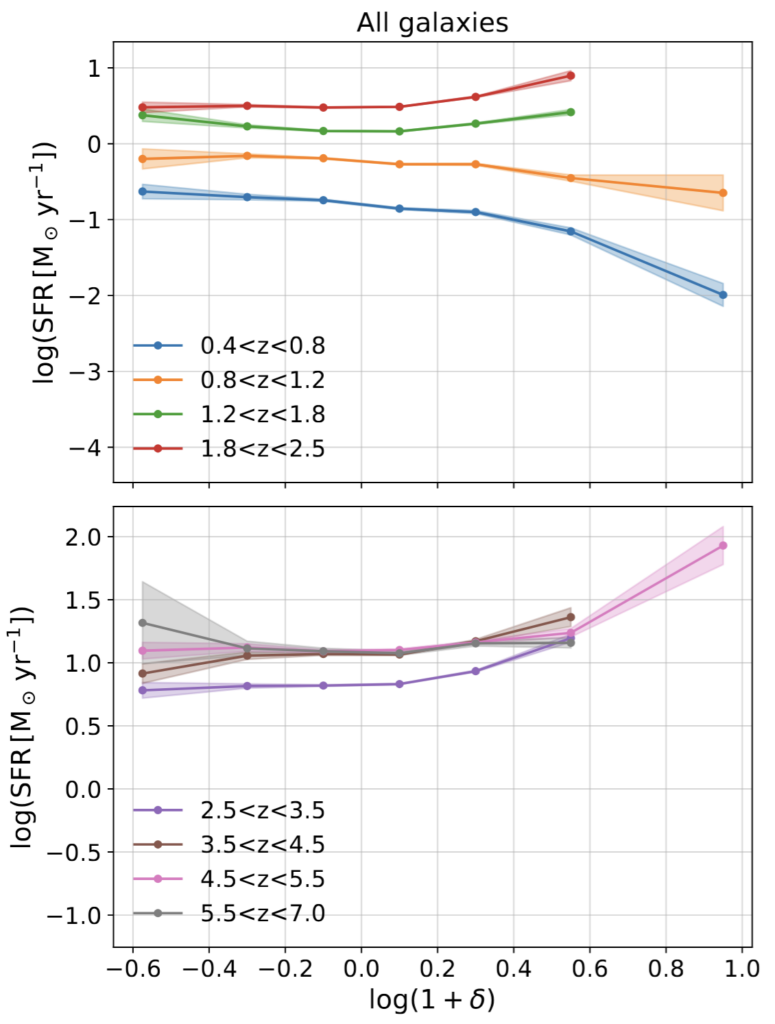
Galaxy quenching is a very active field of study (you can read other astrobites on quenching here and here) but it is often broken into two regimes: mass quenching (processes within the galaxy) or environmental quenching (processes related to the galaxy’s environment). Today’s authors studied the quiescent galaxies in their sample and found that the dominant quenching process changes with redshift. At high-z, mass quenching dominates and the environment only plays a small role. Mass quenching can originate from a variety of processes, such as strong winds from an active galactic nucleus or the heating of infalling gas. At low-z, however, the star formation rate of quiescent galaxies decreases as the density of the environment increases, pointing to environmental quenching being the dominant process. Dense environments, like galaxy clusters, are filled with hot gas known as the intracluster medium (ICM). As a galaxy moves through the cluster, the ICM exerts a drag force on the galaxy that can strip away the galaxy’s gas, preventing it from forming more stars. This is known as ram pressure stripping.
These results demonstrate that environment cannot be ignored in studies of galaxy evolution. In other words, galaxies don’t evolve in a vacuum (well, sort of). As JWST continues to push studies of the Universe’s large-scale structure to even more distant frontiers, we will gain a better understanding of how our place in the cosmic web came to be.
Astrobite edited by Lucie Rowland
Featured image credit: Hatamnia et al. 2026
