
Title: Probing the IMF in the Early Universe – Direct measurements in the Boötes I UFD with JWST/NIRCam
Authors: Keyi Ding, Mario Gennaro, Roberto J. Avila, Massimo Ricotti, Rachael L. Beaton, Martha L. Boyer, Thomas M. Brown, Annalisa Calamida, Santi Cassisi, Vedant Chandra, Roger E. Cohen, Matteo Correnti, Denija Crnojević, Kareem El-Badry, Marla Geha, Puragra Guhathakurta, Nitya Kallivayalil, Evan N. Kirby, Kristen. B. W. McQuinn, Alessandro Savino, Cheyanne Shariat, Joshua D. Simon, Daniel R. Weisz
First Author’s Institution: Department of Astronomy, University of Maryland, College Park, Maryland, USA
Status: Submitted to the Astrophysical Journal (open access) Available on arXiv.
The Stellar Initial Mass Function
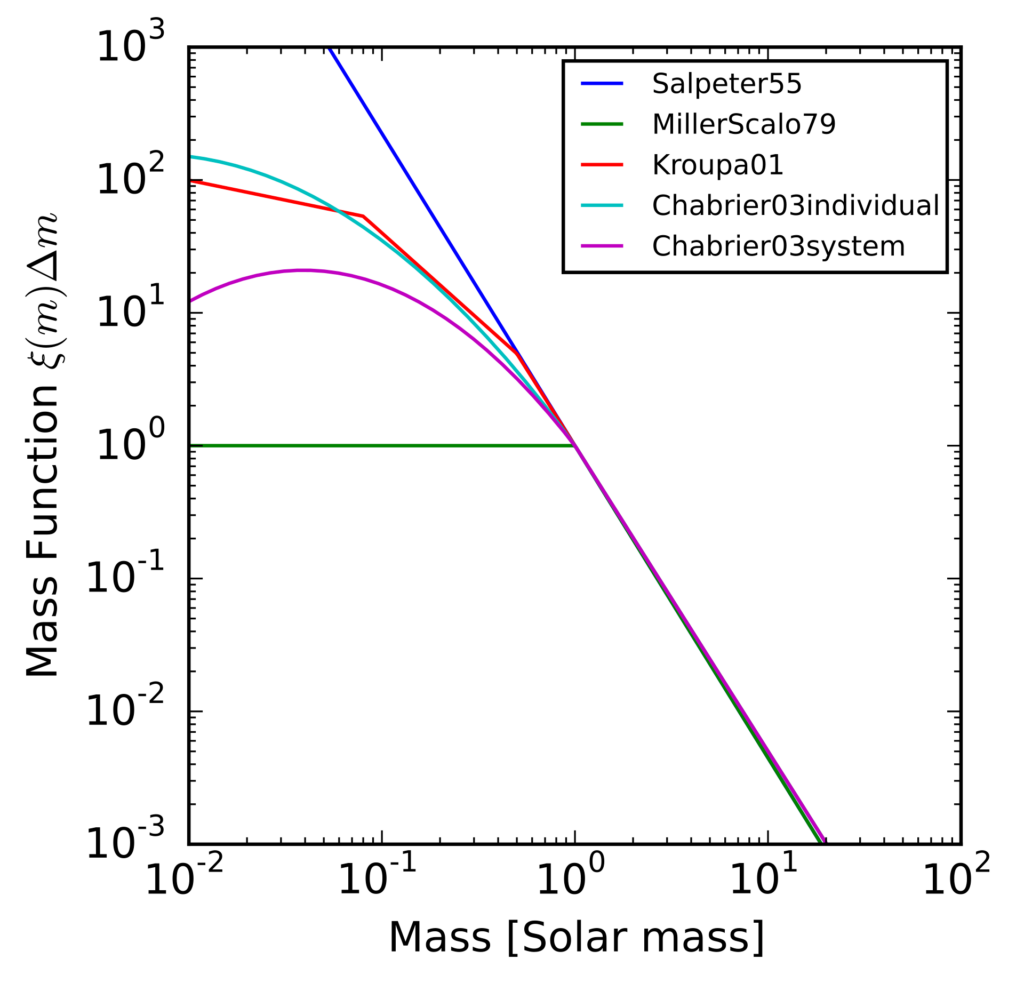
A fundamental concept in astronomy is the stellar initial mass function (IMF). The IMF describes the number of stars of each mass that form from a single birth cloud. If the IMF has a negative slope, it means most stars are low in mass; if it has a positive slope, it means most stars are high in mass. Figure 1 shows some examples of commonly used IMFs, all of which have a negative slope, since we see far more low mass stars than high mass stars in the Milky Way. You may notice that several models deviate from a straight line at about ~0.5 solar masses. This point, known as the turnover or critical mass, is crucial in determining the exact shape of the IMF.
For a relatively simple concept, the underlying physics that shape the IMF are incredibly complicated. Things like turbulence, magnetic fields, and chemical enrichment all play a role in shaping the observed IMF. Additionally, the IMF is a pretty fundamental quantity. An enormous amount of astronomy research relies on making assumptions about the IMF. For example, since most stars are low in mass and low mass stars are dimmer, astronomers use the IMF to convert the amount of light in a galaxy to the number of stars; if there are more or fewer low-mass stars than we expect, our mass measurements will be wrong.
A big question surrounding the IMF is whether or not it’s universal. In the Milky Way, astronomers have been able to measure the IMF accurately, and have found that it seems to be the same regardless of which bunch of stars we use to measure it. However, we know that galaxies in the early universe were very different compared to today. Things get tricky when you acknowledge that most measurements made of early universe galaxies rely on modeling tools that are entirely reliant on assuming an IMF. This gnarly little detail makes measuring the IMF in the early universe especially valuable to astronomers.
What makes Ultra Faint Dwarves so special?
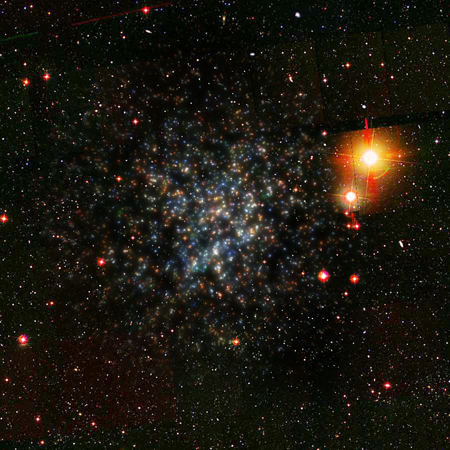
Today’s authors attempt to measure the early universe IMF using a local relic, an ultra faint dwarf galaxy (UFD). You might describe UFDs as ‘incredibly funky little galaxies’. They’re much less massive than the Milky Way, with about 10,000 times less stellar mass. What stars they do have tend to be very old and metal poor. The nature of UFDs has led many astronomers to think of them as fossils: relatively untouched galaxies formed in the early universe. Since we think UFDs are fossils of earlier galaxies, measuring the IMF in Bootes I tells us whether the IMF was the same in the early universe as it is today. They focus on Boötes I, a relatively luminous UFD orbiting the Milky Way. Figure 1 shows the Boötes I as seen by the SDSS survey.
The IMF in Boötes I
Measuring the IMF can get tricky – it’s typically pretty difficult to measure the mass of each individual star in a galaxy. Thankfully, Boötes I is close enough that we can do exactly that! Using JWST’s NIRCam instrument, today’s authors obtain imaging of Boötes I, sensitive enough to extract ~10,000 stars belonging to the galaxy.
To measure the IMF from the observed population of stars, the authors use a modified version of Starwave, a Bayesian inference tool. In short, the tool takes in some assumptions about the population of stars in the galaxy, then generates many potential color magnitude diagrams (CMDs) for various parameter selections. You can then assess how well each simulated CMD fits the observed data, thus determining likely parameters about the stellar population. The authors apply their tool for three different IMF models, testing how close the IMF in Boötes I is to that of the Milky Way. . This allows them to determine how well the IMF compares to that of the Milky Way, which is typically thought of as a broken power law or lognormal distribution. If the IMF in Boötes I aligns with the Milky Way, we’ll have a solid piece of evidence for a truly invariant IMF across cosmic time, allowing astronomers to rest easy knowing our modeling efforts haven’t been bunk this whole time.
So..what did we learn?
The authors find that a single power law can be ruled out to a good degree of confidence. This is good, as Milky Way studies show undeniable evidence of a turnover in the distribution. The broken power law and lognormal models both fit the observed data relatively well, aligning well with Milky Way-derived IMFs. All in, they find solid evidence for an invariant IMF in the early universe.
However, they are unable to say with absolute certainty that the IMF is invariant. Given that their data is nearly perfect (that is, it’s pretty much impossible to get better data), the authors emphasize that a larger sample of UFD IMFs is needed to truly rule out an invariant IMF, but we’re certainly taking steps in the right direction! As the age old saying goes, ‘more data is needed!’
Astrobite edited by Maggie Verrico
Featured image credit: Vasily Belokurov – SDSS-II Collaboration
