
Paper Title: First detection of HDO ice in a protoplanetary disk
Authors: A. Potapov, P. Kalambkar, J. Bouwman, C. Boersma, H. Terada, W. R. Rocha, and H. Linz
First-author institution: Analytical Mineralogy Group, Institute of Geosciences, Friedrich Schiller University Jena, Jena, Germany
Status: Accepted for publication in Astronomy & Astrophysics (Open Access)
Water may be the most important molecule on Earth for life, although it has a complicated history, from planet formation to its place on Earth now. It’s present in every stage of planet formation: in exoplanet atmospheres, in Kuiper belt-like structures around other stars, and in planet-forming discs. But water is important for more than just being useful to life – it’s extremely helpful in understanding other molecules also important to organic life. What can water tell us about the story of life-forming elements?
“Chemical inheritance” is the idea that water that goes into planet formation remains untouched by chemistry and cosmic rays, all the way from a star-forming nebula down to the oceans and atmospheres of young, Earth-like planets. If water is inherited, then other molecules may also be inherited, meaning they are not formed in the planet-forming environment, and instead come from the interstellar medium. This helps us get a better handle on where the ingredients for life come from, although it is a complex question that is difficult to answer without water.
We can tell if water is inherited by how deuterated it is – that is, the hydrogen atoms, written as H, can gain an additional neutron and become heavy hydrogen, or deuterium, written as D. This makes water (H2O) into heavy water (D2O) or semi-heavy water (HDO, or one hydrogen atom and one deuterium atom). A fraction of water in the interstellar medium at temperatures of ~25K can become deuterated, and it is difficult to deuterate water elsewhere as temperatures are not as low as 25K. Deuterated water can later be processed into other molecules via chemistry during planet formation at temperatures > 25K, which is too hot to reform any deuterated water. So, if the water is processed, the deuterated water is lost.
So, if you observe a protoplanetary disc with lots of deuterated water, then the water (and therefore other elements!) are likely chemically inherited from the interstellar medium. Indeed, previous observations of planet-forming discs have provided evidence for this inheritance scenario.
So we’ve seen deuterated water before. What’s new?
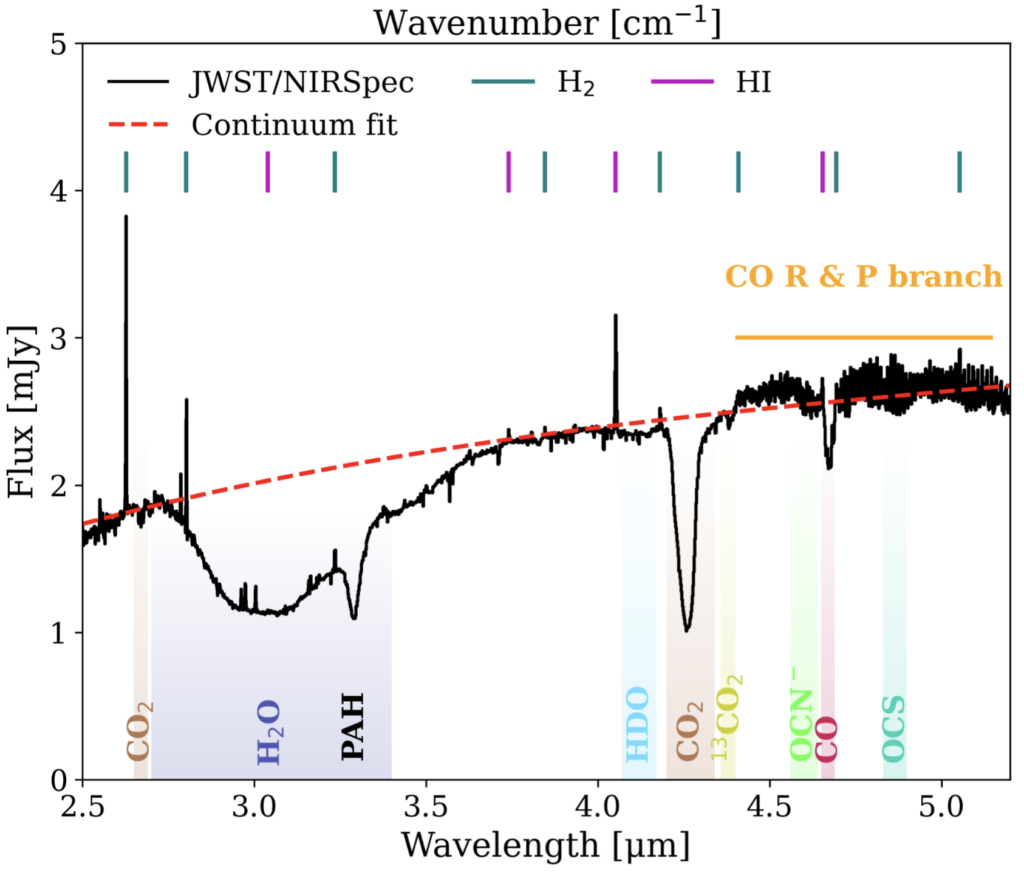
Astronomers found heavy water as a gas in a protoplanetary disc, covered in this previous Astrobite. But, we’ve never directly observed this ice until now. The authors of today’s paper present near-infrared observations from JWST of the protoplanetary disc d132-1832 in the Orion Nebula, which has direct evidence of semi-heavy water ice. This spectrum can be seen in Figure 1.
The authors discovered the presence of HDO when trying to fit their models to the big CO2 dip around 4.3 microns seen in Figure 1. They tried various mixtures of ices, some including the mineral enstatite, and others including chemical reactions between ices. Whilst they could fit the main CO2 absorption feature (the big dip), they could only fit the smaller dip at 4.1 microns by including HDO ice in their models. This marks the first time that HDO ice has ever been observed in the planet-forming environment.
From their model, the authors retrieved an abundance of HDO with respect to water (i.e. the ratio of the number of HDO molecules to water molecules in the spectrum, found from the big H2O absorption feature near 3 microns). They then compared this abundance to the solar system and other objects in space, which can be seen in Figure 2.
The author’s HDO/H2O ratio is an upper limit, as the disc is inclined towards Earth, hiding some ice that can change the absorption features. Nonetheless, they argue that this estimate is fairly robust.
What’s most interesting about Figure 2 is the fact that the HDO/H2O ratio in d132-1832 and other planet-forming environments (labelled YSOs/Young Stellar Objects in the Figure) is significantly higher than that found in solar system comets by about 2 orders of magnitude! This means that there is more HDO with respect to water in planet-forming environments than the solar system. But, the solar system should come from a planet-forming environment like these. So, where has all the HDO gone?
This is the next question the authors are looking to answer in an upcoming study. Between its formation stage and now, the solar system has lost more HDO than H2O (and so HDO/H2O has decreased); comets have a lower HDO/H2O ratio than YSOs. How, then, is HDO removed at a different rate to water, when they are such similar molecules? One possible answer is due to super fine-grained chemistry: water bonds to rocks more than deuterated water, meaning there is more water in comets than HDO. The HDO we see in 132-1832 is ice atop dust grains that are perhaps a few millimetres in size at most, whereas comets are much larger.
Regardless of how this happens, finding HDO ice is a big step forward in the story of water. This unprecedented detection allows us to begin drawing the link from the collapsing nebula that formed the solar system to the comets, planets, and life on Earth that are here today.
Astrobite edited by Annika Salmi.
Featured image credit: J. Williams
