by Elisabeth Newton | Jan 21, 2011 | Daily Paper Summaries
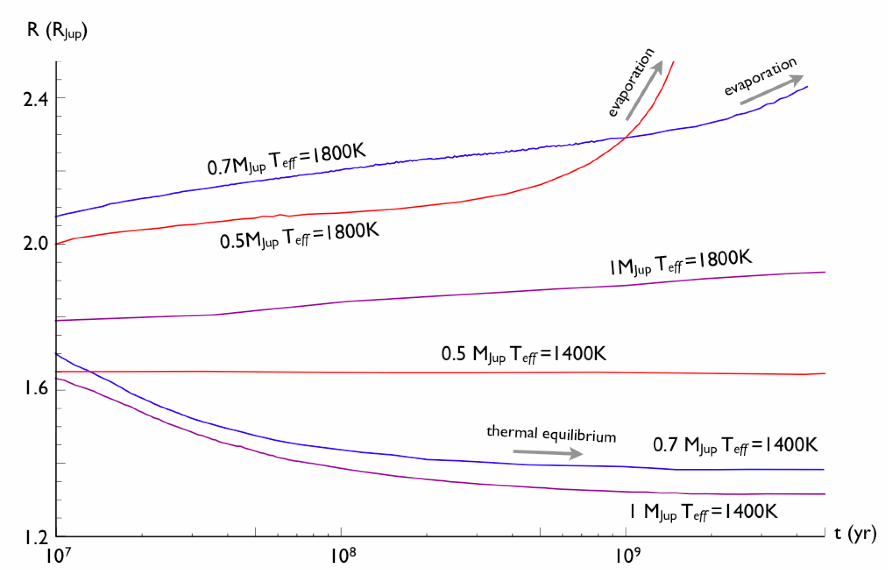
Dozens of the transiting exoplanets discovered to date have radii that are significantly larger than expected, leading astronomers to refer to them as puffy or inflated. Although tidal heating has had some success modeling puffy planets, these authors continue work on a new mechanism which employs planetary magnetic fields.
by Elisabeth Newton | Jan 14, 2011 | Personal Experiences
My first AAS is at a close. On Tuesday, I attended still more talks on exoplanets, some of which I will discuss below, while on Wednesday I manned my poster.
by Elisabeth Newton | Jan 11, 2011 | Personal Experiences
I’m here for the winter meeting of the American Astronomical Society (AAS), which started last night with a kick-off event. In my posts on AAS, I will report on some of the talks I’ve attended. Most of them will be on exoplanets, since this is the field I am beginning research in.
by Elisabeth Newton | Jan 10, 2011 | Quick Notes
Today the discovery of the first definitely rocky exoplanet — as well as the smallest planet discovered to date — was announced. The Kepler 10b press release was made this morning by Dr. Natalie Batalha at the American Astronomical Society (AAS) meeting in Seattle.
by Elisabeth Newton | Jan 6, 2011 | Daily Paper Summaries
The current hierarchical theory for galaxy formation — in which larger galaxies are built up from smaller building blocks and dark matter dominates — is well studied and reasonably well accepted. The book is still far from closed, however.
