Details at a distance
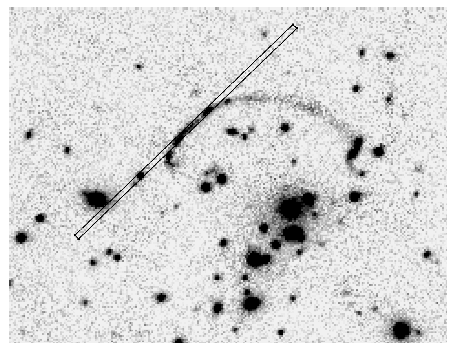
In this paper, the authors seek to explore the properties of star-forming galaxies by looking at a lensed galaxy. This galaxy has been distorted into a giant arc by the gravitational potential of a foreground galaxy cluster.

In this paper, the authors seek to explore the properties of star-forming galaxies by looking at a lensed galaxy. This galaxy has been distorted into a giant arc by the gravitational potential of a foreground galaxy cluster.
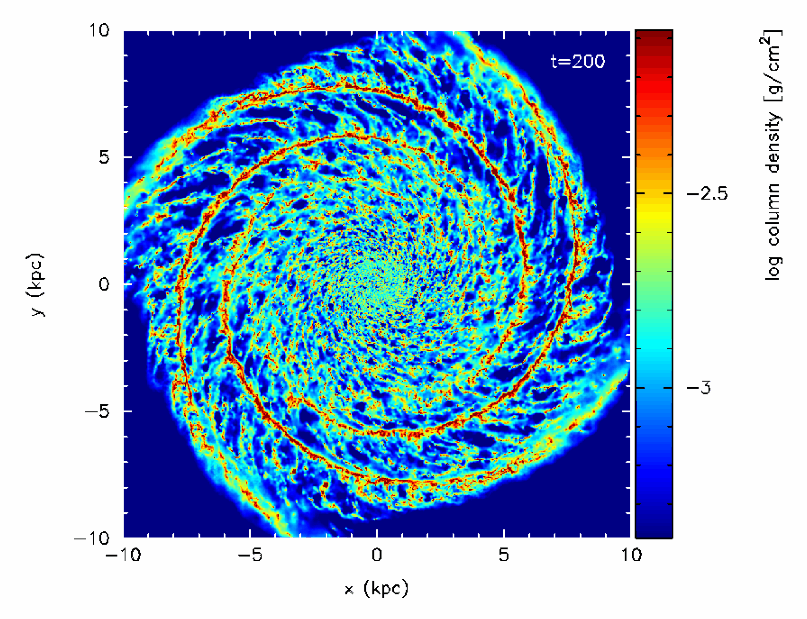
In this paper, Dobbs, Burkert & Pringle suggest that most molecular clouds are not gravitationally bound, as is often assumed. They present simulations in which stellar feedback and collisions between clouds play a prominent role.
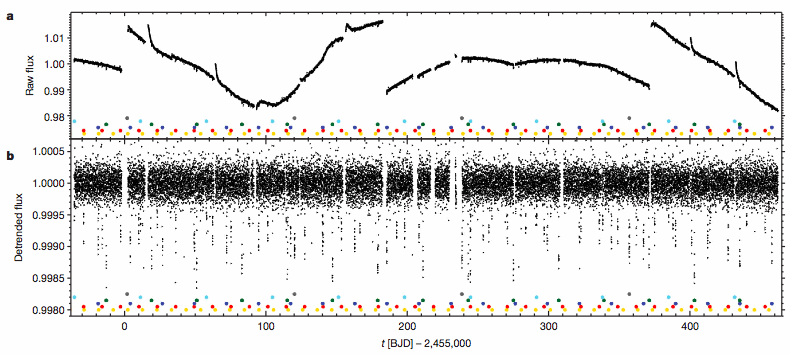
Following the data release, a slew of Kepler papers went up on astro-ph this evening. In my previous post, I went straight to the numbers, but here I’ll discuss the Kepler mission and data in some depth, which I think will generally be useful for understanding current and future Kepler results.

Yesterday, Kepler released data on the 400 most promising and interesting candidate planets and today announced their discoveries. Kepler has now found 1,235 planet candidates, ranging in size from about Earth-sized to larger than Jupiter.
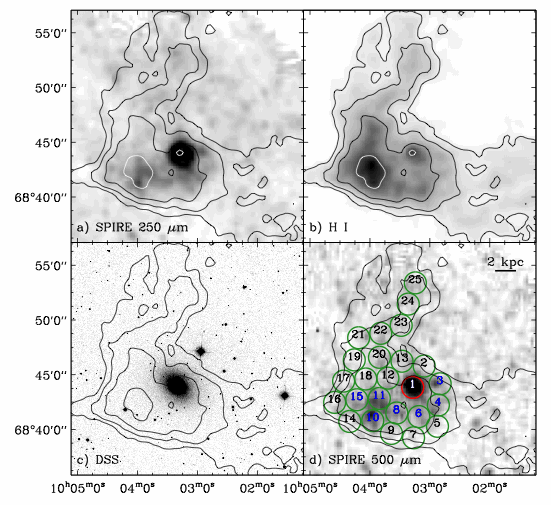
The interacting galaxies in the M 81 triplet are interconnected by tidal features. In this work, the authors study dust in the NGC 3077 tidal stream and discuss its implications.