by Elisabeth Newton | Jan 9, 2012 | Current Events
Simulations tell us of a web-like Universe but it’s hard to explore this topic observationally because we can’t see dark matter. But the Canada-France-Hawaii Telescope (CFHT) Lensing Survey has made the first large scale map of dark matter. On the first day of AAS #219, the CFHTLenS survey shared their results with us.a
by Elisabeth Newton | Jan 7, 2012 | Current Events, Quick Notes
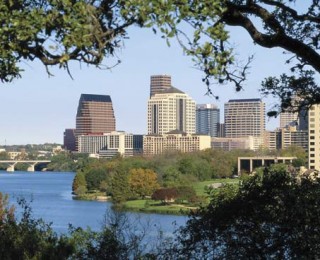
The winter meeting of the American Astronomical Society (AAS) will kick off on Sunday. The 219th meeting will take place in Austin, Texas from January 8-12. There will be four full days of talks and posters on every topic in astronomy. We’ve written about previous AAS Meetings, including Boston (AAS #218) and Seattle (AAS #217).This year at AAS, we’ll be doing something different: liveblogging the conference. The Astrobites authors attending the conference will be keeping you up to date on some of the talks and posters through tweets, short posts and longer pieces. With support from the wonderful folks at AAS, especially Debra Elmegreen and Rick Fienberg, we’ll be attending the press meetings so we can keep you up to date on the exciting discoveries being presented at AAS. So from Monday through Thursday, follow us on twitter and keep checking back here at astrobites.com for updates.If you’ll be at AAS this year, we’d love it if you’d stop by the Astrobites poster! We will present the results of the latest Astrobites Readership Survey and data collected on visits to the site.Astrobites: The Astro-ph Reader’s Digest For Undergraduates Poster #147.01 Monday, Jan 09, 2012, 9:00 AM – 6:30 PMThere several special events for undergraduates at AAS. On Sunday evening there is an undergraduate reception. The Astrobites authors will also be in attendance, so look for us there! On Tuesday, Jane Rigby has organized an exciting splinter session for students of all levels.Student Meet-Up with Nobel Laureate John Mather Tuesday, Jan 10, 2012, 10:00 AM -11:30 AM Room 8The following Astrobites authors will be in attendance and have individual posters and presentations:Dan...
by Elisabeth Newton | Dec 6, 2011 | Current Events
Yesterday, NASA confirmed another new exoplanet from the Kepler mission, Kepler-22b. From some of the headlines, you’d think it was time to pack your bags. The discovery of Kepler-22b is undeniably exciting, but there’s a lot we don’t know about this planet.
by Elisabeth Newton | Nov 23, 2011 | Daily Paper Summaries
Lensing occurs when the mass of a foreground object distorts and magnifies the light from a background galaxy or quasar, sometimes even creating multiple images. It probably isn’t a stretch to say that the neatest thing about lensing is that you can typically see two to four images of the same galaxy. But something else that’s cool is that these distant background objects are magnified, making it possible to study them in detail when otherwise they might not be seen at all: in this way, gravitational lenses act as natural cosmic telescopes.
by Elisabeth Newton | Nov 9, 2011 | Daily Paper Summaries
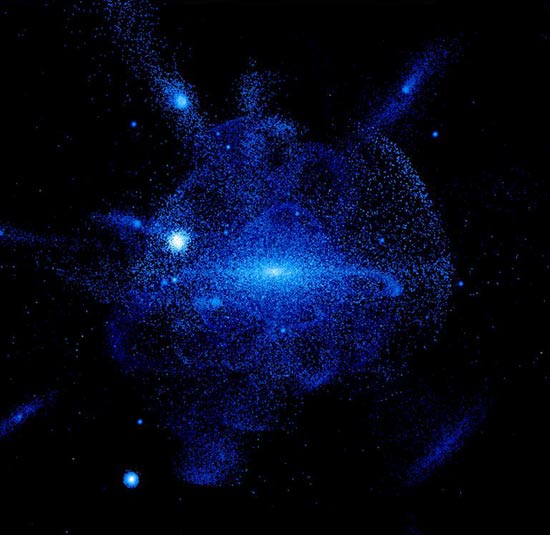
The Milky Way’s stellar halo – a roughly spherical distribution of stars surrounding our spiral galaxy – is a valuable tool for probing the early evolution of our galaxy. The stellar halo contains some of the oldest stars in our galaxy, whose properties reflect that of the environment in which they formed. This paper focuses on using cosmological simulations of galaxy formation to match the observed structure and kinematics (how the stars move) of stars in Milky Way’s halo.
