
Two satellite proposals threaten dark and quiet skies worldwide
Giant mirrors in space to create sunlight at night and an AI data center made up of 1-million satellites are undergoing regulatory approval. How did we get here?

Giant mirrors in space to create sunlight at night and an AI data center made up of 1-million satellites are undergoing regulatory approval. How did we get here?
No, it’s not illegal! Astronomers have developed a technique called delta-doping to make detectors that are much better at detecting ultraviolet light.
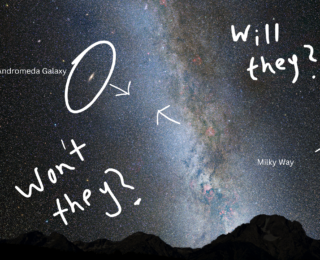
The “timing argument” overestimates the total mass of the local group by oversimplifying it to a two body problem, a new study explore how the complex merger history of objects in the group affect its mass estimates.
Astronomers have tuned their radio telescopes to YZ Ceti, and it might be crackling with a magnetic conversation of a star and its planet. Is this a breakthrough detection, or just stellar noise playing tricks on us?
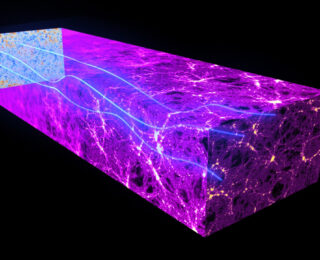
In today’s bite, we explore a new method for studying how structure grows during the Universe’s formative teenage years, using rebellious dropout galaxies and peer-pressured CMB photons.
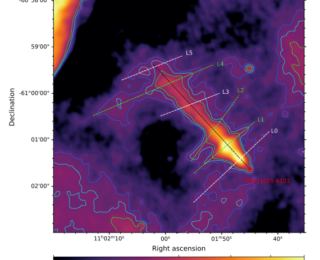
As a pulsar speeds through the interstellar medium, it leaves behind a long, radio-emitting tail shaped by ram pressure. In the Lighthouse Nebula, however, the X-ray emission and radio streaks show unexpected orientations, offering clues to how cosmic rays escape and trace surrounding magnetic fields.