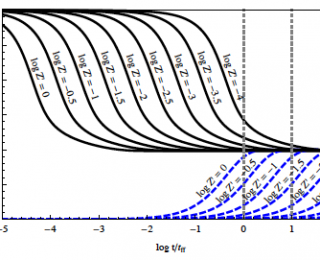
Molecular gas not required for star formation?
Stars forming in atomic gas?? Maybe so, if the metallicity is low!

Stars forming in atomic gas?? Maybe so, if the metallicity is low!
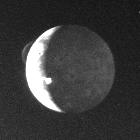
It’s March 2, 1979. Two years ago, the Voyager spacecraft were launched on trajectories that will allow them to carry out their primary missions: the study of the outer Solar System, in particular Jupiter and Saturn. It’s just three days before Voyager 1’s closest approach to Jupiter. The paper that was published on March 2nd, 1979 in Science is a prediction for what the Voyager spacecraft might see on Io based on the orbital motions of these three satellites.
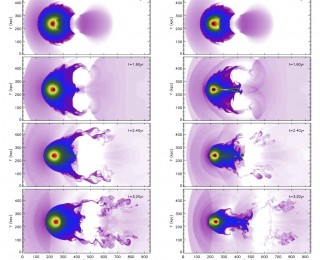
Most simulations to date have implied that satellite galaxies traveling through galaxy clusters are stripped of gas for future star formation in a process known as “strangulation”. In contrast, the authors of this paper suggest that satellite galaxies may not be as cut off as some might think: instead, their simulations show that the cooler, stripped gas from the corona will mix with the surrounding intra-cluster medium and remain near the original galaxy as a potential new source of star-forming fuel.
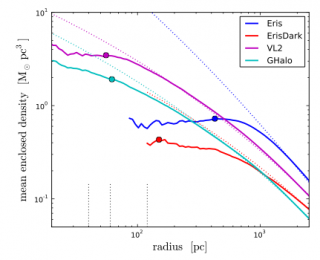
As Astrobites reported a couple of months ago, the Fermi-LAT gamma-ray telescope has reported an anomalous peak at 130 GeV, which could be the long-sought annihilation signature of dark matter. However, one of the strongest critiques of this potential discovery is that the signal is not coming from Sgr A*, the dynamical center of the Milky Way, but rather from about 200 parsecs away. Kuhlen et al. challenge the idea that the dark matter peak must be located at the dynamical center, and find that the combined dark matter-baryonic matter simulation Eris shows a well-defined, consistent offset between its dark matter peak and dynamical center.
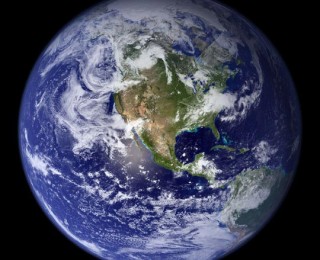
It took homo sapiens hundreds of thousands of years on the planet to understand a fundamental, simple-sounding, question: how old is the Earth? The answer to this question has gone down in the history books as one of the most important geophysical and astrophysical discoveries of the past century. This paper, by Clair Patterson in 1956, is credited with providing the first accurate, measured age of the Earth.
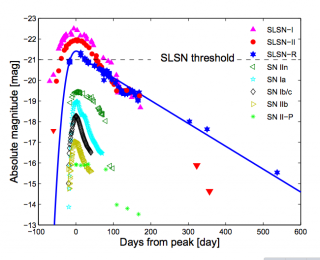
Super-luminous supernovae are a recently discovered rare class of stellar explosions with luminosities 10 – 100 times higher than normal supernovae. We summarize what is known about how these events are powered.