by Nick Hand | Jan 21, 2012 | Daily Paper Summaries
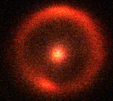
A new dwarf galaxy has been detected a record-breaking 10 billion light years from Earth, using a method based on gravitational lensing. The satellite galaxy is composed mainly of dark matter and is too faint to be observed directly with the current generation of optical telescopes.
by Chris Faesi | Jan 20, 2012 | Daily Paper Summaries
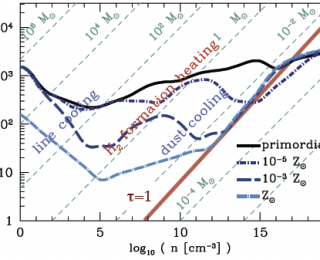
An extremely metal-poor star, which was first discussed on astrobites by Anna in September 2011, may be evidence that dust-induced fragmentation was the catalyst for the change from the top-heavy Initial Mass Function (IMF) of the first stars to the steep IMF we observe today.
by Courtney Dressing | Jan 19, 2012 | Daily Paper Summaries
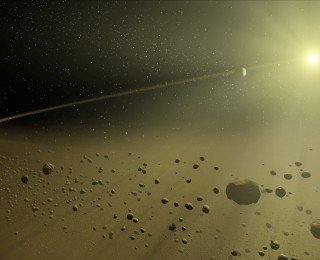
Where should astronomers look to find terrestrial planets? Raymond et al. argue that debris disks are signposts of terrestrial planet formation.
by Elisabeth Newton | Jan 18, 2012 | Daily Paper Summaries
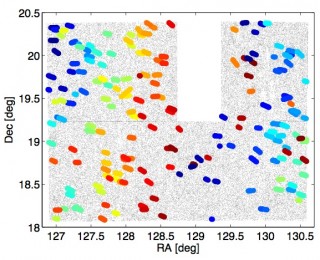
Title: Asteroid rotation periods from the Palomar Transient Factory survey Authors: D. Polishook, E. O. Ofek, A. Waszczak, S. R. Kulkarni, A. Gal-Yam, O. Aharonson, R. Laher, J. Surace, C. Klein, J. Bloom, N. Brosch, D. Prialnik, C. Grillmair et al. First Author’s Institution: Benoziyo Center for Astrophysics, Weizmann Institute of Science, IsraelDetermination of the rotation periods of asteroids has a number of applications. When considering an asteroid individually, it can help one to understand the physical properties of an individual asteroid, including its shape and whether or not it’s a binary. In a statistical sense, the rotations of the entire population of asteroids can help one to understand the physical processes that govern asteroid rotation. The two mechanisms that influence an asteroid’s rotatation are collisions and something called the YORP effect, in which photons from the Sun are actually able to accelerate asteroids through absorption and re-emission. There’s a nice discussion of this type of science which includes a description of the YORP effect in this Cornell press release, while this Discovery news story reports on the first direct detection of the YORP effect (which combines the initials of four different people).*Currently there are 3,700 asteroids with measured rotation periods; using the Palomar Transient Factory, these authors aim to eventually measure rotation periods for 10,000 asteroids. (PTF also finds supernovae, see for example this discovery). In this paper, Polishook et al. report on the identification of 624 asteroids in the PTF survey, 20% of which are new discoveries, and 88 new rotation period measurements. All of the asteroids identified belong to the main asteroid belt. The smallest asteroids...
by Michelle Kislak | Jan 18, 2012 | Daily Paper Summaries
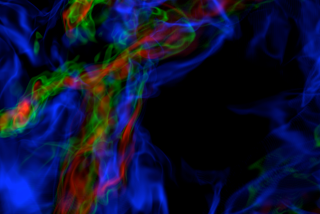
The first simulations of low-mass star formation on parsec scales to include protostellar feedback successfully reproduce observed mass functions, luminosities, and clustering properties.
by Nathan Goldbaum | Jan 17, 2012 | Daily Paper Summaries
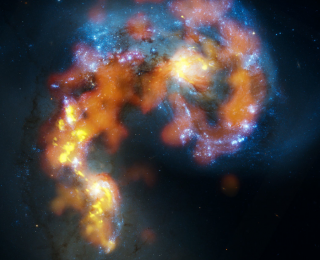
Today we’ll be discussing a paper that leverages some of these early ALMA observations as well as observations at the VLT in Chile to investigate the dynamical state of molecular gas in the ‘overlap’ region of the Antennae Galaxies.
