by Elizabeth Lovegrove | Jan 17, 2012 | Daily Paper Summaries
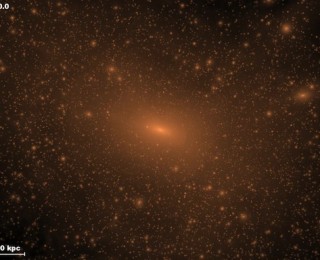
Dark matter is not so dark as the name might imply. Although it so far refuses to interact with normal matter via any force other than gravity, there are secondary signals that we can detect. When we turn our gamma-ray telescopes on regions like the Galactic Center that contain a high density of dark matter, we expect to see a dim, widespread gamma ray haze coming from seemingly empty space, with no baryonic matter source. This paper, due to be published by the Astrophysical Journal, discusses the search for this signature by the collection of satellites that surrounds the Milky Way, and uses the lack of a detection to set an upper limit on the cross-section of the WIMP particle.
by Shannon Hall | Jan 16, 2012 | Daily Paper Summaries
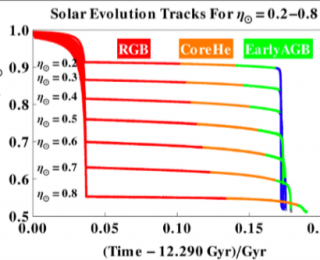
In 6 Gyrs the Sun will stop fusing Hydrogen in its core. It will then go through several phases of post-main sequence evolution. Depicted here are models spanning a range of plausible evolutionary sequences and how such phases might effect the dynamics of the Solar System.
by Kim Phifer | Jan 16, 2012 | Daily Paper Summaries
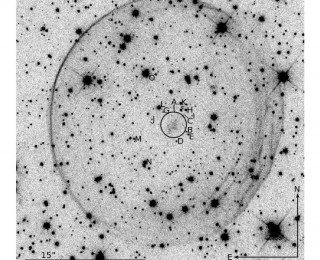
Schaefer & Pagnotta search supernova remnant 0509-67.5 for signs of an ex-companion to the white dwarf which exploded as a type Ia supernovae.
by Maria Drout | Jan 14, 2012 | Daily Paper Summaries
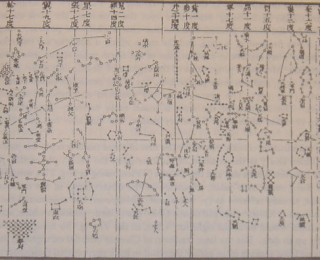
Astronomers combine ancient Chinese and Roman records with a modern understanding of astronomical events.
by Lucia Morganti | Jan 13, 2012 | Daily Paper Summaries
Understanding the structure of our Milky Way is as difficult as trying to see the forest from the trees. Among the many uncertainties, we don’t know whether the molecular ring is really due to a ring structure or it is simply produced by the spiral arms.
by Courtney Dressing | Jan 6, 2012 | Daily Paper Summaries
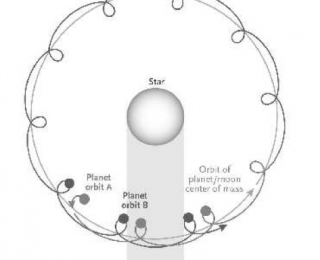
Moons in other solar systems are common in science fiction. Are they common in the universe as well? Kipping et al. are using Kepler data to find out.
