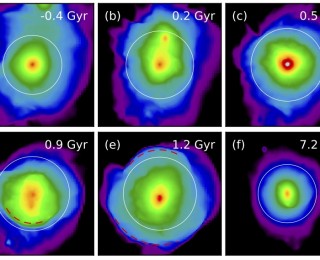
A novel approach for weighing galaxy clusters
Galaxy clusters trace the matter density of the universe, and by counting clusters as a function of mass and redshift, cosmologists can learn about the expansion rate of the Universe

Galaxy clusters trace the matter density of the universe, and by counting clusters as a function of mass and redshift, cosmologists can learn about the expansion rate of the Universe
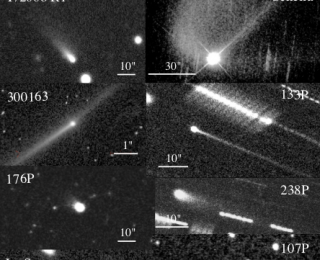
What happens when something looks like a comet but orbits like an asteroid?
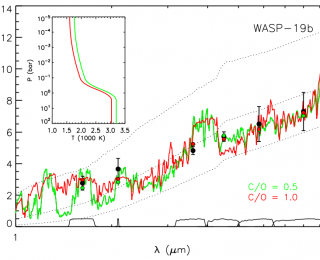
If you would like to live in a less-polluted world, you might want to consider moving to Wasp-19b. Its lack of a temperature inversion helps it keep clear skies.
Can we match models of galaxy evolution to multiwavelength galaxy observations in order to infer galactic properties? In this paper, the authors compare this method to others for a sample of z~1 galaxies.
The moon is usually pictured in illustrations of Christmastime which show evening or night scenes. But, as Peter Barthel reveals in his study, illustrations of the partially lit moon are often astronomically incorrect, unless the scenes take place Down Under.
Last year on Christmas day, scientists observed a unique gamma-ray burst, GRB 101225A. Two interesting and very different models have developed for the ‘Christmas burst:’ a tidal disruption of a comet by a neutron star somewhere in our Galaxy, or a neutron star consuming its companion star over 5 billion light years away.