by Kasper Zoellner | Jan 31, 2026 | Daily Paper Summaries, PRJ
If we want to know about the conditions for life on an Earth-like exoplanet, can’t we just take a picture of it? One where we can see continents, clouds and potential biospheres?
The short answer is we can’t. The long answer as to why not is found in today’s bite.
by Catherine Slaughter | Jan 24, 2026 | Daily Paper Summaries, PRJ
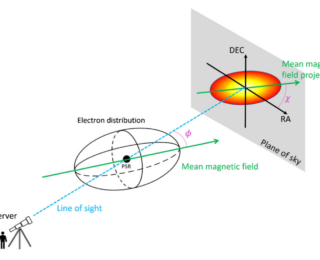
Whether you like them or not, magnetic fields permeate the interstellar medium. Today’s paper outlines a novel way of observing them!
by Caroline von Raesfeld | Jan 10, 2026 | Daily Paper Summaries, PRJ
Today’s astrobite looks at how we can use observations of gamma-rays and neutrinos to test our models of cosmic rays.
by Anavi Uppal | Dec 20, 2025 | Daily Paper Summaries, PRJ
In February 2023, the KM3NeT underwater observatory observed the highest-energy neutrino ever detected. Did it come from a dying primordial black hole?
by Sandy Chiu | Dec 13, 2025 | Classics, Daily Paper Summaries, PRJ
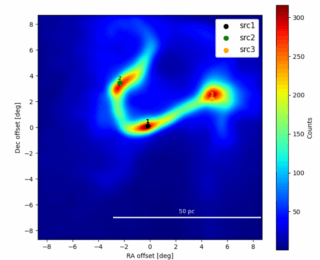
Cosmic rays don’t always reveal their origins honestly—magnetic fields can bend their paths and create “mirage halos” that look like real gamma-ray sources. New simulations show how a single pulsar can masquerade as three, reshaping how we interpret TeV observations.
by Will Golay | Dec 11, 2025 | Daily Paper Summaries, PRJ
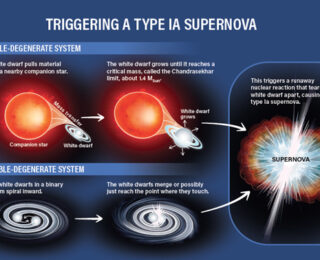
How standardizable of a candle are Type-1a supernovae? Learn how differing initial conditions causing a white dwarf to exceed the Chandrasekhar limit and explode might reconcile independent measurements of the Universe’s expansion rate and history.
