
Featured Astrobites
Our latest posts
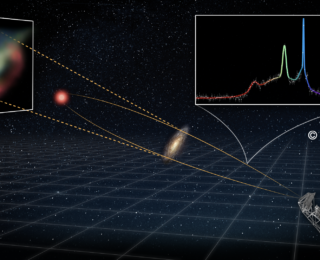
MeerKAT meets a giga-maser!
Space is full of unusual and (sometimes) quite powerful phenomena that cause light to behave in unexpected ways. Maser systems are one of these phenomena. The MeerKAT Radio Telescope recently detected the most luminous and distant hydroxyl (or OH) maser system – so intense it crossed the threshold from “mega-maser” to “giga-maser”. Discover why this system is so remarkable in this bite!

Do we actually know how old the Universe is?
So we have a pretty good idea of how old the Universe is right? Well according to JWST data, maybe not? Rest assured, today’s bite gets to the bottom of the debate.
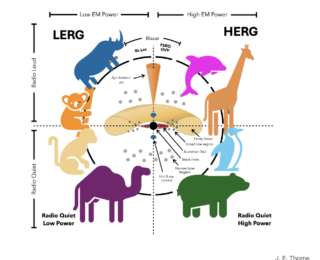
Feeding Time at the AGN Zoo
How do the eating habits (accretion) of active galactic nuclei (AGN) affect the light emitted for animals in the AGN zoo?

Finding Planet X: Hopeless Romance or Concrete Reality?
Pluto’s demotion from a planet didn’t just rewrite a definition, it launched an astronomical treasure hunt. Hidden amidst far flung icy bodies beyond Neptune, is there a ninth planet in our solar system?
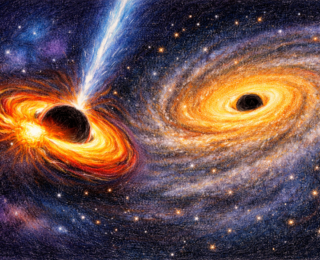
A Wandering Supermassive Black Hole Eating a Star
For the first time, a supermassive black hole is discovered away from its galaxy’s center, exposed when it tears apart a star in a tidal disruption event.
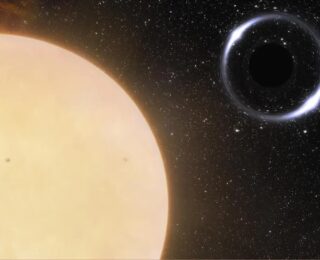
Attack of the Planet-Killer Dark Matter
Today’s bite explores exoplanets’ newest predator: dark matter. Black holes made up of dark matter may be lying at the hearts of planets…and eating them from the inside out.
Beyond astro-ph
Astronomy beyond the research
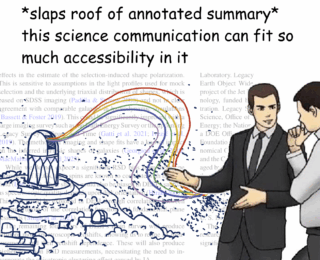
Drawing on Charm to Communicate Scientific Papers
Scientific papers are dense, often even too much for other scientists. Thankfully, your results can be shared even with non-experts by writing a stylised annotated paper!

Beyond: Why Falling Off Walls Makes Me a Better Scientist
Resilient researchers know how to fail. Learning how to fail, however, is easier said than done.
The Do’s and Don’ts of Incorporating LLMs into your Scientific Workflow
While LLMs are certainly a useful tool in many aspects, their usage requires a level of caution, especially when using them throughout the scientific process. In today’s Beyond post, we’ll take a look at the best (and worst) practices for incorporating them in your scientific workflow.
Navigating careers in astronomy
Career advice
Many Astronomers Love Sci-Fi, and There’s Evidence to Prove It!
New research surveyed astronomers to see if sci-fi really does inspire people’s careers in astronomy

A New Initiative to Advocate for Grad Students in Congress
In this guest post, we talk about a new initiative in Congress aimed to advocate for graduate researchers — the GRAD Caucus!

How to choose the right PhD advisor?
Choosing a PhD advisor is one of the most important decisions of our PhDs – yet we have to make it over the course of just a couple of weeks. Here’s a guide for important things to look out for!