
Title: Improved measurements of the age of JWST galaxies at z=6-10
Authors: M.López-Corredoira and C.M.Gutiérrez
First Author’s Institution: Institute of Astrophysics of the Canary Islands
Status: Published in Monthly Notices of the Royal Astronomical Society [open access]
“♪♫ Our whole universe was in a hot, dense state. Then nearly fourteen billion years ago, expansion started… wait. ♪♫”
No really — wait. Did it?
This might sound like settled science, but researchers are still actively testing our understanding of when and how the Universe began its hot, rapid expansion. And new results from the James Webb Space Telescope (JWST) are putting some pressure on our assumptions.
Now, this doesn’t mean the Big Bang didn’t happen, but it does mean astronomers are double-checking whether the timeline of the early Universe fully makes sense.
Why JWST matters
JWST is the most powerful space telescope ever built, designed to see infrared light with incredible sensitivity. This allows it to observe some of the very first galaxies ever formed, only a few hundred million years after the Big Bang.
These early galaxies are cosmic time capsules. If we can figure out how old they are, we can learn when galaxies first started forming, and how quickly structure grew in the young Universe. In simple terms, galaxies can’t be older than the Universe itself. So measuring their ages helps test our cosmic timeline.
(Think of it like this: if you meet a five-year-old child, you immediately know their parents’ relationship started at least five years ago. The child sets a minimum age for the story.)
How do astronomers tell how old a galaxy is?
Galaxies evolve over billions of years, so we obviously can’t watch galaxies age in real time. Instead, astronomers read the information encoded in their light. A galaxy’s light acts like a fingerprint: it carries clues about the stars inside it. One major technique for reading this fingerprint is called Spectral Energy Distribution (SED) fitting.
Here’s the idea:
- Astronomers create computer models of galaxies that include different properties (see Figure 1):
- star-formation histories
- dust content
- chemical composition of gas
- stellar ages
- Each model predicts what the galaxy’s light should look like.
- The models are compared to real observations until the best match is found.
If the best-fitting model requires stars that formed, say, 400 million years ago, that becomes our estimate for the galaxy’s age.

Astronomers also look for specific features in a galaxy’s spectrum. Young stars are extremely hot and tend to glow blue, while older stellar populations appear redder. But colour alone isn’t enough to figure out a galaxy’s age, since dust can also make galaxies look red.
Where the tension appeared
The authors studied 31 galaxies at extremely high redshift (between z=6 and z=10). Meaning we see them when the Universe was only about 700 million years old, based on how fast the universe is expanding!
Here’s the puzzle: Earlier studies analysing many of these same galaxies estimated stellar ages of around 900 million years.
But that creates a problem…
If the Universe itself was only ~700 million years old at that time, how could the stars already be 900 million years old? Either galaxies formed incredibly fast in ways we don’t yet understand, or something in our age measurements is misleading us.
What do the new authors do differently?
Instead of assuming the earlier results were correct, the researchers carefully re-examined how galaxy ages are inferred.
- Better data – They included new infrared observations from JWST, giving a clearer picture of how brightness changes across wavelengths.
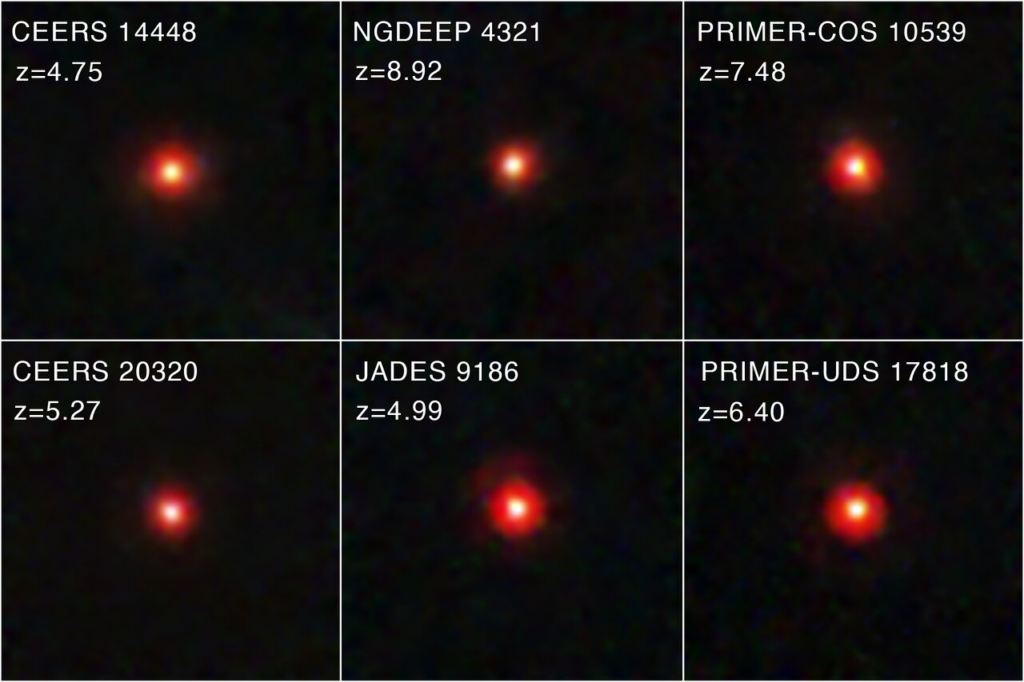
- Dust matters – a lot. Many of these galaxies are known as “Little Red Dots.” Their redness initially suggested old stars. But dust can also redden light. Tiny particles absorb blue light and re-emit energy in infrared wavelengths, making young galaxies look artificially old..
- Emission from hot gas – Young galaxies contain glowing gas that produces strong emission lines. At high redshift, these lines fall directly into JWST filters and can look a lot like emission from older stars.
- More realistic galaxy growth – Earlier models often assumed smooth star formation over time, but early galaxies likely formed stars in chaotic bursts. Allowing bursty histories lets galaxies appear bright and red without requiring extremely ancient stars.
The result
With these improvements, the authors measured these galaxies to have an average age of about 610 million years. That fits comfortably within the age of the Universe at that time, so no need to panic. However, uncertainties remain large, and one galaxy still appears suspiciously old. The authors emphasise that better data and improved models are still needed.
So… is the Universe still 13.8 billion years old?
Yes. For now, all the strongest evidence still supports that number.But studies like this are exactly how science works: bold observations challenge our assumptions, researchers refine their methods, and our understanding becomes sharper.
The Universe hasn’t changed. Our ability to read its history just got better.
Astrobite edited by Elise Koo and Anavi Uppal
Featured image credit: Jayde Willingham
