
Title: Probing Superheavy Dark Matter with Exoplanets
Authors: Mehrdad Phoroutan-Mehr and Tara Fetherolf
First Author’s Institution: University of California, Riverside, CA 92521, USA
Status: published in The Physical Review D [closed access]
Eighty-five percent of the total mass in the Universe can not be seen with the naked eye. This so-called dark matter is primarily observable through gravity but does not interact with electromagnetic forces (i.e. does not absorb, reflect or emit light). Because of this, scientists have been trying to understand the nature of dark matter since it was first proposed by Astronomer Fritz Zwicky and later confirmed with observational evidence by Astronomer Vera Rubin (see other bites on dark matter here). Typically, observational evidence of dark matter is focused on larger scales such as galaxy clusters, rotational curves of galaxies and the Cosmic Microwave Background Radiation. However, in today’s paper, the authors discuss a way to observe dark matter on a smaller-scale: by finding black holes at the cores of planets.
Dark Matter 101
Since we don’t know exactly what dark matter is, multiple candidates have emerged to explain observations of dark matter and understand what it’s made up of. One of the most prevailing dark matter candidates is the idea of a weakly-interacting massive particle (or WIMP). There is no one definition for what a WIMP is but most scientists can at least agree that a WIMP has to be an elementary particle that’s massive enough to interact with gravity and may also (weakly) interact with other forces such as the weak nuclear force (the force responsible for radioactive decay and nuclear fusion). WIMPs are a type of “heavy” dark matter candidate but we don’t mean “heavy” in terms of the weights at the gym! Dark matter candidates can be broadly classified as “light”, “heavy”, “superheavy” and in some cases “ultraheavy” depending on their mass and thus, how much they affect gravity. “Light” dark matter candidates have masses around the size of a proton/neutron or less. “Heavy” dark matter candidates have masses typically between 100 – 100,000 GeV (or about the mass of the Higgs Boson). “Superheavy” candidates have masses closer to things we’re more familiar with such as cells while “ultraheavy” candidates can exceed the mass of things we can see. Figure 1 shows the scale of some prominent dark matter candidates, including WIMPs!
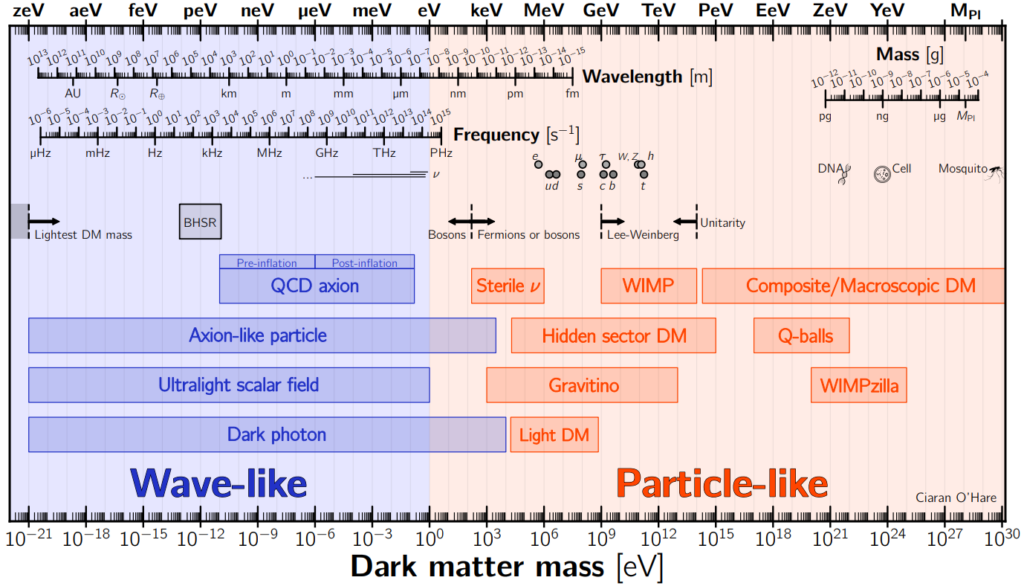
If the WIMP model is so popular, why do we care about any of these other dark matter candidates? Unfortunately, even though the WIMP model can explain things like supersymmetry (i.e. every particle having a “partner” particle with heavier mass and different properties), there have been no direct detections of the particle by particle accelerators. This has opened the door for other theoretical dark matter candidates such as “superheavy” dark matter and brings us to the subject of today’s paper: can planets be giant detectors for superheavy dark matter?
Planets as Detectors
We know dark matter has to interact with gravity but how much it interacts with gravity depends on the mass of the candidate. Superheavy dark matter would be heavy enough to actually gravitationally interact with a large gas giant planet with the planet potentially capturing the dark matter. If captured superheavy dark matter particles do not annihilate each other or decay into other particles, they could start accumulating in the center of a planet where gravity is strongest. Get enough of them in there and you might reach a critical mass enough for the core to collapse and create a black hole! From there, the black hole could eventually eat the planet or irradiate away via Hawking radiation. The authors decide to model these two effects and show what observations might be possible to prove superheavy dark matter!
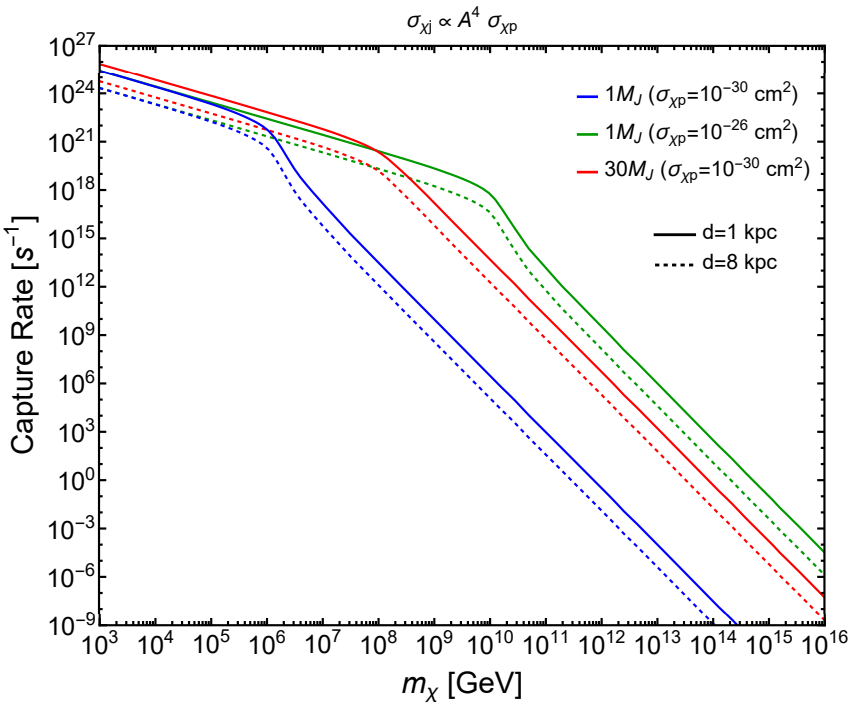
To do this, they model the scattering and capture rate of superheavy dark matter by different sizes of gas giant exoplanets, distances from the galactic center and the cross-sections of the candidate particles. Dark matter is densest at the core of our galaxy for the exact same reason that captured dark matter particles by planets will eventually settle in their cores: gravity is strongest at this location. Thus, the closer an exoplanet is to the galactic center, the more likely it will be to capture superheavy dark matter particles. Figure 2 illustrates this as the solid lines (representing planets closer to the galactic center) capture more photons than the dashed lines (representing planets farther from the galactic center). Less massive dark matter particles are more likely to lose kinetic energy via scattering and thus have an easier time being captured by planets than heavier dark matter particles (as seen in Figure 2). This can be seen in Figure 2 where the rate of capture of dark matter (y-axis) is largest when the mass of the dark matter particle is smallest (left side of the x-axis).
After the authors modeled capture rates for different planet masses and distances, they modeled the formation of a black hole at the center of a planet. As a dark matter particle passes through a planet’s atmosphere, it gravitationally interacts with the chemicals in the atmosphere and loses kinetic energy via scattering. After several passes through the planet’s atmosphere, eventually the particle slows down and loses enough energy to become gravitationally captured. At this point, the particle will start migrating towards the center of the exoplanet, drawn by gravity but also slowed by drag (see this bite for more information on dark matter drag). As long as the time for it to reach the core does not exceed the lifetime of the exoplanet (the authors estimate the lifetime of a gas giant planet like Jupiter to be about ~ 5 Gyr), we can start seeing clumps of dark matter at the core! From here, it’s a battle of timescales. If our dark matter particles can accrete enough mass during a planet’s lifetime, we can watch it collapse into a black hole!
A lighter (but still classified as superheavy) dark matter particle mass will cause a black hole to form with a larger initial mass (i.e. more particles will be captured as seen in Figure 2). With a larger initial mass, the black hole can become stable and start eating more material, eventually swallowing up the entire planet. Vice versa, a heavier (but still superheavy) dark matter particle mass will create a black hole with a smaller initial mass and this could quickly evaporate away by Hawking radiation. We could observe these effects by either detecting a planet-mass black hole or detecting the effects that Hawking radiation would have on the planet from the evaporating black hole!
These effects could include neutrino emissions, high energy photons or heating of the planet itself. Internal planetary heating by dark matter is something we’re possibly observing right here in our Solar System (see this paper for more information). Uranus has an unusually low internal heat compared to Neptune and the other gaseous planets in the outer Solar System. One of the possible reasons is the loss of dark matter in Neptune’s core which has resulted in a lower internal temperature. This process could be the same for exoplanets with evaporating dark matter black holes at their core! On the flip side, planetary mass black holes have never been detected before (the smallest black hole detected is only a couple times bigger than our Sun!). While we don’t quite have the technology to observe these phenomena yet, the authors are hopeful for the future. Finding these planet-eating black holes or the radiation that they leave over once they evaporate away could be a “heavy” win for superheavy dark matter candidates!
Astrobite edited by Kasper Zøllner
Featured image credit: International Gemini Observatory/NOIRLab/ NSF/AURA/ J. da Silva/ Spaceengine/ M. Zamani
