
Title: MeerKAT discovery of a high-redshift strongly-lensed hydroxyl gigamaser
Authors: Thato E. Manamela, Roger P. Deane, Tariq Blecher, Ian Heywood, Athol J. Kemball, Danail Obreschkow
First Author’s Institution: Department of Physics, University of Pretoria, Hatfield, Pretoria, South Africa
Status: [Accepted to] MNRAS Letters [open access]
Introduction
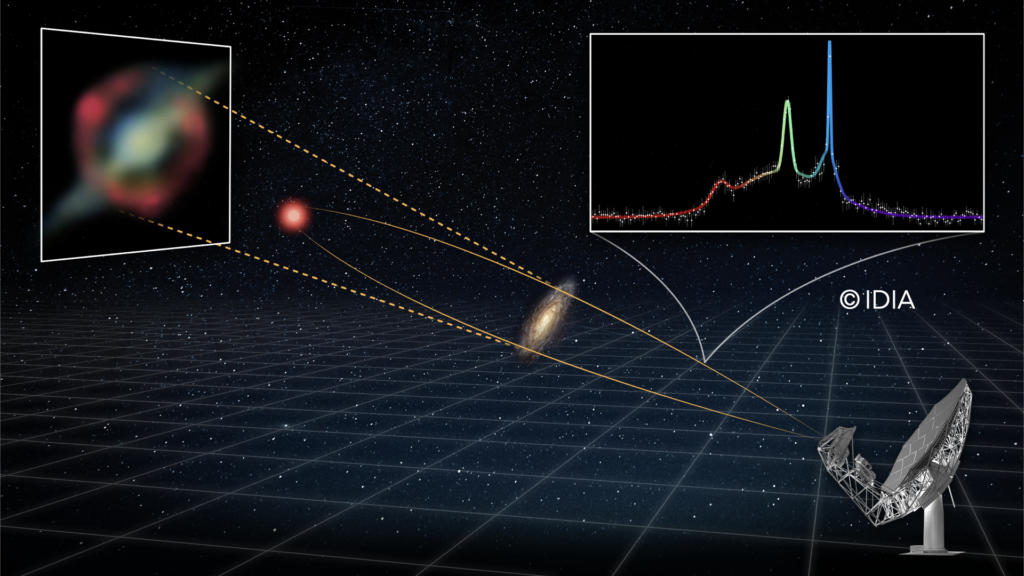
Space is full of unusual and (sometimes) quite powerful phenomena that cause light to behave in unexpected ways. Maser systems are one of these phenomena. Depending on the strength of the detected emission in extra-galactic sources, these may be classed as “mega” masers because their luminosities are typically over a million times greater than those found in the Milky Way. The MeerKAT Radio Telescope recently detected the most luminous and distant hydroxyl (or OH) maser system – so intense it crossed the threshold from “mega-maser” to “giga-maser”. Figure 1 illustrates the detection.
What is a maser?
In galaxies, these systems can be produced by different molecules (for example, classic H2O or OH). Just like the acronym “laser”, masers are caused by light amplification by stimulated emission of radiation. In this case, the light is in the micro-wavelengths – which makes it detectable by radio telescopes. They occur when light passes through a cloud of material that has more atoms in a high-energy (atomic) state than in a low-energy state. These atoms absorb and re-release photons with a specific frequency – which can stimulate the same reaction in surrounding atoms if more energy is added to the system (a “pumping action”) that keeps atoms in the high-energy state. In combination, this produces intense, monochromatic (i.e. at the same frequency) light.
OH masers produce two prominent emission lines at 1665 and 1667 MHz – with the 1667 MHz line typically more dominant in extragalactic sources. Because the stimulated emission requires far-infrared emission to sustain the mechanism, they are often found in Luminous Infra-red Galaxies (LIRGs) or Ultra-Luminous Infra-Red Galaxies (ULIRGs) – many of which are in a major merger.
How was this system detected?
The authors of this study used the MeerKAT radio telescope to target gravitational lensing systems to detect OH at higher redshifts. They observed this giga-maser in the system HATLAS J142935.3-002836 at z ~ 1. They compared various lensing models and decided on a near infra-red model to decompose the system into and work out the magnification factor of the OH emission. Figure 2 shows a multiwavelength image of the lensing system.
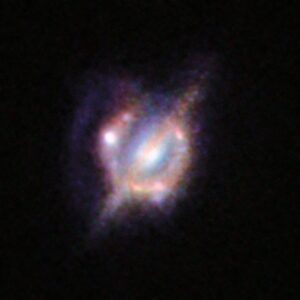
Credit: NASA/ESA/ESO/W. M. Keck Observatory
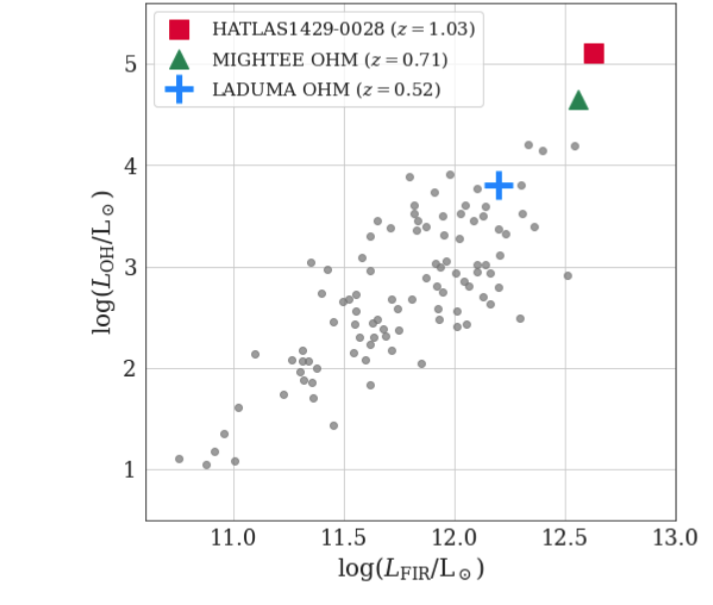
Since OH megamasers are typically found in infra-red sources, the far-infrared-OH luminosity correlation is often measured to understand the physical mechanisms (such as the relative temperature of the OH gas and nearby gas clouds) that produce masers. This remarkable system still follows the far-infrared -OH luminosity correlation, as shown in Figure 3. From this, they could also determine that this system is the most luminous and distant OH maser detected thus far.
Possible gas outflows from the system?
Alongside the OH emission, they also detected neutral hydrogen in absorption. Detecting neutral hydrogen is often quite challenging because neutral hydrogen only has a single spectral line with a wavelength of 21 cm due to what’s known as the spin-flip transition. When the light from a bright, background source passes through a cloud of neutral hydrogen, some of the atoms in this cloud undergo this transition and absorb the 21 cm wavelength photons – resulting in the observed absorption line. The neutral hydrogen absorption is consistent with the optical redshift of the source galaxies, as well as previous measurements of molecular (CO) gas. However, the OH emission from the megamaser is blueshifted (or offset) from these positions in velocity space, indicating that the OH is possibly tracing an outflow of warm gas from the galaxy.
Because this maser is so luminous, they speculate that star formation and active galactic nuclei (AGN) activity contribute to the emission as part of the pumping action. AGN and star formation activity could also potentially drive gas outflows. However, they are unable to sufficiently separate the foreground lens and emitting source – and require higher angular resolution observations – to conclude on this. If OH masers can be used to trace gas outflows, they can help contribute to the overall understanding of how galaxies process gas for star formation in the baryon cycle.
Astrobite edited by: Neel Kolhe and Sandy Chiu
Featured image credit: Inter-University Institute for Data Intensive Astronomy
