
Featured Astrobites
Our latest posts
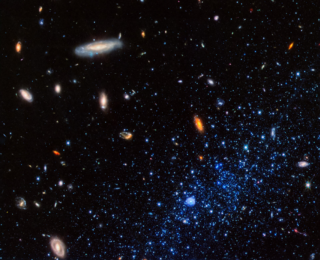
On the Hunt: Molecular Hydrogen in Leo P
Considering that molecular hydrogen is the most abundant molecule in the universe, you’d think it’d be easier to find.
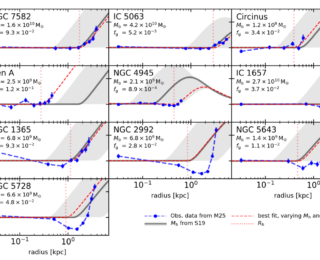
Shocking drama in wind-driven outflows
There’s drama in the extragalactic astronomy community today. Some strange accretion-driven outflows in nearby active galaxies have been observed to accelerate in the galactic outskirts. In today’s paper, our authors explain why an earlier proposed theory is likely wrong, present their own theory, and let the observers know what they need to do to settle the debate.
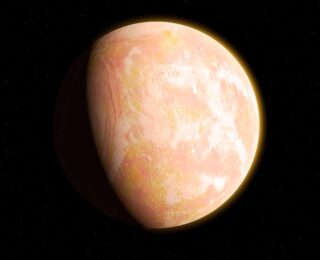
Know Thy Star, Know Thy Life
Today’s bite explores how life in Earth’s past could exist around the dimmest stars in the galaxy.
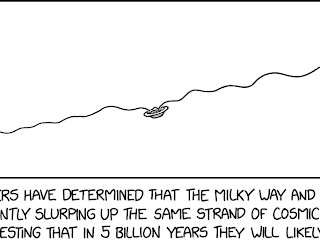
Guest: Trapped in the Web: The Effect of the Cosmic Web on Galaxies and Halos
In this bite, we explore how slurping on (or being slurped by?) cosmic spaghetti affects galaxies.
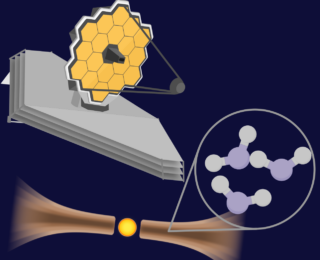
The First Detection of Icy Semi-Heavy Water Where Planets Are Formed
Understanding the odyssey of water from interstellar space down to the oceans on Earth is hard. Today’s paper has given us another key link in this process: the first detection of deuterated water ice in space.
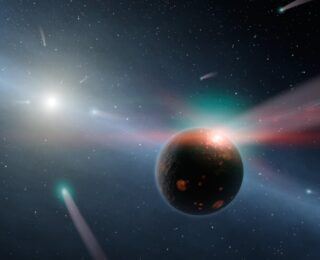
Let’s go hunting for exocomets!
How do you find a comet orbiting a star dozens or hundreds of light-years away? Join us today, as we look into this very question and what we can learn from finding these tiny, distant objects.
Beyond astro-ph
Astronomy beyond the research
How the AAS Education Committee Is Making Meetings Better for Students
The AAS Education Committee discusses how they’re improving AAS meetings for first-time student attendees.
Guest – Don’t Ask, Don’t Tell: Transgender Astrophysics in America
In today’s beyond post, an anonymous author reflects on why being transgender in astrophysics often feels like something best left unspoken, and what can be done.
So, Trump fired the National Science Board. But what is the National Science Board?
Trump fired all 24 members of the National Science Board at the end of April. In this bite we explore what this means for the NSF, science funding, and, more broadly, the American government, with a perspective from Dr. Keivan Stassun, an astrophysicist at Vanderbilt and a recent NSB member.
Navigating careers in astronomy
Career advice
Meet the AAS 248 Plenary Speakers: Dr. Esra Bulbul
Meet Dr. Esra Bulbul: 2025 HEAD Mid-Career Prize winner, X-ray cosmologist, and the scientist mapping galaxy clusters to uncover the nature of dark energy.
Meet the AAS 248 Plenary Speakers: Dr. Sanmi Koyejo
Meet Dr. Sanmi Koyejo: Stanford computer scientist, AI researcher, and AAS plenary speaker working to make artificial intelligence a more trustworthy partner in scientific discovery.

A Guide to Writing Your First Referee Report
The email asking you to referee your first paper is coming. Here’s a practical, step-by-step guide for that exact moment, built from the AAS peer review workshop.