
This guest post was written by Fernanda Sophia Morais Laroca, a junior at Amherst College, for an assignment in Spring 2025 Advanced Astrophysics taught by Professor Mia de los Reyes. Fernanda studies Physics & Astronomy, with most of her research experience focusing on brown dwarf multiplicity. She is also interested in particle physics and is currently studying abroad in Switzerland, where is interning at CERN and working on simulations for optical neutrino detectors. When she is not doing physics, she enjoys choral singing, crocheting, and taking long walks.
Authors: Youcai Zhang, Xiaohu Yang, Hong Guo, Peng Wang, and Feng Shi
First Author’s Institution: Shanghai Astronomical Observatory, Xuhui District, Shanghai, China
Status: Published in Monthly Notices of the Royal Astronomical Society [open access]
What is the web?
The distribution of galaxies throughout the Universe is far from random. Tiny density fluctuations in the early Universe created potential wells where dark matter (DM) congregated (or “collapsed”) into halos due to gravity. Since DM makes up most of the matter in the Universe, when it moved into these early gravitational potential wells and formed halos, it dragged gas in with it. Then, the gas started forming stars, creating galaxies. These early halos are now regions of high matter density in our Universe, while areas outside of them are lower in density. These density differences are the defining feature of the cosmic web, as we see in Fig. 1.
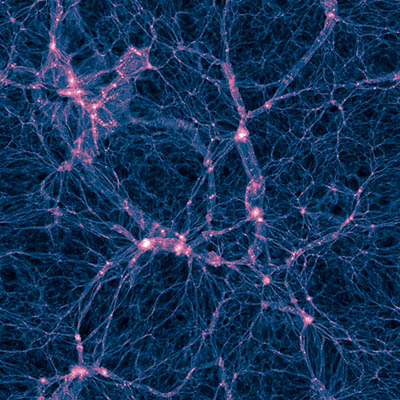
The cosmic web has four main components: knots, filaments, sheets, and voids, from most to least dense. The highest-density areas are knots, full of bright galaxy superclusters; filaments are dense structures that connect galaxy superclusters, acting as transportation channels for matter and galaxies; sheets are low-density, made of low-brightness galaxies spread over flattened environments; voids are the largest structures, consisting of enormous areas with barely any galaxies. In some ways, the cosmic web is similar to the human body, with a tangle of arteries and veins (filaments) carrying blood and other nutrients (gas and matter) from one organ (knots) to another, with the space (void) in between each vein and artery usually being empty. (The main difference is that galaxies are also present in these filaments, but we usually wouldn’t find organs in our veins!). These filaments, and their connection to the galaxies and DM halos within them, are what interest today’s authors.
The search for filaments
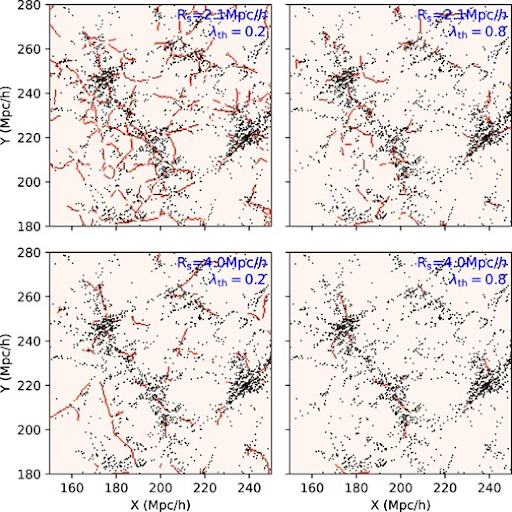
The authors use both simulations and observations to find correlations between a galaxy’s distance to filaments and its properties. The Exploring the Local Universe with the reConstructed Initial Density field (ELUCID) algorithm approximates the Universe as containing only dark matter particles. This is a good approximation, since DM makes up ~85% of the matter in the Universe and the authors are only concerned with large scales, where DM dominates structure formation. It then evolves the Universe over ~13 billion years to reach present-day densities. These densities are calibrated to match observations of 600 thousand galaxies in the New York University Value-Added Galaxy Catalogue (NYU-VAGC), as seen in Fig. 2. ELUCID then finds where each component of the cosmic web is in the simulation and uses the COsmic Web Skeleton (COWS) method to find the filament axes.
The authors get information on galaxy properties from an amalgamation of previous works on the NYU-VAGC galaxies, and analyze the correlations between these properties and the distance to the filaments. The paper presents many results, but this Astrobite will focus on the three main ones: mass, age/color, and morphology.
Mass correlation
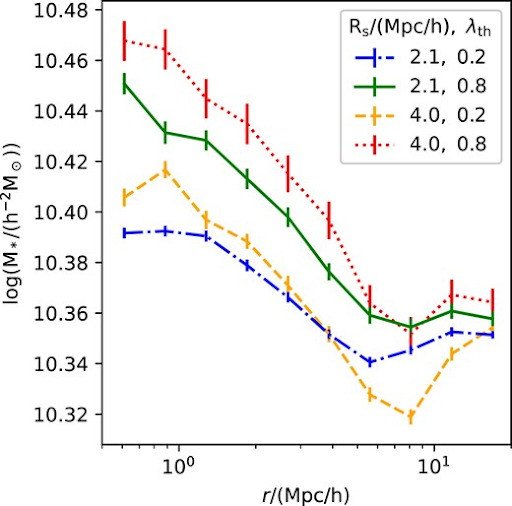
As shown in Fig. 3, the authors find that galaxies closer to filaments tend to have higher stellar mass. Following the stellar mass-halo mass relation, galaxy DM halos follow the exact same relationship as the galactic stellar mass.
Age and color relations
Closer to filaments, galaxies tend to have lower subhalo formation redshifts. Formation redshift is a measurement of how old something is, and a higher redshift indicates the halo formed earlier in time.
They also find that galaxies closer to filaments are “redder” in color. The color of a galaxy can tell us about the age of its stellar population: red colors indicate older stars, since hotter, bluer stars die more quickly than cooler, redder stars. This agrees with the observation that galaxies closer to filaments are older. Older stellar populations in galaxies can also mean that stars haven’t recently formed in these galaxies, meaning a lower star formation rate (SFR). In fact, the authors find that galaxies farther from filaments form more stars, while closer to filaments, galaxies don’t produce significant quantities of stars.
Morphology changes
Elliptical galaxies are a galaxy category characterized by their smoother shape and less-defined features compared to their spiral counterparts, as shown in Fig. 4.
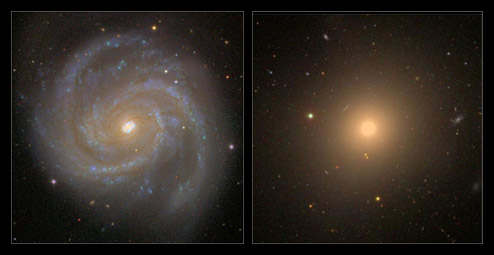
It is common for elliptical galaxies to be redder and form fewer stars (aside from a few exceptions). Therefore, since they find a decreasing SFR and reddening in galaxies closer to filaments, it is unsurprising that they also find more elliptical galaxies there. Since these filaments have a lot of stuff in them, it is probable that this overabundance of elliptical galaxies is a product of interactions with other galaxies that disrupt their shapes.
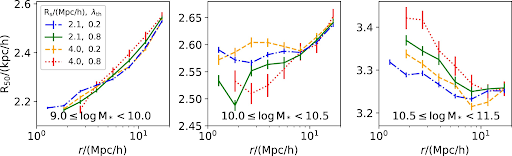
As shown in Fig. 5, low-mass galaxies near the centers of these filaments usually have smaller radii. This is likely due to galaxy interactions, as they would lose some of their outer components to their neighbors because of their stronger gravitational pull. High-mass galaxies, however, have larger radii closer to these filaments because they can absorb smaller galaxies in these interactions.
Conclusion
Although many of the relationships found in this paper have already been identified as correlations in the study of galaxies (e.g., redder galaxies usually form fewer stars), this study reminds us that there is more at play in these galactic environments! By connecting galaxy properties to the large-scale structure of the Universe, today’s authors show that the filaments that connect these galaxies are not just transportation mechanisms, but they also play an important role in shaping the evolution of galaxies themselves.
Astrobite edited by Brandon Pries
Featured image credit: XKCD #2938
