
Title: Observations of Exocomets
Authors: Judith Korth, Azib Norazman, Raphäel Bendahan-West, Grant Kennedy, Cristina Madurga Favieres, Daniela Iglesias, Olena Shubina, Siyi Xu, Nathan X. Roth
First Author’s Institution: Lund Observatory, Division of Astrophysics, Department of Physics, Lund University, Lund, Sweden
Status: Accepted to Space Science Reviews [open access]
Comets are often described as small icy objects that orbit the Sun. They mostly originate from the far, cold regions of the Solar System, such as the Kuiper Belt or the Oort Cloud. Their orbits are occasionally disturbed by Neptune or galactic tides from the Milky Way. This sends some of them hurtling towards the Sun. When a comet approaches the Sun, its ice heats up and turns directly into gas (a process called sublimation). This gas carries dust away from the solid core made of ice, dust, and rock, creating a bright tail that can stretch for millions of kilometers. Some comets pass by periodically, such as the famous Halley’s comet with a period of 76 years (we are all staying turned for 2061). Others evaporate entirely or never come back.
We know that comets exist around other stars. These so-called extrasolar comets, or exocomets, offer valuable clues about how planetary systems form and evolve. Like the comets in our own Solar System, they can reveal details about the early history of their planetary systems, providing insights into how planets form, evolve, and migrate over time.
But how do we even observe comets around other stars? After all, they are very small and far away and spotting these tiny objects can be a challenge even in our own solar system. Today’s article reviews our two best methods for detecting exocomets.
Look for the signs
We detect exocomets dying – sounds a bit morbid, I know. What it means is that we look for comets undergoing the same process as comets in the Solar System; the sublimation and the extensive tail that it produces. If exocomets are composed of materials similar to those found in Solar System comets, then carbon monoxide, carbon dioxide, and water-ice should vaporize as they approach their host stars, producing tails large enough to be detected. We can then observe these tails using two main techniques: photometry, which measures changes in a star’s brightness, and spectroscopy, which analyzes the light passing through the comet’s gaseous envelope.
Like when looking for exoplanets, photometry detects exocomets by watching for tiny changes in a star’s brightness. When an exocomet passes in front of its host star, the cloud of dust surrounding it and the tail trailing behind can block a small fraction of the starlight. Unlike the neat, symmetrical dip produced by a planet, an exocomet often creates an uneven pattern because its dusty tail stretches out behind it. This is illustrated in Figure 1.
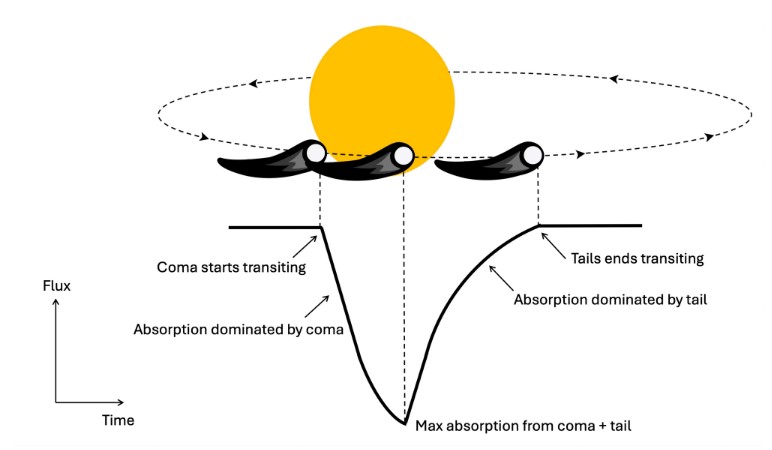
Figure 1: Illustration of an exocomet transits. As the comet moves in front of the star, it blocks out some of the light. The tail results in an asymmetric light curve that falls off more gradually than what we see for exoplanets. Figure 1 in the paper.
However, this method only works when the exocomet passes directly between us and its star and is close enough to the star for its tail to be actively producing gas and dust. As a result, we can observe only a small fraction of the exocomets that are likely to exist.
With spectroscopy, the case is the same as with photometry but here we are looking for variable absorption in specific atomic lines rather than a general decrease in brightness.This method is often more sensitive to exocomets than photometry. A relatively small amount of evaporated gas can produce detectable absorption lines that are superimposed on the stellar spectrum. Because the gas is moving relative to the star, these features are Doppler shifted with respect to the stellar rest frame. In the case of infalling material, the absorption lines are typically redshifted, indicating gas moving toward the star and away from the observer along the line of sight. Conversely, blueshifted features trace material moving away from the star and toward the observer. The magnitude and evolution of these velocity shifts provide direct information about the kinematics of the transiting gas. A defining characteristic of exocomet detections is the presence of sporadic, short-lived absorption events whose depths and velocities vary on timescales of minutes to hours. In some cases, the observed velocity changes during a single event are consistent with accelerating gas released by cometary bodies on star-grazing orbits.
Models for the two types of signals that we are looking for are shown in Figure 2, along with examples of detections from both photometric and spectroscopic data.
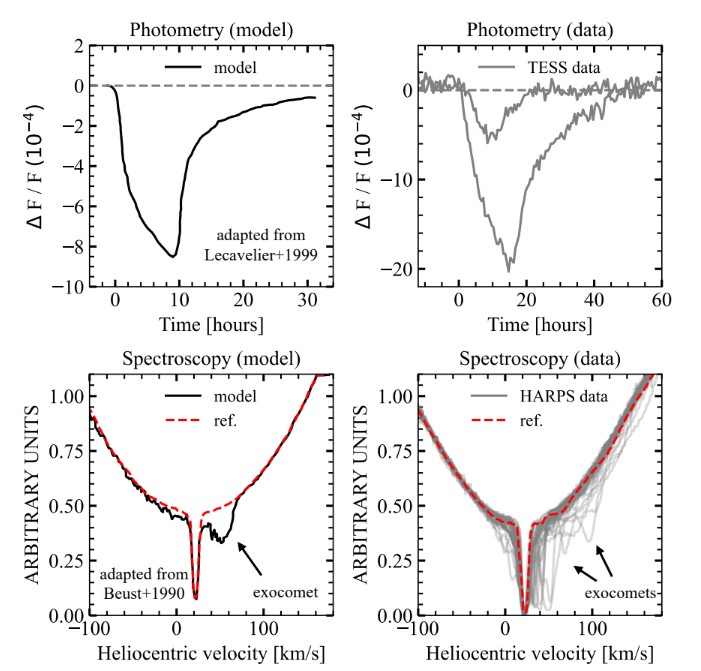
Figure 2: Examples of exocomet detections using photometric (top) and spectroscopic (bottom) observations. The panels on the left show the expected observational signatures of an exocomet transit, while the panels on the right present real observations that closely match these predictions. In photometry (top), an exocomet transit produces a small, asymmetric dip in stellar brightness due to absorption and scattering by dust in the comet’s tail. The top-right panel shows two such events observed with TESS, with the grey curves representing individual transit detections of different depths. In spectroscopy (bottom), gas released by the exocomet absorbs starlight at specific wavelengths, producing additional absorption features in the stellar spectrum. The bottom-right panel shows repeated HARPS observations centered on the Ca II K line. The grey spectra correspond to individual observations, while the red spectrum serves as a reference without exocomet signatures. Variable absorption features that appear relative to the reference spectrum are interpreted as evidence of transiting exocomets. The deep, persistent absorption feature marks stable circumstellar gas and provides a reference for the system’s velocity.. Figure 2 in the paper.
The comets are out there but the questions remain
The first exocomets were detected around Beta Pictoris back in the eighties using spectroscopy. Since then, exocomets have been detected around several other stars using one of the two techniques. Examples include systems such as 49 Ceti and HD 172555. While we have yet to detect the same exocomet with both techniques simultaneously, we have had the great fortune to be visited by at least three interstellar objects that journeyed all the way here from other star systems; Oumuamua in 2017, 2I/Borisov in 2019 and 3I/Atlas in 2025.
Despite the growing number of discoveries, exocomets remain one of the least understood components of planetary systems. Astronomers still do not know how common they are, whether they are found around most stars or only under special conditions, or how representative the handful of known systems truly are. Even more fundamentally, the physical properties of exocomet dust and the chemical composition of these distant bodies remain largely unknown. Because comets preserve material from the earliest stages of planet formation, answering these questions could reveal how planetary systems form and evolve. Future observations may finally allow us to determine not only what exocomets are made of, but whether the cometary populations around other stars resemble those found in our own Solar System.
Astrobite edited by Neev Shah
Featured image credit: NASA/JPL-Caltech
