by Astrobites | Jun 11, 2012 | Current Events
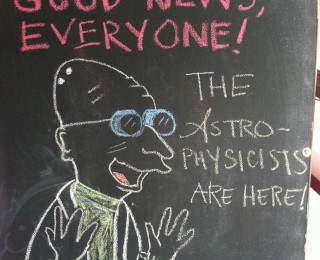
A collection of thoughts about AAS events throughout Monday afternoon.

by Astrobites | Jun 11, 2012 | Current Events
A collection of thoughts about AAS events throughout Monday morning.
by Chris Faesi | Jun 10, 2012 | Current Events
Greetings from Anchorage, AK, site of the American Astronomical Society (AAS) 220th Meeting taking place June 10-14, 2012. Just as we did at the AAS meeting in Austin this year, Astrobites will be liveblogging and reporting from Anchorage, suspending our regular posts for the next four days. This is now the fourth consecutive AAS meeting at which we’ve had an official presence; we were also at Seattle (AAS #217), Boston (AAS #218), and Austin (AAS #219).We’ll have lots in store for you over the next four days as we attend press conferences, talks, and poster sessions, so follow us on twitter and keep an eye on your RSS feeds and our website. We’ll follow a similar format to Austin, posting two articles a day (one each for morning and afternoon) that are continuously updated with short summaries and press report announcements. Thanks again to AAS President Debra Elmegreen and AAS Press Officer Rick Fienberg for inviting us once again to attend the press conferences, allowing us to report on the latest astronomy headlines as they happen!If you’re here at the meeting, come see us at the Undergraduate Orientation Sunday night from 6:00-7:00 pm at the Fairbanks Room in the Marriott Downtown. We’re also presenting a poster (with updated statistics!), and would be delighted if you stopped by:Astrobites: The Astro-ph Reader’s Digest for UndergraduatesPoster #437.01Wednesday, June 13, 9:00 AM – 7:30 PM, Exhibit Hall, Dena’ina CenterThe following Astrobites authors are giving scientific presentations at the meeting:Magnetic Domination of Recollimation Boundary Layers in Relativistic JetsPoster #335.18Tuesday, June 12, 9:00 am – 6:30 pm, Exhibit Hall, Dena’ina CenterSusanna Kohler, M. C. BegelmanEclipsing...
by Elisabeth Newton | Jun 7, 2012 | Personal Experiences
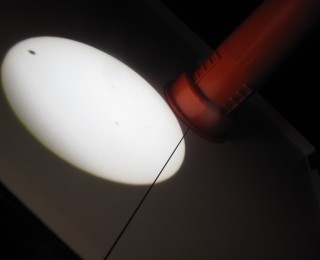
Tuesday was was the second of this century’s pair of transits of Venus; I didn’t catch the 2004 transit, but I was fortunate to have a prime view of Tuesday’s. Like many others, I turned my eyes (safely behind sun filters) towards the Sun and the little black dot traversing its surface. I asked the Astrobites authors to share their experiences with us.
by Alice Olmstead | Jun 6, 2012 | Daily Paper Summaries
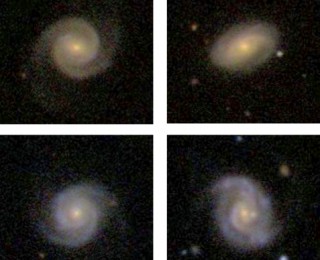
The discovery of a population of red spiral galaxies has caused astronomers to questions the relation between galaxy color and morphology: a closer look at their star formation rates reveals a clearer picture.
by Alice Olmstead | May 9, 2012 | Daily Paper Summaries
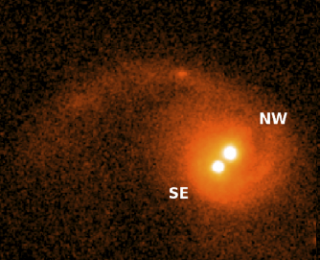
It has long been known that galaxies can merge; thus, we should expect their central supermassive black holes to interact as well. However, our ability to study this is limited as most mergers happen in the distant universe. The exceptional nearby source CID-42 can be explained by a recent binary or triple supermassive black hole interaction, giving astronomers a rare chance to witness the repercussions of such an event.
