by Elisabeth Newton | May 9, 2012 | Daily Paper Summaries
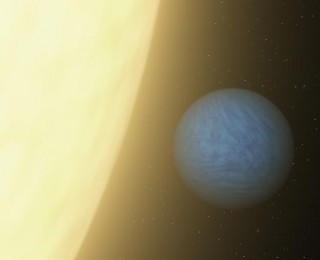
Last year, I reported on how the mystery of 55 Cancri e was resolved. In this Letter, Demory et al. observe the secondary eclipses of 55 Cnc e (when the planet passes behind the star), allowing them to determine the planet’s temperature. At 3,800 degrees Fahrenheit: this super Earth is not looking like a good vacation spot. They are also able to explore possible compositions for the planet.
by Elisabeth Newton | Apr 26, 2012 | Daily Paper Summaries
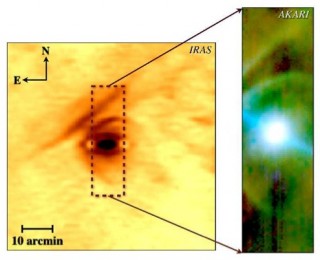
Sometimes we see strange shapes when we look through our fancy telescopes and we’re left wondering how they formed. How did the rings and “pearls” of SN1987A form? Or the hexagonal cloud pattern on Saturn? The star Betelgeuse – famous for being Orion’s left shoulder – presents another unusual geometric appearance.
by Elisabeth Newton | Apr 11, 2012 | Daily Paper Summaries
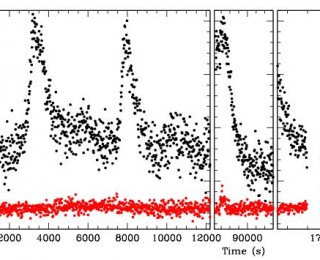
Title: SDSS J184037.78+642312.3: The First Pulsating Extremely Low Mass White Dwarf Authors: J. J. Hermes, M. H. Montgomery, D. E. Winget, Warren R. Brown, Mukremin Kilic, Scott J. Kenyon First Author’s Institution: UT Austin, TX97% of all stars — those with initial masses less than about 8 solar masses — end their lives as white dwarfs (WDs), hot objects with roughly the mass of the Sun but with the radius of the Earth. They have virtually no internal source of energy and so simply cool with time. Some of the coolest white dwarfs have been around for quite a while and are probes of conditions in the early Universe. They are also tracers of galaxy evolution and can be used to date stellar populations. Understanding their nature is key if we are to use white dwarfs for these purposes.Asteroseismology of pulsating white dwarfs is one way to learn about the interior structure of these fascinating objects. Asteroseismologists use stellar vibrations in much the same way as seismologists use earthquakes to study Earth’s interior (see this astrobite and this one). The authors of this paper are on a hunt for DAV WDs. For those of us who don’t speak white dwarf lingo, that’s a white dwarf (“D”) with a hydrogen atmosphere (the “A” subclass) that pulsates (“V” for variable). There are actually quite a few of these DAV WDs, but the 150 we know of are fairly massive for white dwarfs, with masses between 0.5 and 1.1 solar, and are believed to have carbon-oxygen cores. These authors are after a rarer beast: a pulsating helium-core white dwarf, which would have...
by Elisabeth Newton | Mar 28, 2012 | Daily Paper Summaries
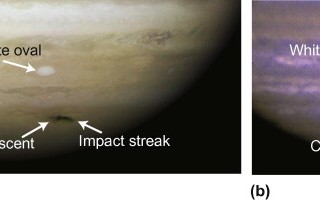
The impact of comet Shoemaker-Levy 9 was a remarkable event: in 1994, a comet, torn into pieces during a close approach with Jupiter two years prior, crashed into Jupiter. It was the first collision between two solar system bodies to ever be observed, and the effects on Jupiter’s atmosphere (see the figure below) were visible for months. At the time, Harrington et al. (2004) predicted that it would be hundreds of years before such an event occurred again. But two and a half years ago, another object collided with Jupiter. No one witnessed the collision, but amateur astronomer A. Wesley noticed a dark streak with properties closely matching those seen after the impact of SL-9. Because of these similarities, it is believed that this feature was the result of an impact.
by Alice Olmstead | Mar 15, 2012 | Daily Paper Summaries
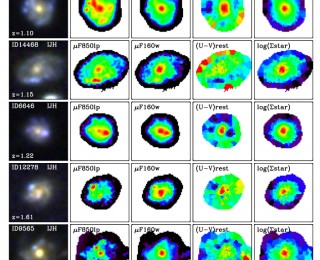
The lack of observed major mergers at high-redshift has prompted discussion of inside-out growth, that is, galaxies building up their stellar populations by cold gas accretion, starting in the inner regions and gradually moving outwards. This picture is far from settled, however, and so the authors of this paper set out to investigate whether or not the observations match the theory.
by Elisabeth Newton | Mar 14, 2012 | Daily Paper Summaries
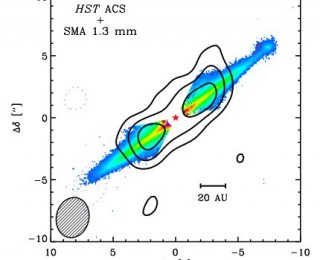
AU Mic is a low mass star that undergoes unpredictable brightening events, called flares. It’s located just 10pc and has a circumstellar disk. In this paper, Wilner et al. report on observations of the disk at millimeter wavelengths and find evidence for a planetesimal ring.
