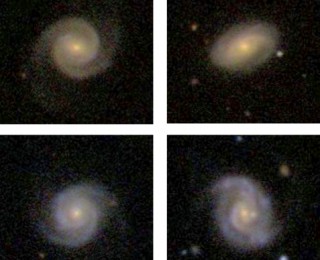
Red spirals are not dead
The discovery of a population of red spiral galaxies has caused astronomers to questions the relation between galaxy color and morphology: a closer look at their star formation rates reveals a clearer picture.

The discovery of a population of red spiral galaxies has caused astronomers to questions the relation between galaxy color and morphology: a closer look at their star formation rates reveals a clearer picture.
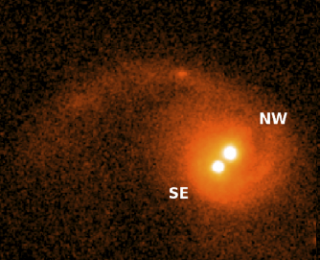
It has long been known that galaxies can merge; thus, we should expect their central supermassive black holes to interact as well. However, our ability to study this is limited as most mergers happen in the distant universe. The exceptional nearby source CID-42 can be explained by a recent binary or triple supermassive black hole interaction, giving astronomers a rare chance to witness the repercussions of such an event.
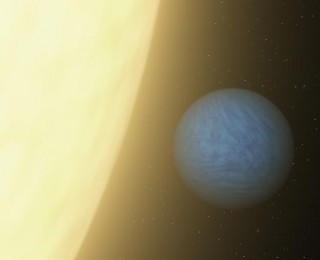
Last year, I reported on how the mystery of 55 Cancri e was resolved. In this Letter, Demory et al. observe the secondary eclipses of 55 Cnc e (when the planet passes behind the star), allowing them to determine the planet’s temperature. At 3,800 degrees Fahrenheit: this super Earth is not looking like a good vacation spot. They are also able to explore possible compositions for the planet.
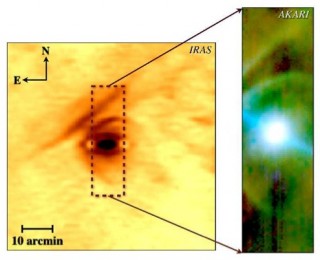
Sometimes we see strange shapes when we look through our fancy telescopes and we’re left wondering how they formed. How did the rings and “pearls” of SN1987A form? Or the hexagonal cloud pattern on Saturn? The star Betelgeuse – famous for being Orion’s left shoulder – presents another unusual geometric appearance.
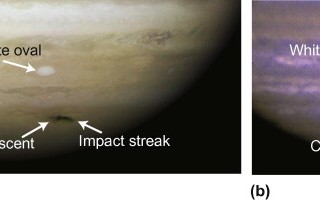
The impact of comet Shoemaker-Levy 9 was a remarkable event: in 1994, a comet, torn into pieces during a close approach with Jupiter two years prior, crashed into Jupiter. It was the first collision between two solar system bodies to ever be observed, and the effects on Jupiter’s atmosphere (see the figure below) were visible for months. At the time, Harrington et al. (2004) predicted that it would be hundreds of years before such an event occurred again. But two and a half years ago, another object collided with Jupiter. No one witnessed the collision, but amateur astronomer A. Wesley noticed a dark streak with properties closely matching those seen after the impact of SL-9. Because of these similarities, it is believed that this feature was the result of an impact.