• RSS
  • Submit a Guest Post
  • Undergraduates: Submit your Research!
  • Suggest a Paper Topic!
astrobites
  • About
    • About Astrobites
    • Meet the Authors
    • Statement of Inclusivity
    • Copyright & Permissions
  • Latest Research
    • Daily Paper Summaries
    • Classics
    • Undergrad Research
    • Physical Review Coverage
  • Beyond astro-ph
    • Beyond astro-ph Library
    • Interviews
    • Career Navigation
    • Personal Experiences
    • Current Events
    • Teaching with Astrobites
  • Guides
    • EM Spectrum
    • Galaxies & AGNs
    • Spectroscopy and Spectral Lines
    • Adaptive Optics
    • Gravitational Waves
    • Transient Astronomy
    • Astrophysical Software
    • Graduate School
    • Writing a personal statement for grad apps
    • First Observing Run
    • …More Guides!
Select Page
Twinkle, twinkle, little quasar! Can you tell me how far away you are?

Twinkle, twinkle, little quasar! Can you tell me how far away you are?

by Anavi Uppal | Sep 22, 2025 | Daily Paper Summaries

When we don’t have spectra, we can estimate the distance to a quasar by calculating its photometric redshift. Today’s authors present a new way to use the ‘flickering’ of quasars to improve these distance estimates.
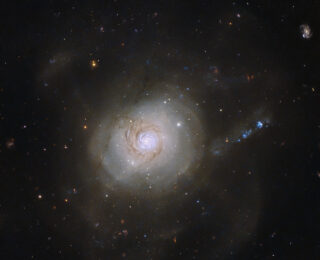
A Black Hole Egg that Forgot to Hatch

A Black Hole Egg that Forgot to Hatch

by Ansh Gupta | Sep 19, 2025 | Daily Paper Summaries

Giant black holes may have hatched from cosmic eggs. What happens when we find one on our doorstep?

Quasars at Work: My photons come from a land where the accretion disks glow and the X-ray coronas plunder (energy from the disk)

Quasars at Work: My photons come from a land where the accretion disks glow and the X-ray coronas plunder (energy from the disk)

by Chloe Klare | Sep 9, 2025 | Daily Paper Summaries

In this exciting new paper, our authors show that in quasars, X-ray coronas fueled by energy stolen from the accretion disk around the black hole may be responsible for the interesting ultraviolet and optical emission we see!

Did this supermassive black hole form from the collapse of a giant gas cloud?

Did this supermassive black hole form from the collapse of a giant gas cloud?

by Anavi Uppal | Aug 13, 2025 | Daily Paper Summaries

The Infinity Galaxy might be home to a newborn supermassive black hole that formed directly from a gas cloud instead of a star. Could this help reveal how these objects formed in the early universe?

Crushing, Collapsing, Combusting — How Massive Single Stars Die

Crushing, Collapsing, Combusting — How Massive Single Stars Die

by Guest | Jul 30, 2025 | Classics, Daily Paper Summaries

A deep dive into the classic paper on how massive single stars die, and what it means for the evolution of the universe.

Following up on flares: Can we spot black hole mergers in AGN disks?

Following up on flares: Can we spot black hole mergers in AGN disks?

by William Smith | Jul 15, 2025 | Daily Paper Summaries

In today’s Astrobite, we revisit the possibility of binary black hole mergers in AGN disks creating flares, which could have interesting implications for multimessenger astronomy and cosmology.

« Older Entries
Next Entries »

Loading

Follow our socials

  • Bluesky
  • Facebook
  • Instagram
  • RSS Feed

More Posts About

AAS AGN astronomy astrophysics binary stars black holes cosmology dark matter dwarf galaxies exoplanets galaxies galaxy evolution gravitational waves habitability JWST Kepler Milky Way observations planetary science planet formation protoplanetary disks radio astronomy simulations solar system spectroscopy star formation stars stellar evolution supernovae theory

Posts by Category

  • Accessibility
  • Applications
  • Beyond
  • Book Reviews
  • Career Navigation
  • Classics
  • Climate Change
  • Course Assignments
  • Crossposts
  • Current Events
  • Daily Paper Summaries
  • Game Reviews
  • Guides
  • Historical Astronomy
  • Instrumentation
  • Interviews
  • Outreach
  • Personal Experiences
  • PRJ
  • Quick Notes
  • Satellites
  • Teaching
  • Undergraduate Research

More Astronomy

  • AAS
  • AAS Nova
  • astro-ph
  • AstroBetter
  • APOD

Read Astrobites in Other Languages

  • Astrobitos (Spanish)
  • Astropontos (Portuguese)
  • staryab (Farsi)

Listen to Astrobites

  • astro[sound]bites

Discover More Incredible Science

  • ScienceBites Network
  • RSS

© 2026 Astrobites | All Rights Reserved | Supported by AAS | Designed by Elegant Themes | Powered by WordPress