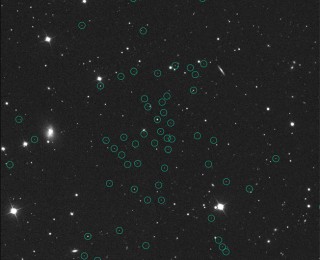
What Defines a Galaxy?
“A galaxy is a gravitationally bound collection of stars whose properties cannot be explained by a combination of baryons and Newton’s laws of gravity.” (Willman & Strader, http://arxiv.org/abs/1203.2608)

“A galaxy is a gravitationally bound collection of stars whose properties cannot be explained by a combination of baryons and Newton’s laws of gravity.” (Willman & Strader, http://arxiv.org/abs/1203.2608)
Using the unique chemical composition found in every star’s atmosphere, the authors identify potential members of a dissolved star cluster in the Sextans dwarf spheroidal galaxy and investigate the origin of dwarf galaxies in the Milky Way halo.
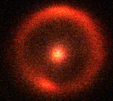
A new dwarf galaxy has been detected a record-breaking 10 billion light years from Earth, using a method based on gravitational lensing. The satellite galaxy is composed mainly of dark matter and is too faint to be observed directly with the current generation of optical telescopes.
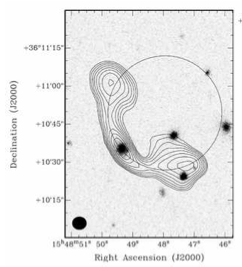
Freeland & Wilcots (2011) present observations of seven “double bent” radio galaxies which they use to measure the density of the intergalactic medium in galaxy groups. They use these observations to draw conclusions about the disruption of dwarf galaxies and the baryon content of these groups.
The current hierarchical theory for galaxy formation — in which larger galaxies are built up from smaller building blocks and dark matter dominates — is well studied and reasonably well accepted. The book is still far from closed, however.