
History lessons from chemical elements
Chemical elements are pretty good history teachers! Today’s paper describes how chemical abundances can tell us about the history of where a planet formed.

Chemical elements are pretty good history teachers! Today’s paper describes how chemical abundances can tell us about the history of where a planet formed.

The number of super-Earths with small semimajor axis appears to decrease with the mass of the host star. How can this be, if more massive stars have more massive protoplanetary disks and thus more material to build planets from? An icy dead zone may be the answer to this riddle!
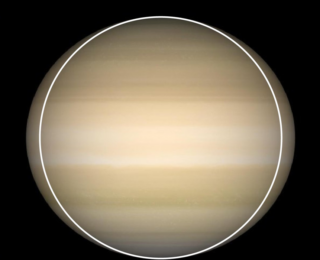
We usually assume that all exoplanets are perfectly round. Today’s authors wonder: what are we getting wrong if some are slightly squished?

Transmission spectroscopy shows /
no gases or features, although /
whether sunspots or hazes /
or both (how in blazes?) /
this atmosphere’s spectrum is sloped!

Interpreting observations of an exoplanet’s atmosphere can be tricky, but in today’s astrobite, planetary rings could be the missing piece of the puzzle

The collision –or even a near-miss– of a neutron star and a main sequence star can possibly explain long-lived, bumpy supernovae and hypervelocity stars.